Editor score 4.2 / 5
Insight
If you're filtering Nike shoes, the biggest challenge isn't "finding more products"—it's turning on-site browsing, image checks, and link records into a reviewable filtering workflow.
This article tackles a specific task: first locating candidate shoes in fashion-reps' website-style product catalog, then using Google Sheets to build a filterable, collaborative record sheet, and finally completing image, style, and link verification before ordering.
This method suits users who need to compare multiple shoe models, record QC images, save product pages, and organize pending confirmations. It's not suitable for using Google Sheets as a real-time source for prices, stock, logistics, or platform policies; those should still be verified on the current product page and your chosen shopping agent page. 🧾
Define the Shoe Candidate Filtering Task and Data Boundaries
Before starting, turn "want to find Nike shoes" into an executable filtering task. For example:
- Target category: Nike casual shoes, basketball shoes, running shoes, or another specific category.
- Target model: Record the series, colorway, size, or the displayed style name.
- Image requirements: Whether you need to view QC images, and whether to keep only candidates with clear images.
- Link requirements: Whether you must keep product page, QC page, or an entry that continues to the shopping agent.
- Collaboration requirements: Whether others need to jointly mark "pending confirmation," "keep," or "exclude."
Website-style spreadsheets or catalogs are good for discovery and initial browsing, while Google Sheets helps turn candidates into a structured list. They serve different purposes: the former provides page context and image entry points, the latter helps you compare fields, add judgments, and keep processing records.
Note that product names, sizes, stock, prices, shipping, taxes, after-sales policies, and link statuses can all change. The page feature observations in this article are bounded by the fashion-reps page verified on October 8, 2026, and do not treat a single page display as a long-term promise. 🔎

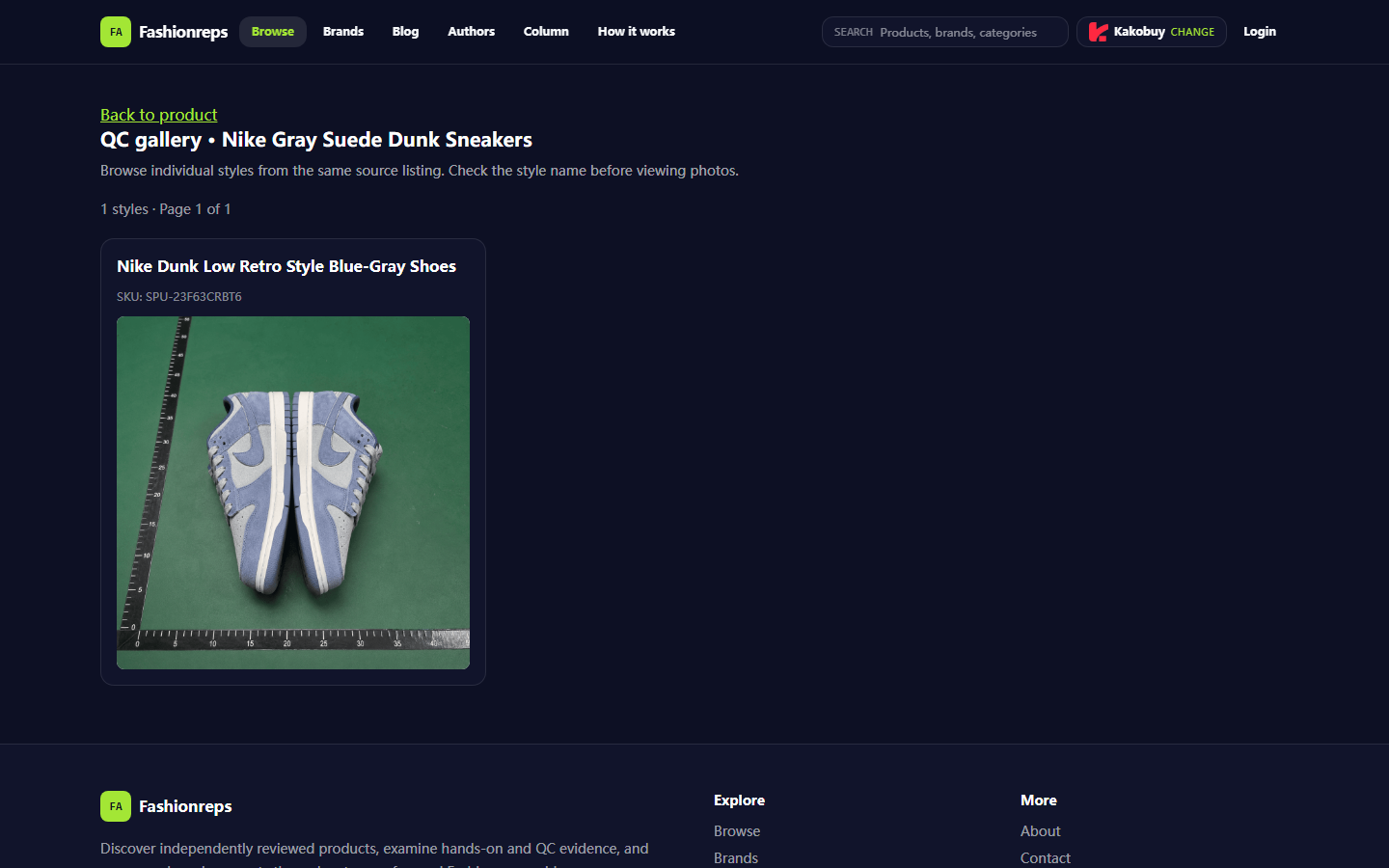
Figure: Example of Nike shoe page and QC image entry in fashion-reps product catalog.
How to Locate Nike Shoes in fashionreps Website-Style Spreadsheet
In the visible pages of fashion-reps, the product catalog provides entries for brands, blog, product browsing, and search. Product pages may also show product name, number of styles, SKU, and QC image entry. Taking the currently verified page as an example, it displays Nike Gray Suede Dunk Sneakers and lists a specific style name and SKU; the QC page provides an entry to view images.
Recommended order to locate candidates:
- Start from the brand or search entry to access Nike-related results.
- Open the candidate product page and confirm that the product name matches the target category.
- Check whether the page lists specific styles or number of styles; don't judge solely by thumbnails.
- Record the SKU, style name, and page status shown on the product page.
- Enter the QC image area and verify that the images indeed correspond to the current style.
- Keep the page entry that allows returning to the product page or shopping agent process.
"Has images" in the website catalog does not equal "quality judgment completed." QC images can only help you review the appearance details provided on the page, and cannot prove material, comfort, durability, fit, or the final condition of the received product. For shoes, especially list the upper, toe box, sole, label, left-right pairing, and size markings as separate items to check. 👟
The shopping agent selector on the page lets users choose different agent entries. Orders, payment, and shipping are still handled by the selected agent's website, so do not interpret navigation information in the fashion-reps catalog as a complete order, stock, or logistics commitment.
How to Set Up Shoe Filtering Columns in Google Sheets
The value of Google Sheets is breaking down each candidate shoe into fixed fields, rather than piling all information into notes. Start with these columns:
- Keep status: Pending, Keep, Exclude, Verified.
- Product name: Copy the name visible on the current page.
- Brand: e.g., Nike.
- Model or series: Fill in based on the visible name on the product page; don't add information not shown.
- Colorway or style: Only record styles explicitly shown on the page.
- SKU: Keep the SKU shown on the page for easy reference.
- Size info: Record size content visible on the page or agent page, and note the verification date.
- Product page record: Save page identification info; don't treat broken links as permanent evidence.
- QC image status: Not viewed, Viewed, Insufficient images, Needs re-verification.
- Key observations: e.g., toe shape, sole pattern, label position, or whether both left and right shoes are present.
- Risks or questions: Blurry images, style mismatch, missing size info, etc.
- Last verified date: Record the date you viewed the page.
- Next step: Find more images, confirm size, ask agent, or exclude.
If collaborating, use filter views to see "Pending" and "Verified" items separately, avoiding interference when multiple people change filter conditions simultaneously. Try to use fixed options for the status column to reduce confusion caused by synonyms like "to see," "look again," "undetermined."
A practical filtering logic: first filter brand and category, then filter image status, and finally sort by risk and next step. Don't start with too many conditions, or you might mistakenly delete candidates still worth reviewing.
For example, filter conditions could be:
- Brand is Nike.
- Product name or series matches current goal.
- QC image status is not "Insufficient images."
- Product page or page identification info is recorded.
- Last verified date has not exceeded your set review period.
- Keep status is "Pending" or "Keep."
Google Sheets can help organize these fields, but it does not automatically verify product authenticity, image rights, stock changes, or order outcomes. Facts involving purchase decisions should still be verified on the currently visible page. 📋
Search, Category, Image, and Link Verification Steps
Step 1: Build candidates first; don't rush to judge quality
Search results or category pages are only for discovering candidates. When you see Nike shoes with similar names, first record the product name, page identification, and current status in the sheet, then decide whether to view images.
Don't judge series, colorway, or size based solely on a word in the product title. The style name shown on the product page takes precedence over your speculation; if the page doesn't provide enough information, mark "insufficient info" in the sheet.
Step 2: Confirm that page and style match
After opening the product page, check whether the following are consistent:
- Product title matches target shoe category.
- Number of styles listed matches the style you're viewing.
- SKU belongs to the current product or style.
- QC images are accessed from the current product page.
- No obvious conflict between images, style name, and product name on the page.
If a page contains multiple styles, do not automatically assume one set of QC images applies to all styles. Split rows by style in the sheet, or clarify in notes which style the images correspond to.
Step 3: Record what images can and cannot prove
Images support limited appearance checks, such as whether you can see the toe box, upper, sole, label, or both shoes. Images alone cannot prove wearing comfort, actual material, long-term durability, or final condition upon receipt.
Use short, reviewable descriptions:
- "Toe area visible; details need zooming for confirmation."
- "Sole image provided; abrasion resistance not assessed."
- "Only one shoe seen; left-right pairing pending confirmation."
- "Size marking not clearly shown in current images."
Avoid conclusions like "authentic," "quality guaranteed," "comfortable to wear," "absolutely flawless" that lack page evidence.
Step 4: Verify links and time
Link records help you return to the source page, not replace real-time verification. Before each purchase, reopen the page to confirm that product name, style, images, and available entries remain consistent.
If the page redirects, becomes inaccessible, shows blank content, or no longer displays sufficient product information, mark the record as "needs review" and do not continue treating old information as current fact.
How to Record QC Images and Product Information Separately
Separating "product information" and "image observations" into two groups of fields reduces misreading.
Product information fields record content explicitly displayed on the page, such as product name, style, SKU, number of styles, and verification date. Image observation fields record what you actually see in QC images, such as whether the sole is visible, whether the label is clear, whether both left and right shoes appear.
Don't mix the two types. For example, "Nike gray suede Dunk, great quality" mixes page name, material judgment, and quality conclusion. A safer approach: record product name as shown on the page; write image observation as "Current images show upper and sole; material and durability not judged from this."
For collaboration, keep for each image observation:
- Viewer or collaborator tag.
- Viewing date.
- Image number or page location.
- Observation content.
- Unresolved issues.
- Whether re-viewing is needed.
This prevents one person raising a question based on images while another mistakenly assumes the question has been resolved. 🧩
Comparison Table of Applicable Scenarios for the Two Tools
| Task | fashion-reps website-style spreadsheet or catalog | Google Sheets |
|---|---|---|
| Discover candidates | Good for discovering pages via search, brand, or product browsing | Not suitable as original product discovery source unless you've imported candidate records |
| View page context | Can view current page info like product name, style, SKU, QC image entry | Primarily saves fields and notes; cannot replace product page |
| Image verification | Good for entering product-related QC image area | Good for recording whether images viewed, observations, and to-dos |
| Multi-condition filtering | Good for browsing on-site products and page entries | Good for combining filters by brand, status, date, risk, and next step |
| Collaborative organizing | Good for viewing shared product pages | Good for multiple people maintaining status, notes, and review dates |
| Real-time fact confirmation | Need to return to current page or agent page to verify | Should not treat historical records as current prices, stock, or policies |
The most reliable combination: use the website catalog for discovery and viewing, Google Sheets for recording and comparing, then return to the website and selected agent page for final verification. Don't treat old rows in the sheet as a ready-to-order list.
Data Update Time and Link Verification Boundaries
Prices, stock, sizes, images, agent entries, shipping, taxes, after-sales, and logistics conditions on shoe pages can change. Google Sheets can record "what was seen when," but it doesn't automatically keep these facts current.
Set review rules for high-volatility fields:
- Before adding to cart, recheck product name, style, and available sizes.
- Before payment, recheck price, shipping, taxes, and agent terms.
- Before shipping, confirm QC images correspond to current order and style.
- If page becomes inaccessible or content changes significantly, mark old record as pending review.
- Do not treat historical links, screenshots, or notes in the sheet as stock guarantees.
If you need to record prices or fees, include currency, verification date, and applicable conditions. Without these, numbers are easily misread after exchange rate changes, promotions, agent rules, or destination country tax changes. 💰
Pre-Order Action Checklist After Combined Use
After filtering, proceed in this order:
- In Google Sheets, keep only target shoes and delete clearly duplicate or non-matching records.
- Open each candidate's current product page and confirm product name, style, and SKU.
- View QC images corresponding to the current style and mark whether images sufficiently support next judgment.
- Record image observations and unresolved issues separately; don't write image impressions as material or durability conclusions.
- Reconfirm size information; don't substitute similar shoe size experience for current page info.
- Enter the selected shopping agent page and verify order, payment, shipping, taxes, and after-sales conditions.
- Before ordering, check that links are still accessible and page still shows sufficient product information.
- Save last verified date and change processed records to "Verified" or "Pending review."
This combined method mainly saves organizing time, not guarantees lower prices. It suits users who need to compare multiple candidates, collaborate, or repeatedly recheck links. The added risk is that the sheet may hold outdated information, or lead one to mistake "recorded" for "verified." If you're only filtering one shoe, page info is sparse, or you can't re-verify the current page before ordering, it's not advisable to rely on old sheets for direct purchase.
Common Questions About Shopping on Agent Platforms
1. What steps should I take on yupoo.tips to verify the quality of a product?
To evaluate product quality on yupoo.tips, examine the QC pictures instead of depending only on factory photos, since those are usually edited. Before completing a purchase, use the QC images to check whether the item meets your particular detail requirements. Additionally, avoid extremely low-priced products, as they tend to be of poor quality.
2. Could you explain what QC photos mean on yupoo.tips?
Every drop-shipping platform, including yupoo.tips, employs a specialized quality control team. When your items are delivered to the yupoo.tips warehouse, the platform performs a quality inspection and captures QC photos. Typically three photos are taken, and the team confirms that the color, dimensions, specifications, and quantity align with your order. They also look for any quality defects, though for electronic products only the external appearance is checked. If there is a quality problem or a size or color mismatch, the team promptly requests a return from the seller. This process helps guarantee that the products you receive meet quality standards.
3. What should I do on yupoo.tips if I am not satisfied with the item I received?
Get in touch with yupoo.tips customer support right away. For most non-specialty items from Chinese sellers, there is a 5-day unconditional return and exchange period. If you are unsatisfied, you may ask for a return. If the product has already been shipped from the warehouse and reached your address with a quality issue, contact yupoo.tips customer service so they can assist you in negotiating a compensation arrangement with the seller.
Customer service email addresses for each platform are listed below:
kakobuy: service@kakobuy.com
oopbuy: support01@oopbuy.com
usfans: support@usfans.com
hipobuy: care@hipobuy.com
superbuy: care@superbuy.com