Editor score 4.2 / 5
Insight

If you care about whether this gray AJ1-style low-top shoe can grip stably, whether the outsole is durable, and whether the workmanship is worth further verification, the available information only supports partial judgment: the product page lists a rubber outsole and multiple colorways, public feedback mentions tread grip performance of similar AJ1 Lows, but there is no independent wear test for this specific product. Therefore, before paying, focus on the sole structure and QC photos rather than just color or upper material descriptions.
Confirmed Product Information
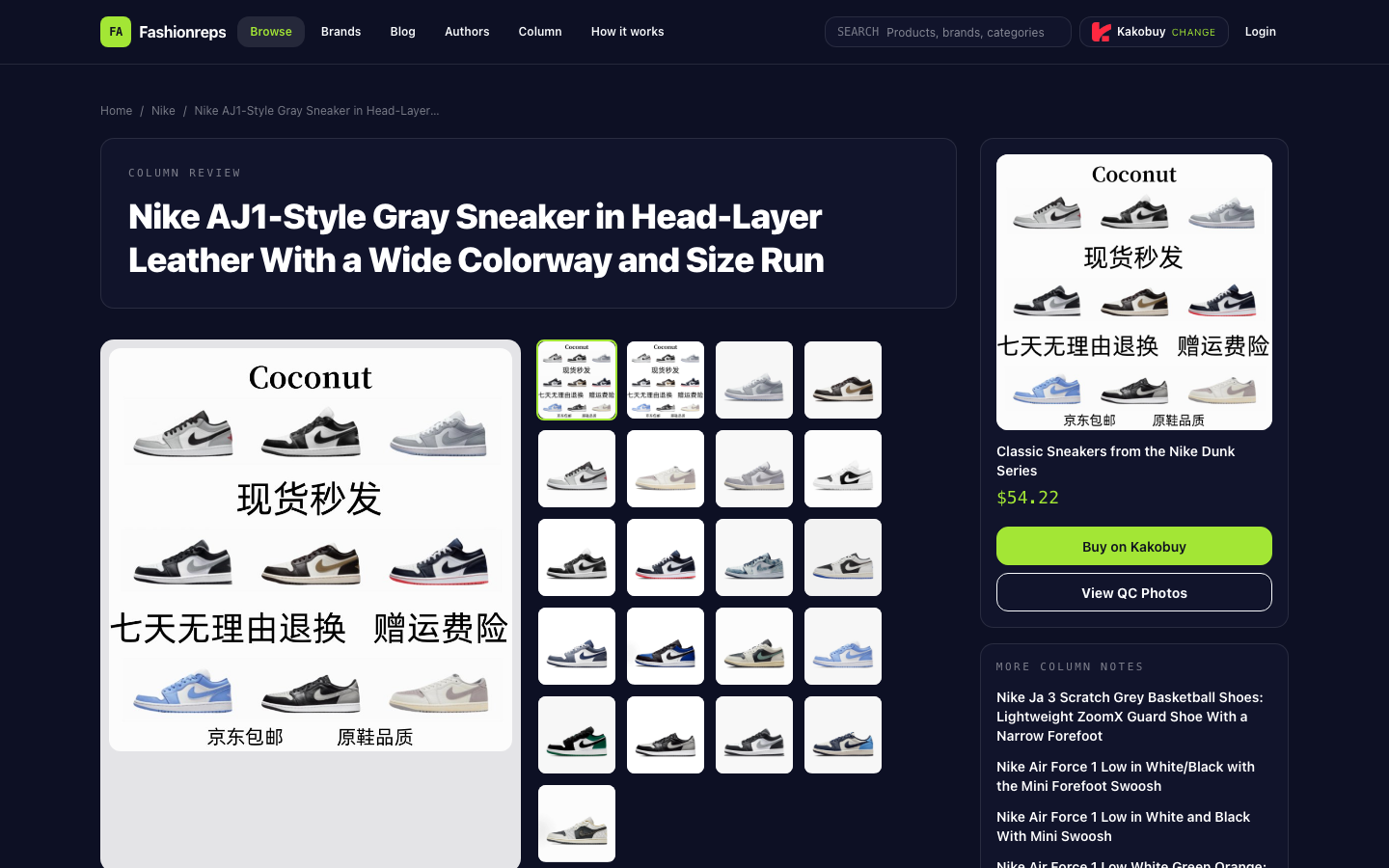
The product page describes this shoe as an AJ1-style lace-up sneaker, with the upper marked as top-grain cowhide, a rubber outsole, sizes ranging from 36 to 46, and multiple colorways, including gray options like Smoke Gray and Shadow Gray. The page also shows a reference price, but the final product price, service fees, and international shipping need to be confirmed on a shopping agent platform; you cannot judge the actual total cost from the page price alone.
This information tells you the outsole material type and color range, but it does not prove that specific colorways use the exact same outsole batch, nor does it prove that sole hardness, tread depth, or bonding quality meet any fixed standard.
Grip: Check Tread Continuity First, Then Public Feedback
In public feedback, a review of an AJ1 Low "Shadow" describes the outsole grip as excellent and mentions the tread has a wear-resistant orientation, with strong everyday durability. But this is feedback from a similar AJ1-style shoe, not actual evidence for this product; it cannot be directly equated to this item's performance.
After getting QC photos, check in this order:
- Check whether the forefoot and heel both have clear, continuous rubber tread, avoiding large overly smooth areas.
- Check whether the tread edges are intact, with no noticeable gaps, collapses, overflow, or partially flattened areas.
- Check whether the left and right shoe treads are basically symmetrical. Slight differences may not affect use, but obvious misalignment may reflect mold, trimming, or assembly issues.
- Check whether the tread in the forefoot flex zone retains sufficient segmentation. Completely smooth or overly shallow tread areas cannot be confirmed for grip from photos alone.
- Check whether the sole edges have obvious curling, delamination, or adhesive overflow, especially the forefoot outer edge and heel corners.
If the QC photos only show the upper, or the sole is obscured by angle, shadow, or packaging, you cannot confirm grip performance. In that case, a more reasonable conclusion is insufficient evidence, and you need to request additional photos showing the sole front, side, and both shoes for comparison.
Outsole Durability: Distinguish Material Description from Actual Evidence
A rubber outsole usually means the product has a basic wear-resistant structure, but the term "rubber outsole" by itself does not prove durability. The page does not provide rubber compound, hardness, thickness, tread depth, or lab abrasion data, nor does it provide long-term wear records for this specific product.
Therefore, durability verification should focus on three areas:
- Forefoot flex zone: Check whether the tread is too shallow or has obvious uneven thickness. This is an area with repeated bending and friction during walking.
- Heel strike area: Check whether the heel rubber block is complete, edges are even, and left and right heel heights are noticeably different.
- Outsole-to-midsole connection: Check for continuous gaps, delamination, open bonding, or abnormal adhesive overflow. Seeing a little glue residue alone does not directly mean it will come apart, but continuous openings require heightened caution.
Public reviews mention that similar AJ1 Lows have strong everyday durability, but they also note that leather quality may vary between batches. That feedback mainly targets the upper and similar products, and cannot replace a physical QC inspection of this shoe's sole.
Visible Workmanship: Focus on Stitching, Heel, and Edge Finishing
Product page reviews consider a certain AJ1 Low to have neat stitching and heel shape, performing above expectations for its price range. However, this is still not an independent inspection of the current product. When continuing verification, request or review close-up photos of the actual item:
- Whether the sole edges are straight, and whether there are obvious width differences between left and right on the forefoot.
- Whether there are continuous gaps between outsole and upper, or outsole and midsole.
- Whether stitching has skipped stitches, broken threads, obvious curving, or left-right position differences.
- Whether heel height, collar shape, and heel stitching line are basically symmetrical.
- Whether there is noticeable color difference on different parts of the gray upper, especially the toe, side, and heel counter.
Slight creasing on the toe does not automatically mean poor workmanship. Public reviews consider toe creasing on leather shoes normal wear; what really matters is whether QC photos already show abnormal pressure marks, coating cracks, edge peeling, or severe left-right inconsistency.
Pre-Payment Verification Checklist
Before confirming the order, check item by item:
- Whether the colorway name is indeed the target gray version, not just judged from thumbnails.
- Whether the size matches the seller's size chart. Current info shows sizes 36 to 46, but this cannot replace confirming specific foot length and internal shoe length.
- Whether QC photos show the sole front, sole side, forefoot, heel, and left-right comparison.
- Whether the sole tread is intact, with no noticeable gaps, flattening, delamination, or curling.
- Whether stitching, heel shape, and sole edges have obvious issues requiring return.
- Whether the final product price, service fees, international shipping, and return policy have been confirmed on the shopping agent platform.
Conclusion: Worth Further Verification, but Not Enough to Directly Judge Durability
The available information supports these conclusions: this gray AJ1-style shoe is labeled with a rubber outsole and has many colorways and sizes; public feedback on similar AJ1 Lows provides positive clues about grip and everyday durability. But there is no independent wear test for this specific product, and insufficient QC details to confirm tread depth, bonding quality, and left-right consistency.
If you can obtain clear sole QC photos and confirm the target gray colorway, size, and return policy, this shoe is worth entering the next round of verification. If the seller cannot provide sole details, or the photos show discontinuous tread, edge delamination, or significant left-right differences, you should not judge it as worth buying based solely on the description "rubber outsole."