Editor score 4.2 / 5
Insight

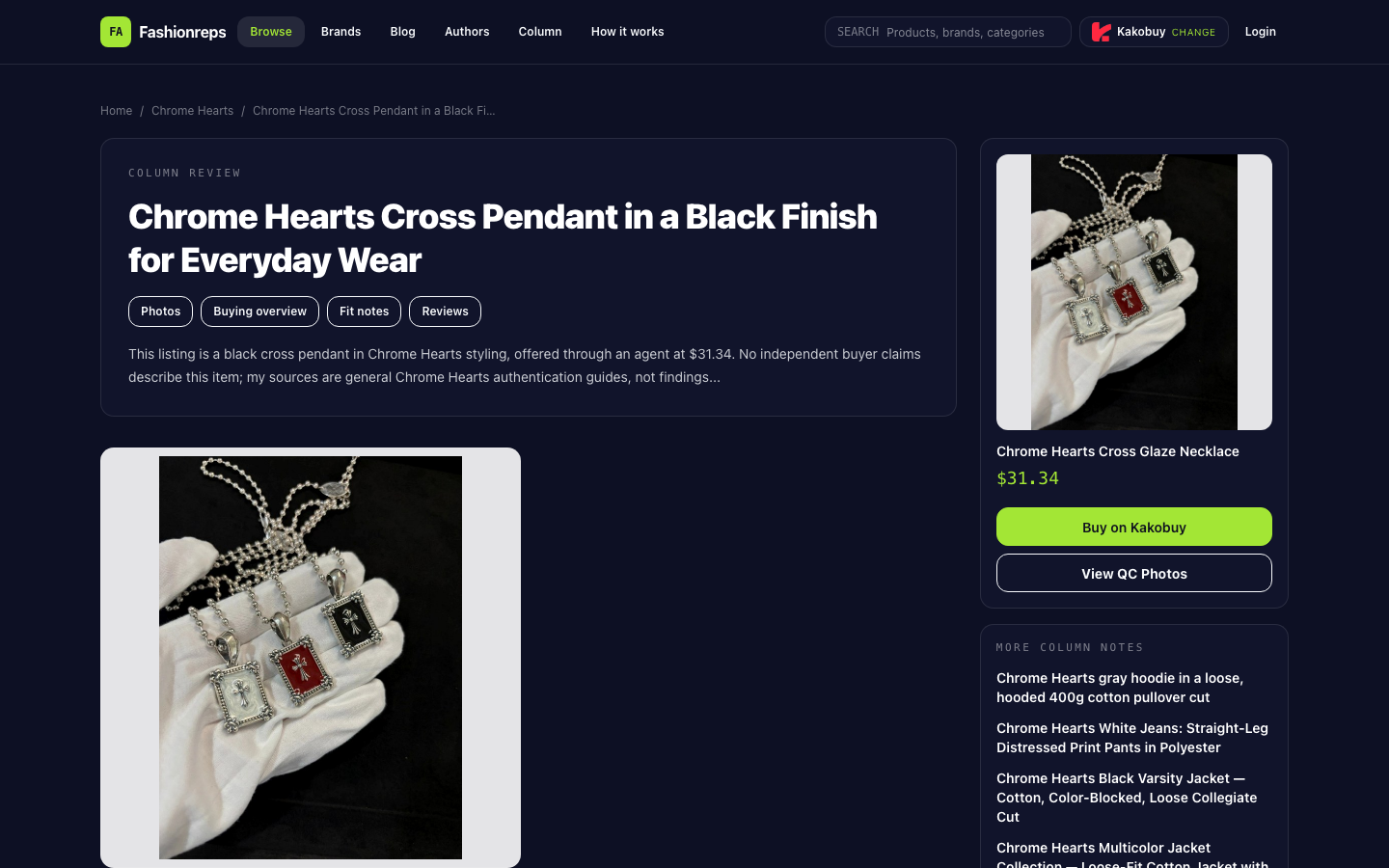
The product page currently confirms that this is a black cross pendant necklace, described as Chrome Hearts style, with a reference price of $31.34. The page does not provide clear information on the clasp type, pendant connection ring structure, or the connection points between the chain and clasp. Therefore, you cannot determine from the product page alone whether it is prone to falling off during wear, nor can you treat the appearance description on the page as proof of structure.
Before ordering, check the three connection points separately
Do not just ask the agent to "take clear photos of the necklace." Instead, explicitly request supplementary photos of the following three areas:
- Clasp body: Confirm whether it is a lobster clasp, spring ring clasp, ring clasp, or other structure, and request photos of both the closed and open states.
- Pendant connection ring: Observe whether the ring at the top of the pendant is completely closed, and whether there is any obvious gap, deformation, or connection relying only on a small metal piece between the connection ring and the pendant.
- Chain connection points: Check the transition areas at the chain ends, extension chain, or connection rings to the clasp for any signs of breakage, flattening, or abnormal welding.
These three areas serve different functions. The clasp is responsible for opening and closing, the pendant connection ring bears the weight of the pendant, and the chain connection points determine whether the entire necklace can form a continuous load path. Seeing only the front of the pendant cannot replace checking these areas.
Make the supplementary photos truly useful for judgment
It is recommended to give the agent a structured list of requirements at once to avoid receiving repetitive front views:
- One full flat lay photo of the necklace, with the clasp, pendant, and both connection points in frame.
- One close-up of the clasp, showing both the closed and open states.
- One side close-up of the connection ring at the top of the pendant, focusing on whether the ring is closed and whether there are obvious gaps.
- One close-up of the connection between the chain end and the clasp, ideally from both front and side angles.
- Place a ruler or common reference object in each photo, only to help determine if the photo is clear enough, not to confirm actual durability.
If the agent can only provide distant flat lay photos, or if the connection areas are obscured by the pendant, packaging, or reflections, continue to request supplementary photos rather than inferring structure from blurry outlines.
After receiving photos, inspect in this order
First, check whether the photos indeed correspond to the same item. The pendant shape, chain color, and clasp position in the full flat lay photo should correspond to the parts in the close-ups. If a close-up only shows an isolated clasp, you cannot confirm that it is installed on this necklace.
Next, check whether the clasp forms a clear closure relationship. In the closed state, you should be able to see the connection between the clasp body and the connection ring; in the open state, you should see the opening and closing mechanism, not just an unidentifiable metal outline. Photos still cannot prove the actual strength of the spring, hinge, or internal locking mechanism, but they can help rule out cases where information is clearly insufficient.
Then inspect the pendant connection ring. The focus is not on whether the design resembles a certain brand, but on whether there are signs of obvious opening, misalignment, flattening, or detachment from the pendant body. If the connection ring is completely obscured by thick black surface treatment or shadows, request brighter side photos.
Finally, check the chain ends. Ideally, there should be independent, clear transition points between the chain and connection ring, and between the connection ring and clasp. If the chain is directly obscured behind the clasp body, and you cannot confirm whether a connection ring exists in between, you cannot judge the structural integrity based on that.
When to pause payment
If any of the following situations occur, it is recommended to pause the order first:
- Neither the product page nor supplementary photos show the clasp type.
- The top of the pendant is obscured, making it impossible to confirm whether the connection ring is closed.
- The clasp close-up cannot be matched to the same item as the full flat lay photo.
- The agent only provides one front view, with no side or close-up photos of the connection points.
- Image clarity is insufficient to distinguish the relationship among the connection ring, chain ends, and clasp.
- The agent refuses to explain the clasp and connection points, only repeating appearance photos.
Pausing payment does not mean judging that the product is definitely defective; it means that the current evidence is insufficient to complete this structural verification. The product page does not provide complete specifications such as chain length, pendant size, or clasp type, nor does it have independent buyer feedback to replace supplementary photos. Even if photos show clear connections, that does not prove material, internal mechanism strength, wear lifespan, or brand authenticity.
Conclusion
Whether this black cross necklace is suitable for ordering depends first on whether the agent can provide corresponding photos of the clasp, pendant connection ring, and chain connection points. Before payment, at least three things should be confirmed: the photos belong to the same item, the clasp's open/close relationship is clear, and the three connection points are not obscured to the point of being unjudgeable.
If the agent cannot provide these structural photos, the safest decision is to hold off on purchasing rather than using the pendant's appearance or price as a substitute for assessing wear risks.