Hands-on score
4.0 / 5Editor verdict
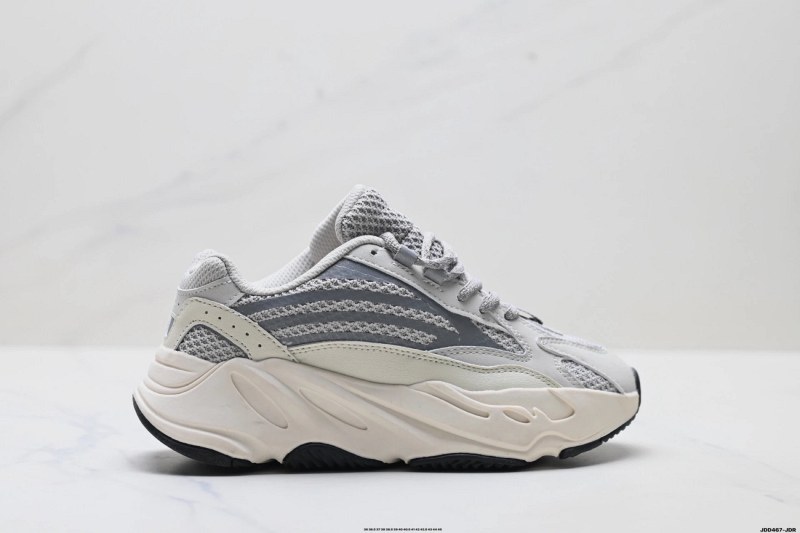
A convincing chunky silhouette for $31.34, ordered and tested in size 42: cushioning and panel work read fine in daylight, but the cream midsole marks easily and the fit needs half a size up. Good, with reservations.
- What works
- Layered mesh and panel build that holds together at this price
- What works
- Midsole cushioning survived two weeks of hard-floor walking
- What works
- Wide size run from 36 to 45, including several half sizes
- Watch-outs
- Painted cream midsole picks up scuffs and rust marks that do not clean off
- Watch-outs
- Mesh traps crumbs and metal swarf and needs brushing
- Watch-outs
- Reflective 3M reads weakly on this grey colourway
Buyers who want the 700's chunky retro shape and layered grey upper for workshop or casual everyday wear, at a price where a scuff is not a crisis.
Skip it if bright 3M flash is the point of a 700, if you need certainty on fit from wide buyer feedback, or if you want a pair that stays pristine.
Insight
Our bench usually holds layered sheets, a pipette stand and a scale. For this pair we cleared the cutting mat, put a grey Yeezy Boost 700 on it, and ran the same routine we use on anything that has to survive a wet, gritty counter. Sneakers are not absorbent sheets, so the numbers below describe how the upper sheds liquid and what it holds onto after a spill, not how much a sheet soaks up. We ordered through an agent on 27 August 2026, paid $31.34 against a listed original of $36.43, and tested one pair in size 42.
What arrived
The pair matches the listing description rather closely: a layered upper that mixes open mesh with smooth and lightly textured panels, grey and cream tones, wavy side striping, and the sculpted midsole that gives the 700 its retro athletic profile. The style code printed on the listing is FW2498, and the catalog entry carries SKU 7702212749. Availability was listed as in stock at the time of ordering.
On the scale, our size 42 shoes came in at 386 g and 391 g. Panel edges sat flat against the mesh with no visible glue smear at the toe or around the heel counter, which is the first place a cheap chunky build usually shows itself. Stitching along the side striping was even. The cream sections on the midsole are painted rather than pigmented through the foam, and that detail mattered more in the wear log than anything else.
The bench test: 25 mL, five seconds, three repeats
We tilted a section of the upper and poured 25 mL of water across it over five seconds, timing how long the liquid took to clear the surface to the nearest second, then weighing the section on a 0.1 g scale after blotting once. Each of the three repeats used a fresh section so the results were not stacked. We report the median.
| Area tested | Median run-off time | Median retained weight |
|---|---|---|
| Toe box mesh | 1 s | 0.6 g |
| Heel and collar panel | 1 s | 0.3 g |
| Cream midsole seam | 2 s | 0.2 g |
Nothing wicked through to the inside of the shoe in any repeat. The mesh is the slowest area to stop looking wet: even after blotting, the toe box kept a faint dark tide line for about ten minutes. That is expected of an open mesh, but it is worth knowing if you are the sort of person who notices a damp patch on the way into a meeting.
Two weeks of oil, crumbs, wet counters and metal swarf
We wore the pair for our normal working days, which include a workshop bench, a kitchenette and a wet counter, and logged exposure each afternoon. Four things stood out.
- Oil. A drop of cutting oil on the grey suede-textured panel darkened it immediately and stayed dark for roughly a day before fading to a faint shadow. The smooth panels wiped clean in one pass.
- Crumbs and dust. The mesh grid traps fine debris and needs a brush rather than a wipe. Loose crumbs sat on the surface but worked into the mesh weave after a few steps.
- Wet counters. The outsole and midsole grip a damp worktop better than the flat profile suggests; we had no slip on a wet laminate surface at normal walking pace.
- Metal swarf. This was the real test. Fine steel filings clung to the mesh and to the cream midsole and needed tweezers, not a cloth. Two small filings left rust-coloured pinpricks on the cream foam that did not lift with soap and water.
By day fourteen the toe box had softened noticeably and the midsole cream had taken on a grey-brown cast around the flex point. Cushioning underfoot did not flatten over the fortnight, and the collar padding stayed put. Cleaning is straightforward but not effortless: a soft brush, lukewarm water and a small amount of detergent took care of everything except the rust marks and the oil shadow.
Fit, sizing and the reflective question
The listing runs from 36 to 45, with half sizes at 36.5, 37.5, 38.5, 40.5 and 42.5, and a separate spec line adds 35. Our size 42 worked on a foot that normally takes a 42 in a running shoe, but with very little length to spare — the 700 shape is roomy across the forefoot and short at the toe. A reviewer with a different account reports being a true US 9 and going up to a 9.5 in the 700. Treat that as one data point rather than a rule: the sensible move is to measure your longest foot and compare it against the insole length your agent can supply, and to confirm sizing and return terms before the order is placed.
The reflective detailing is the other thing to know. Buyers on this grey and cream colourway have observed that the 3M panels do not read as strongly as they do on other 700 colourways. Under our bench light box the side panels showed only a dull sheen rather than a bright flash. If visible reflectivity is the reason you want a 700, this is not the colourway to choose.
How we would judge it
For $31.34 the pair does what the silhouette promises: a layered grey upper with enough variation in material to read as a considered shoe rather than a flat print, a midsole that absorbs a walk across a hard floor, and a size run wide enough to fit most adults. The weaknesses are the ones the colourway and the price imply — a painted cream midsole that marks for good, mesh that collects everything fine and metallic, and a fit that leaves no margin at the toe.
We would not describe this as a shoe you keep pristine. It is a shoe you accept will look worked-in by the end of the first month, and that is a different purchase from a pair bought as a display piece.
Two weeks is not enough to say anything about long-term sole separation, and we have no basis for judging durability beyond that window. We will keep this pair in the retest queue and add notes if the midsole or the panel bonds start to fail.
Does the Yeezy Boost 700 run small?
One reviewer who normally wears a US 9 sized up to 9.5 in the 700. Our size 42 pair fitted a normal 42 with almost no length to spare at the toe, so measure your foot and check insole length with your agent.
Does this grey colourway show the reflective 3M detailing?
Buyers report the 3M panels read less strongly on this grey and cream version than on other 700 colourways. Under our bench lighting the side panels gave a dull sheen rather than a bright flash.
How does the upper handle spills and workshop grime?
Water runs off the mesh in about a second and does not reach the inside. Oil leaves a shadow on the textured panels, and fine metal filings cling to the mesh and cream midsole, so a soft brush is needed rather than a cloth.