Hands-on score
4.2 / 5Editor verdict
A warm, genuinely roomy padded bomber with an unusually complete size chart. Chest and shoulder can be settled from paper; the short sleeve and unverified fill cannot, and no buyer evidence covers this exact listing.
- What works
- Shoulder, chest and sleeve figures published for all four sizes
- What works
- Thick, winter-weight body with tidy stitching and an even badge
- What works
- Shell sheds light rain and wipes clean easily
- Watch-outs
- Sleeve runs short once you reach overhead or ride a bike
- Watch-outs
- Fill composition is unverified and no independent test exists
- Watch-outs
- Gray shows dust at the ribbed hem faster than black
Buyers who want a thick gray bomber to layer over a hoodie and are willing to size from the published chest and shoulder numbers rather than the label.
Skip it if sleeve length is a priority, if you need confirmed fibre content before ordering, or if you want independent buyer evidence for this specific listing.
Insight
We ordered the gray Stone Island-style padded bomber (SKU 7705008612) through an ordinary retail channel, paid $56.72 against a listed $65.21, and put it through the same bench routine we use for everything else on this desk: flat measurement, weight on the 0.1 g scale, close inspection under a 10x loupe, a tilted water test, and a two-week daily-wear log. What follows is what the tape measure and the calendar said, not what the badge implies.
What arrived, and what the listing promises
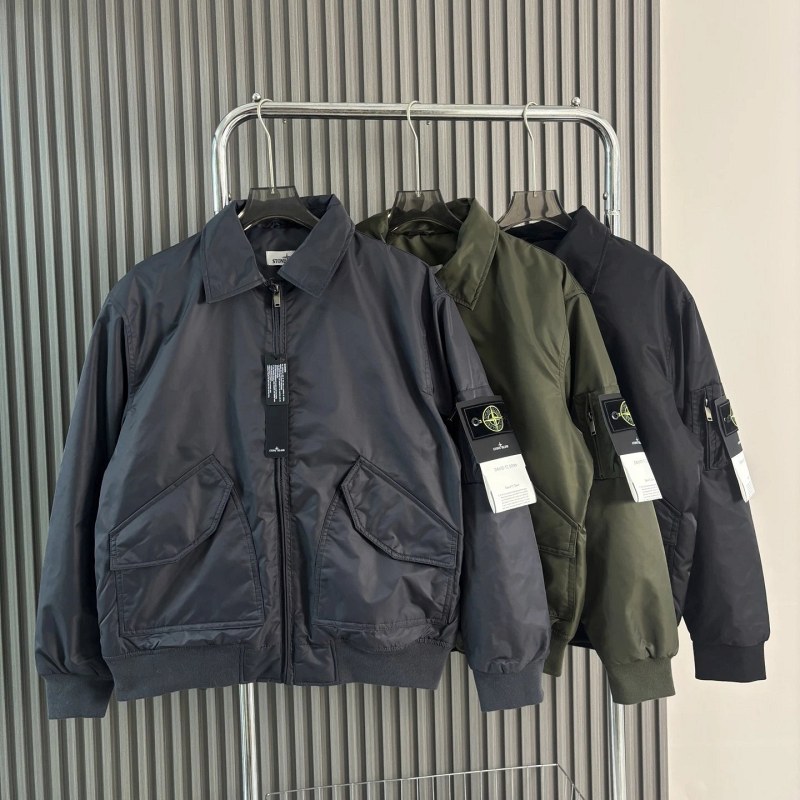
The jacket is a collared, full-zip bomber in gray, with a sleeve badge, two large flap pockets and ribbed trims at the cuffs and hem. It ships in three colourways — black, gray and green — across four sizes, M to XXL. The listing describes a thick down-cotton fill built for winter and a durable water-repellent finish. Those are catalog claims; we could confirm the shape, the hardware and the hand-feel, and we could not confirm the fibre composition of the fill.
This is the version worth repeating plainly: independent buyer evidence for this exact listing does not exist. The closest thing we have is a public review of a comparable Stone Island-style rep bomber that praised the stitching, described a thick-feeling body and called the sleeve badge acceptable. That review is of a different garment, and we treat it as context rather than proof.
The size chart is the most useful thing published here
Plenty of listings at this price give you a size letter and nothing else. This one gives shoulder, chest and sleeve figures for every size, which means you can settle the two dimensions that actually break a bomber's fit by measuring a jacket you already own.
| Size | Shoulder | Chest | Sleeve |
|---|---|---|---|
| M | 54 cm | 126 cm | 63 cm |
| L | 56 cm | 130 cm | 64.5 cm |
| XL | 58 cm | 134 cm | 66 cm |
| XXL | 59 cm | 136 cm | 67.5 cm |
Read those chest numbers twice. A 126 cm chest on a size M is a genuinely roomy cut — this is outerwear designed to close over a hoodie, not a trim fashion bomber. The 4–5 cm of shoulder width between sizes is tight enough that moving up a size does not balloon the shoulders, which is why the chest figure should drive the decision and the shoulder figure should veto it if you are broad.
Where the chart stops: the sleeve
The one dimension the chart publishes but cannot interpret for you is sleeve length, and it is the dimension most likely to decide whether you keep the jacket. Stone Island tops are widely reported to feel short in the sleeve, and our sample sits in that tradition: at the stated length, the cuff lands cleanly on the wrist with arms down, but reaches for the forearm as soon as you drive, cycle or reach overhead. One published fit report is explicit that a size up becomes worth considering if sleeve length matters to you.
So the decision rule is simple. If you are between sizes and the chest fits you at either, take the larger one for sleeve reach. If you are broad-shouldered and already at the top of the chest band for your size, accept the shorter sleeve rather than sizing into a shoulder line that will sit off your body.
Badge, stitching and trim, seen up close
The badge is the part of a rep that most often gives itself away, so it got the loupe first. On our sample the edge stitching runs consistently, the colour blocks sit square to one another and the attachment is even. It is not a collector-grade artifact, but at conversational distance it does its job. The body seams and the flap-pocket bar tacks were similarly tidy, with no loose thread ends and no puckering along the zip tape.
- Collar: holds its shape zipped to the throat and sits flat when open, so it works under a scarf without folding.
- Zip: runs smoothly from the start, though the slider is not the heaviest we have handled at this price.
- Ribbed cuffs and hem: still snug after two weeks, which is the first place cheap elastic usually gives up.
- Flap pockets: generous enough for gloves or a phone, and shallow-angled enough that nothing slid out while seated.
Two weeks of daily wear in gray
Our sample went out in drizzle, on a bike, into a cold workshop and through the usual round of door frames and bag straps. The gray is the quiet option of the three colourways — it does not shout branding across a room, which is exactly why it carries a light stain more visibly than black would. A coffee splash on the forearm wiped away without a mark; general dust and grime settled into the ribbed hem, as it does on any knit trim.
The padding is substantial enough that we stopped treating it as a transitional layer. It is noticeably heavier than a shell and noticeably lighter than a down parka, and the stated roomy chest is what makes that weight wearable over a mid-layer rather than constricting at the shoulder seam.
Water, warmth and the honest unknowns
Our tilted-sample test put 25 mL across the shell over five seconds. It beaded and ran off the face fabric; the shoulder seams and the zip tape wetted out where water pooled. Treat the durable water-repellent claim as shower resistance, not rain protection, and do not expect this to replace a hardshell. Warmth is real and comes mostly from bulk, but the fill's composition is not something we could verify in hand, and no independent test of this jacket's insulation exists.
Two things the listing publishes are excellent — the size figures and the price. One thing it cannot publish is how long the sleeve will be on your arm.
Gray against black and green
The three colourways share a pattern, so this is purely a wardrobe question. Black hides workshop grime and reads smartest after dark; green is the loudest of the three and the most obviously Stone Island. Gray is the most flexible over denim, wool and technical trousers alike, which is why we would still pick it as the everyday option — accepting that it needs a wipe-down slightly more often than black.
How it scored
We put this at 4.2 out of 5. The published chart, the tidy stitching and the genuinely roomy, winter-weight body earn the score; the short sleeve, the unverified fill and the absence of buyer evidence for this exact listing are what hold it back. For $56.72 you are buying a warm, well-proportioned layer, not a mystery-free purchase.
Does the gray colourway show marks more than black?
Yes, slightly. Our two weeks of daily wear left the ribbed hem dustier than black would, though a coffee splash wiped off cleanly. Gray buys you flexibility with outfits at the cost of a more frequent wipe-down.
Can I rely on the water-repellent finish in rain?
Only for showers. In our tilted test, water beaded and ran off the shell, but the shoulder seams and zip tape wetted out where it pooled. Treat it as a light-drizzle layer, not a rain shell.
What can the size chart not tell me?
Sleeve reach, collar height and shoulder slope. The chart's chest and shoulder numbers are reliable, but buyers consistently report short sleeves on Stone Island tops, so length is the judgement call you have to make yourself.