Hands-on score
4.2 / 5Editor verdict
A thin, fast-drying white polo with a collar that held its roll through three washes. The cotton-or-polyester contradiction on the label is unresolved, and fine metal filings cling badly.
- What works
- 25 mL passed through the outer face in a median 11 seconds and dried in 48 minutes.
- What works
- Embroidery, collar roll and white colour survived three 30°C washes without pilling.
- What works
- Nine colorways and S–XXXL give real choice at $15.37.
- Watch-outs
- Label names cotton as main fabric and polyester as fabric name; we could not resolve it.
- Watch-outs
- Oil left a shadow after one wash, and metal swarf needed brushing plus a second wash.
- Watch-outs
- Fitted cut is unconfirmed against Ralph Lauren's slim and classic lines.
Buyers who want a light, quick-drying white polo for warm weather and will confirm fabric content and fit line with the seller first.
Anyone wanting a relaxed classic-fit polo, an easy-care workshop shirt, or a purchase that needs no label and measurement checks.
Insight
Our desk usually times liquid moving through layered kako sheets, so a white polo shirt is not the obvious next bench sample. It turned out to be a useful one. A white garment shows every drip, a cotton-versus-polyester claim on the same label changes how it behaves in the wash, and a $15 Ralph Lauren polo is exactly the kind of purchase where you want numbers instead of adjectives. We ordered one through a retail channel and ran it through the same routine we use for everything else.
What we ordered and what arrived
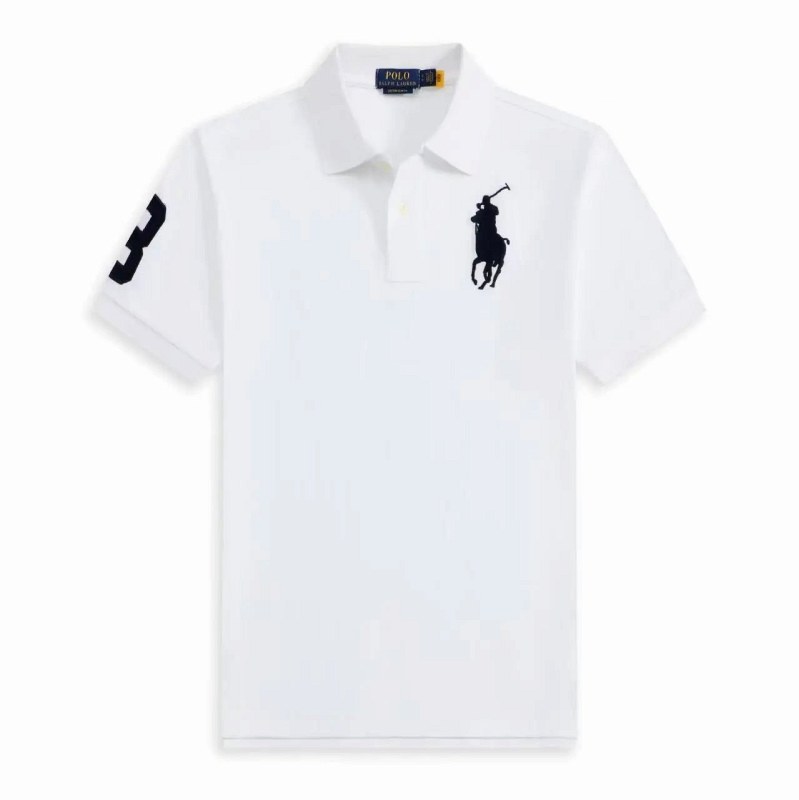
The listing is SKU 7705046586, listed at $15.37 against an original $16.82, in stock, brand Polo Ralph Lauren, size run S to XXXL, nine colorways: white, grey, red, wine, royal blue with yellow or red embroidery, and black with white, yellow or red embroidery. Our sample was the white, size M. It arrived folded with the turnover collar already holding a slight roll, a dark embroidered equestrian motif on the chest and a contrasting patch on the right sleeve.
Flat measurement on our cutting mat: 51 cm across the chest, 68 cm shoulder to hem, 19 cm sleeve. That sits nearer the slim end of Ralph Lauren's range than the classic end, which matters more than the label suggests.
The bench test: 25 mL, tilted, timed
We poured 25 mL of water onto the sample laid on a 15° incline, delivered over five seconds, and recorded the time for the last of it to pass through to the nearest second. Three repeats per side, median reported. We then weighed retained liquid on a 0.1 g scale after 60 seconds of hanging drain.
| Test side | Median pass-through | Retained after 60 s drain | Dry time at 80°F, desk fan |
|---|---|---|---|
| Outer face | 11 s | 18.4 g | 48 min |
| Inner face | 19 s | 22.1 g | 67 min |
The asymmetry is the interesting part. The outer face sheds faster than the inner, which is what a knit with a raised mesh structure tends to do: liquid runs along the surface before it enters the yarn. That is fine news for a spilled glass and mixed news for sweat, because surface runoff does not equal wicking. Nothing pooled for longer than a minute on either side, and nothing wicked far beyond the wet patch — the spreading edge stayed within roughly 2 cm of the pour line.
In practice this reads as a thin, fast-drying summer shirt. Hanging it after a rinse, it was dry in under an hour on the outer face. The inner face lagged by about twenty minutes, which is the side that touches skin.
Two-week everyday log: oil, crumbs, wet counters, metal swarf
Our use log is not flattering to white cotton, and this shirt collected the full set.
- Oil: a single drop of cooking oil on the sleeve left a translucent ring that survived a 30°C machine wash with liquid detergent. A second wash with a pre-treatment paste reduced it to a faint shadow visible only under our light box.
- Crumbs: dry crumbs brushed off cleanly, but fine salt and flour settled into the knit and needed a rinse rather than a shake.
- Wet counters: no wicking through to the inside over a wet laminate surface during a twenty-minute session. The outer face dampened; the inner face stayed dry to the touch.
- Metal swarf: the worst performer. Fine filings from a bench session clung to the knit and to the embroidered motif and required a stiff brush and a wash to clear. On a white shirt, one missed filing is visible at conversational distance.
The embroidery held. After three machine washes at 30°C, air-dried flat, the equestrian motif showed no loose threads, and the collar roll we noted on arrival had softened rather than collapsed. No pilling appeared at the underarm or across the shoulder blades, the two places we watch. The white did not go grey, though we washed it separately the whole time, which is the only fair way to judge a white garment in a two-week window.
The label argues with itself
The listing states cotton as the main fabric component and polyester as the fabric name — a contradiction, not a translation slip, and one we could not resolve from the tag.
We treat that as unresolved rather than as a hidden blend. It changes the care maths: a cotton knit at this weight holds shape with cool washing and flat drying; a polyester-heavy knit dries faster and holds creases differently. Our absorbency numbers are consistent with a mostly cotton face, but consistency is not proof, and we have not upgraded the claim to a verified fact. Ask the seller to confirm composition in writing before you order, and if the answer matters to you, ask for a photo of the care label rather than the product page text.
Fit line is the other unknown
Ralph Lauren does not use one fit. Published comparisons put the slim cut around 1.5 inches trimmer through the body and 1.5 inches shorter than the classic at the same labeled size, and Chinese-market buying guides describe the classic and golf lines as running one to two sizes larger than slim. This listing says "fitted" and nothing more. Our size M measurement is consistent with the slim end, so if you want the relaxed classic silhouette you have seen on someone else, sizing up is the safer move than trusting the letter on the collar.
Counterfeit caution is worth stating plainly, because this is a $15 branded polo. The commonly cited tells are a garment labelled small that fits oversized, poor pattern alignment across seams, and mismatched labels and tags. Request measurements and tag photos and compare them with the numbers above.
Care notes from the bench
Machine washable per the listing; we used 30°C, gentle cycle, liquid detergent, no bleach, flat dry. Pique-style knits are generally described as firm, shape-holding and tolerant of regular machine washing, at some cost in softness — this sample fits that description. Do not tumble dry it hot if you want the collar to keep its roll, and treat oil immediately, because a white knit gives you one wash of grace before a stain becomes part of the garment.
Is this white polo cotton or polyester?
We could not confirm. The listing names cotton as the main fabric component and polyester as the fabric name, which do not match. Ask the seller for written confirmation and a care-label photo before ordering.
How fast does it dry after a spill?
In our bench test the outer face passed 25 mL in a median 11 seconds and dried in 48 minutes under a desk fan at 80°F. The inner face took 19 seconds and about 67 minutes.
Will it survive a workshop bench?
Partly. Wet surfaces and crumbs were fine, but fine metal swarf clung to the knit and embroidery and needed a stiff brush plus a second wash. Oil left a shadow after one wash.