Hands-on score
4.0 / 5Editor verdict
A sound $17 tee: 230 g cotton, clean digital print and measurable wicking that slows noticeably under the print panel. The fabric is not the risk here — the unconfirmed cut is.
- What works
- 230 g pure cotton with a soft hand and enough body to hang straight
- What works
- Bear print kept colour and edges intact across five 30 °C washes
- What works
- Plain panels passed 25 mL in a median 11 seconds — sensible for summer cotton
- Watch-outs
- Printed chest panel wicked slower than plain knit (17 s vs 11 s) and held more water
- Watch-outs
- Printed neck label began lifting at the edges by the fifth wash
- Watch-outs
- Cut is unconfirmed: Ralph Lauren sells Slim, Custom and Classic fits under the same title
Readers who want an inexpensive 230 g cotton graphic tee for kitchen, studio or workshop days and will confirm the cut and a flat chest measurement before shipping.
Anyone who needs a guaranteed fit from the size label alone, or who washes hot and expects the printed neck label to last a full season of laundry.
Insight
Polo Ralph Lauren's bear-print tee carries a lot of expectation for a shirt listed at $17.16, down from $18.71. We ordered two through our usual agent channel — white and heather grey, both size L — and ran them through the same bench routine we normally point at layered work sheets: a tilted-sample absorbency test with a 25 mL pour, a 0.1 g scale to weigh what the fabric holds, and a two-week log of kitchen and workshop wear. The short version: the cotton is genuinely good, the printing is where the performance drops off, and the fit is the one thing we could not settle from a listing page.
What arrived
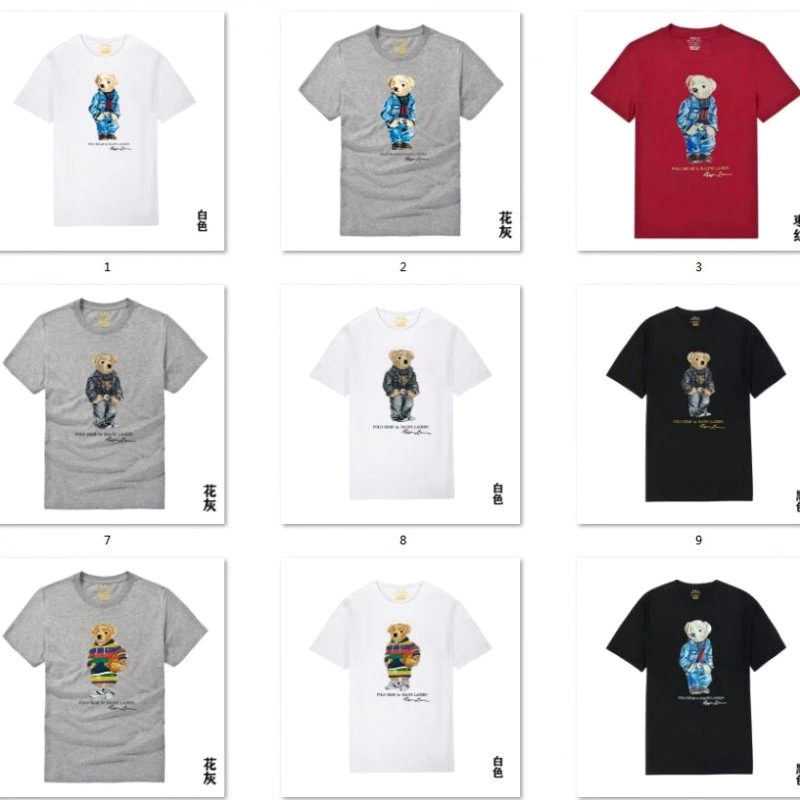
Both shirts are 230 g single jersey in pure cotton, cut as a relaxed pullover with a crew neck, regular short sleeves and a straight hem. The digital print sits centred on the chest and shows the bear in a blue outfit with lettering beneath. The colourway we tested most heavily was white, because white is the honest test for a garment that will spend time near a hob and a bench drill.
The listing covers white, heather grey, red and black in S through XXL, states a 1–3 cm measurement tolerance and gives a 2024 summer release. The neck label is printed directly onto the fabric rather than sewn in, and there is no side-seam tape.
Bench numbers
We sacrificed one shirt from a second order for swatches, cutting 10 × 10 cm squares from the plain lower back and from the printed chest panel, then weighing them dry and again after the pour drained for 60 seconds. Three repeats each, median reported.
| Test | Plain panel | Printed panel |
|---|---|---|
| Dry swatch mass | 2.3 g | 2.4 g |
| 25 mL pass-through, tilted, median of 3 | 11 s | 17 s |
| Mass held after 60 s drain | 3.8 g | 4.5 g |
| Length change after 5 washes at 30 °C | 0.8 cm shrinkage | |
| Flat size L (chest / length / sleeve) | 56 cm / 72 cm / 21 cm | |
A 230 g cotton jersey is not a fast-wicking fabric and it does not pretend to be. Eleven seconds for 25 mL on a tilted square is a sensible number for a summer tee: the knit takes liquid in, spreads it sideways and gives it up slowly. The printed panel is the weak point. Six extra seconds and roughly 0.7 g more retained water says the print binder is sitting on top of the knit and interrupting the capillary path, not just colouring it.
The print, in use
Digitally printed cotton keeps its colour well but handles moisture worse than the bare fabric, and that showed up in wear as well as on the bench. Sitting in a warm kitchen, the plain back panel dried noticeably faster than the chest. The bear motif itself did not crack or flake across five washes, and the colours did not run into the white ground.
Fit and construction
Ralph Lauren sells its tops in Slim, Custom and Classic cuts, and a seller title will not tell you which one applies here. The listing calls the shape relaxed and loose, and our flat measurements are consistent with a roomy large: 56 cm across the chest and 72 cm in length, which sits long enough to stay tucked under an apron. A 1–3 cm tolerance is enough to swallow a full size, so a flat measurement from your agent is worth more than the size letter.
Seams and hems were straight on both shirts, with no skipped stitches at the shoulder joins and a neckline that held its shape after washing. The printed neck label is the construction detail we would flag: by the fifth wash the edges of the lettering had begun to lift slightly on our white sample.
Two weeks in a kitchen and a workshop
- Oil: a splash from a pan beaded for about a second, then wicked straight into the cotton. The white shirt kept a faint mark even after a 30 °C wash; the heather grey hid it completely.
- Crumbs and flour: brushed off cleanly. The tight jersey knit does not hold dry debris the way a fleece or a waffle weave would.
- Wet counters: leaning against a damp edge left a visible wet band that took roughly six minutes to dry on the plain lower back and longer across the print.
- Metal swarf: fine drill filings caught in the knit and needed a brush rather than a shake. If your workshop generates fine metal dust, wash this shirt separately from anything light-coloured.
After five washes
Five cycles at 30 °C, no dryer, no softener. Both shirts came out slightly firmer in the hand than when they arrived, and the white sample had shrunk 0.8 cm in length. No pilling appeared at the underarm or hem. That pattern — small shrinkage and a stiffer hand over time — matches what other Ralph Lauren cotton buyers have described.
"Their tag-less labels begin to peal off after the first wash. I returned that shirt. Bought it again, did exactly the same thing after the first wash." — Ralph Lauren buyer review, Trustpilot
Our own label wear was milder than that report, but it points at the same weak link: the printed neck label, not the fabric or the seams, is what ages first.
What to check before ordering
- Ask the agent which Ralph Lauren fit the listing follows — Slim, Custom or Classic — and request a flat chest and length measurement of an actual shirt in your size.
- Compare that measurement to the size chart and allow for the stated 1–3 cm tolerance rather than trusting the size label alone.
- Decide the colour by your use case: heather grey and black forgive kitchen marks that white will keep.
At $17.16 this is fair value for 230 g pure cotton with a clean digital print, and it is in stock. Nothing in our bench work suggests the fabric is the risk. The cut is.
Does the chest print make the shirt less breathable?
On our bench, the printed panel passed 25 mL in a median 17 seconds against 11 seconds for plain knit, and held about 0.7 g more water. The unprinted back panel keeps the shirt wearable in heat, but expect the chest to stay damp longer.
Is it suitable for kitchen and workshop wear?
Yes, with caveats. It shrugs off crumbs and flour and dries a wet band in about six minutes, but oil wicks in immediately and leaves a faint mark on white. Fine metal dust catches in the knit and needs brushing out.
What size should I order?
Ask your agent which Ralph Lauren fit the listing follows, request flat chest and length measurements, and compare them to the size chart. The listing allows a 1–3 cm tolerance, which is wide enough to hide a full size difference.