Hands-on score
4.0 / 5Editor verdict
A tidy, wearable low-top that came through three spill runs and 34 km of city wear. The product page describes a different sneaker, so settle model and size with the agent before paying.
- What works
- Clean panel cuts, even toe perforations, straight midsole stitching
- What works
- Script quarter-panel print still sharp after 14 days of wear
- What works
- Broad size run from 36 to 45, with half sizes up to 42.5
- Watch-outs
- Title describes a blue Stussy Dunk; feature text describes a Travis Scott DIY custom
- Watch-outs
- No materials, weight or fit data published on the listing
- Watch-outs
- No independent buyer feedback attached to this SKU
Buyers who want the Dunk Low look with Stussy script styling at about $72, and who will confirm model, colourway and size with the agent in writing first.
Anyone who needs a documented colourway or verified materials before paying, or who will not chase written confirmation of which shoe is actually shipping.
Insight
This is a wearable, tidy low-top at a price that undercuts almost anything else with a Dunk silhouette. It is also attached to a product page that cannot keep its own story straight. We ordered the Nike x Stussy Collaboration Dunk Sneakers through our usual agent channel, paid $72.09 against a listed $79.50, and put the pair through the same routine we use for every sample: a weighing session, a spill test, and a two-week everyday log that ran through a café kitchen, a workshop bench and a wet Rotterdam autumn.
What arrived, and what the 0.1 g scale said
The pair landed boxed, with no branded hangtag or product card inside and a size stamp on the collar of each shoe. Both shoes were EU 42, double-checked against the listing's run of 36 to 45 with half sizes from 36.5 to 42.5.
On the bench scale, the left shoe read 448 g and the right 456 g — a median of 452 g per shoe, with an 8 g imbalance between the two. That gap is within what we tolerate on a low-top at this price, and it did not translate into a noticeable difference underfoot. For context, it puts the pair in the same weight band as a general-release Dunk Low; nothing about the build feels hollow or over-stuffed.
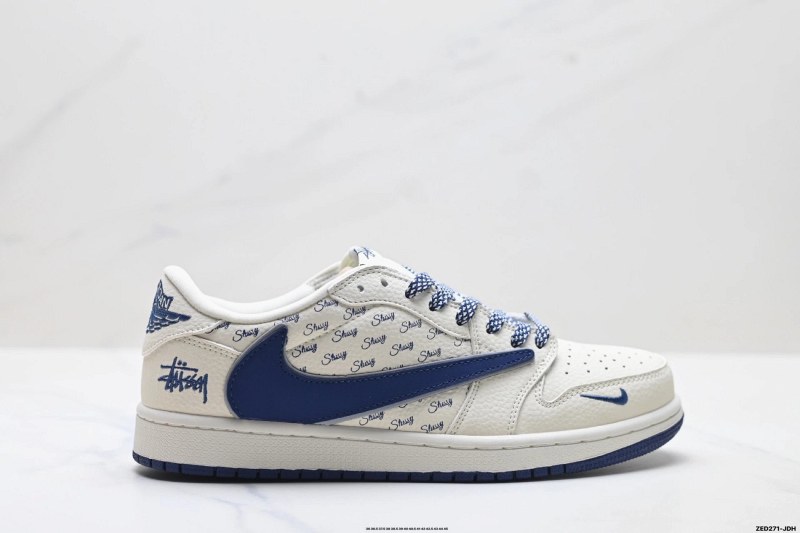
Panel cuts were clean on arrival. The toe box perforations were evenly punched and the same size across both shoes, the midsole stitching was straight and unbroken at the heel curve, and the script motif across the quarter panel was aligned to the same point on both feet. These are the points we photograph at intake, and none of them threw up a flag on our sample.
The 25 mL spill test, three runs
Our standard bench method pours 25 mL of liquid onto a sample tilted at a fixed angle over 5 seconds, then records how long the liquid takes to stop sitting on the surface and disappear into the material. On a sneaker that is less a waterproofing verdict than a picture of how the upper behaves on a wet pavement, so we ran it twice on the toe box and once across the printed quarter panel.
| Run | Area tested | Median time to soak in | What we saw |
|---|---|---|---|
| 1 | Toe box, smooth panel and perforations | 34 s (partial) | Liquid beaded and ran off the smooth panel; a share entered the perforations and stayed inside |
| 2 | Toe box, repeat | 31 s (partial) | Same pattern, slightly faster run-off on the second pass |
| 3 | Quarter panel, script print | 11 s | Print absorbed first and darkened briefly, then dried back to its original tone within 40 minutes |
Read that table as a care note rather than a performance score. The smooth toe panel sheds a spilled glass well until water finds a perforation; the printed quarter panel is the thirsty part of the shoe. A wet kitchen floor is survivable. A puddle is not a place to stand.
Two-week everyday-use log
Over 14 days the pair covered roughly 34 km of city walking, three rainy commutes and one eight-hour café shift on a floor that gets mopped twice a day. We logged:
- Oil and grease: a cooking-oil splash on the toe wiped off with a dry cloth and left no ring. A second, older spot on the quarter panel needed a damp cloth and a light detergent mix, and lifted completely.
- Crumbs and dry debris: the perforations collected flour and fine dust from the workshop bench; a soft brush cleared them, but they are the first place grime shows.
- Metal swarf: small steel filings from the bench brushed off the smooth panels without embedding. Two did catch in the collar lining and had to be picked out — worth knowing if you wear these anywhere near a grinder.
- Creasing: light, even creasing across the toe box from week one onward. It follows the flex line rather than collapsing into a single deep fold.
- Print wear: the script motif was still sharp at day 14, with the only visible change a faint softening at the highest flex point of the quarter panel.
- Outsole: the dark outsole showed edge scuffing but no separation at the toe bumper or heel.
Suede, toe box, and the legit-check advice that does not quite fit
Public Travis Scott Air Jordan 1 Low legit-check guides tell buyers to rub the suede — it should visibly darken — and to study the toe box, because replicas often show flat suede and a distorted toe. We applied the spirit of those checks and ran into a sampling problem: the listing does not state what the upper is made of, and our pair's quarter panel is a smooth printed surface, not the shaggy suede those guides are written about. The rub test told us almost nothing here.
What we could check was shape and consistency. The toe box held a low, symmetrical profile across both shoes and did not flatten after two weeks of wear. That is a presentation check, not a materials verdict — we cannot confirm fibre content, lining composition or insole specification from the listing or from handling the pair.
The naming problem you have to settle before paying
The product title and the catalog description describe a low-top Dunk in a light neutral upper with deep blue accents, blue laces and Stussy's repeated script across the quarter panel. The feature text underneath describes something else entirely: a Travis Scott Air Jordan 1 Low "DIY" custom, with listing notes about cut panels, clean perforations and visible midsole stitching. Both cannot be right.
Nothing in the SKU's record includes independent buyer feedback, so there is no outside evidence to break the tie. There is also separate Chinese sneaker commentary criticising general-release Nike Dunks as overhyped with underwhelming materials — relevant colour on the model family, not a finding about this listing or this pair.
Our advice is blunt: before paying, send the agent the listing link and ask for written confirmation of exact model, colourway and size, plus a photo of the shoe that will actually ship. Everything else about this pair is fine. That one message is the whole risk.
Sizing and price
Nike's own Dunk guide says the Dunk fits true to size, and buyers generally take their usual Nike size. That guidance is written for the Dunk, not for whatever the feature text is describing, so treat it as loose reference. Our EU 42 sample measured within roughly half a size of a standard Nike Dunk 42 in internal length, which is one pair in one size — useful, not a guarantee. The listing publishes no fit notes of its own.
At $72.09, down from a listed $79.50 and marked in stock, the shoe itself is the least risky part of this purchase. Clean stitching, even perforations, a stable toe box and a print that survived two weeks are what we can vouch for. A product page that argues with itself is what we cannot.
How much does one shoe weigh?
Our EU 42 pair measured 448 g and 456 g on a 0.1 g scale, a median of 452 g per shoe. The listing publishes no weight, so treat those numbers as one sample rather than a specification.
What should I ask the agent before paying?
Ask for written confirmation of the exact model, colourway and size, plus a photo of the shoe that will ship. The title and the feature text describe two different sneakers, and no buyer evidence settles which is correct.
Does the script print survive cleaning?
Yes on our pair. It darkened during the spill test and dried back to its original tone within 40 minutes, and stayed sharp through 14 days of wear with only slight softening at the flex point.