Hands-on score
4.2 / 5Editor verdict
A well-built $53 Dunk-style mash-up that sheds splashes on its leather panels and lets water straight through the perforated toe box. Clean panel work, true-to-size fit for average feet, and creasing that stays cosmetic.
- What works
- Splash-resistant black overlays; no pass-through in 300 seconds.
- What works
- Clean panel edges and flat-stitched heel tag after two weeks.
- What works
- True to size on our measured foot, with a 36–45 run.
- Watch-outs
- Perforated toe box let water through in a median 34 seconds.
- Watch-outs
- Toe box creased from about 6 km and kept creasing.
- Watch-outs
- QC reports on comparable Dunks flag staining; inspect on arrival.
Buyers who want a black-and-white low-top look at about $53, wear average-width feet, and will check the panels and sizing before and after delivery.
Wide-footed buyers who won't size up, anyone expecting the pair to handle puddles, and shoppers who want documented proof of this exact batch before paying.
Insight
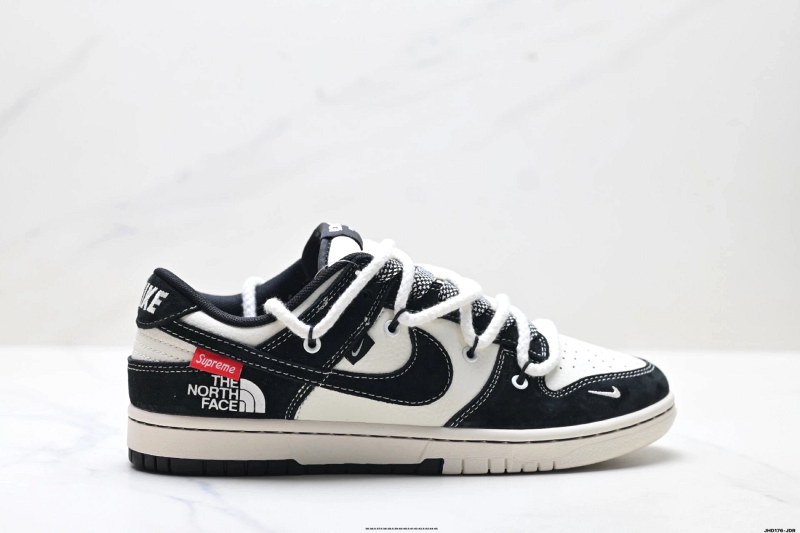
The listing calls this pair a Nike and The North Face collaboration, and the photographs show the usual ingredients of a mash-up: a low-top Dunk-style silhouette, a white base under black overlays, white laces, a perforated toe box and a red rectangular tag near the heel. We ordered a pair through the retail channel at $53.28, down from a listed $61.71, and put it through the same bench routine we use on everything else that arrives in the testing room — a measured liquid test, a weighing, and a two-week log of real floors.
What arrived, and what it weighs
The pair came in a plain box with no collaboration packaging to speak of: two shoes, spare laces, nothing else. On the 0.1 g scale, a single size 42 shoe weighed 436 g, which is ordinary for a padded low-top with a thick sole unit and tells you the upper is not a stripped-down summer build. The upper is layered, with cleanly cut panels, even stitching along the overlay edges and a padded tongue and collar. The listing specifies a full-grain leather upper; we cannot verify the fibre from the outside, so treat that as the seller's specification rather than our finding.
Two details decide whether a mash-up reads as deliberate or as noise. Here, the black curved side logo sits on the white panel without smudged edges, and the red heel tag is stitched flat rather than glued. Both survived the two weeks without lifting.
The 25 mL water test
We poured 25 mL of liquid onto a tilted shoe over five seconds, recorded the time until moisture registered on the inside to the nearest second, and repeated the test three times per site. The figure below is the median.
| Test site | Median pass-through | What we saw |
|---|---|---|
| Perforated toe box | 34 s | Water tracked through the perforations almost immediately and wicked into the toe lining |
| Side panel (black overlay) | None in 300 s | Beaded and ran off; the surface underneath stayed dry to the touch |
| Padded tongue | 71 s | Foam absorbed the pour and stayed damp for roughly an hour |
Read that as a splash rating, not a weather rating. A puddle stepped into will find the toe box; a wet counter, a spilled glass or a light drizzle on the walk to the workshop will mostly run off the leather panels. The tongue is the slowest part to dry, so if the pair gets soaked, stuff it rather than leaving it against a wall.
Two weeks of crumbs, oil and swarf
Our everyday-use log covered kitchen floors, a wet countertop prep area and a small metalworking bench. Crumb pickup along the midsole seam was the only thing that needed real work: a stiff brush cleared it, and the white midsole came back without a grey shadow. Cooking oil splashed onto the black overlay wiped away with a dry cloth and left no darker patch. Metal swarf — fine curls from a drill — settled in the tread and in the collar padding; the tread released it with a knock against a bin, the collar needed picking out by hand.
Creasing started at the toe box at around the 6 km mark and deepened across the fortnight. Lab testing of the Dunk Low rated the toe box 4/5 for durability while noting it creases more than other silhouettes, and that matches what we saw: cosmetic folds, no separation at the panel edges. The laces held their knots through a full day of standing work, and the padded collar did not rub.
Nothing in the fortnight suggested a structural weak point. Everything that went wrong was surface-level, and most of it washed off.
Sizing across the 36–45 run
The listing carries 36 to 45, with a 35–45 spec line, so the middle of the run is well covered and half sizes appear in the smaller end. Nike's own Dunk guidance says the model fits true to size. A wide-footed buyer in a public Dunk sizing thread reported the SB Dunk Low Pro running small and went up a full size, describing regular Dunk sizing as less consistent, and Chinese-language overviews describe a standard cut with a toe box that is not especially narrow. Our size 42 fitted true against a measured foot, with a thumb's width at the toe. If your feet are wide or you wear thick workshop socks, size up and confirm it with your agent before the order ships.
What to inspect when the pair lands
A quality-control review of black-and-white Panda Dunks bought directly from Nike documented brown or black staining around the upper and midsole, so check those areas first under daylight. Then look at the panel edges the listing claims are cut clean, the join between the black overlay and the white base, and whether both shoes sit flat without rocking. A cut-in-half teardown of Dunks found the swoosh panel was real leather, which is encouraging for the category but says nothing about this specific batch.
Value at $53.28
At this price the pair is being sold as a look rather than a certified collaboration, and the honest way to judge it is on the parts we could measure: a heavy sole, a splash-resistant leather-faced upper, clean panel work and a size run that reaches the smaller and larger ends. The perforated toe box and the padded tongue are the two places water gets in, and the toe box is where creasing will show first. Buy it for the black-and-white styling and the price; inspect the staining risk on arrival and settle sizing before it ships.
Is $53.28 the price we should expect to pay?
That is what we paid, against a listed original of $61.71, with the pair shown in stock. Stock and price move, so confirm the current figure with your agent before ordering; we retest if the price shifts more than 15 percent.
Does the mash-up branding look convincing in person?
The black curved side logo sits cleanly on the white panel, the red heel tag is stitched rather than glued, and the black heel lettering is legible. Nothing looked misaligned on our pair, though the box carries no collaboration packaging.
Can they be worn for workshop or kitchen work?
Yes, with limits. Dry crumbs, oil splashes and wet counters wiped off cleanly in our fortnight of testing, but metal swarf collects in the tread and collar, and the perforated toe box lets water straight through.