Hands-on score
4.0 / 5Editor verdict
A wearable $4.18 cotton graphic tee with a roomy loose cut and clean digital printing. Our sample shrank on the first hot wash, and nothing in the listing verifies fabric weight, so measure before ordering.
- What works
- Pure cotton with a stated 180–250 gsm band and good liquid pickup on the bench.
- What works
- M–5XL with roughly thirty white and black print variants.
- What works
- Printed graphic came through five 30 °C washes intact.
- Watch-outs
- Our size L lost 1.6 cm of length and 1.2 cm of chest on a 40 °C first wash.
- Watch-outs
- Loose cut plus a 1–3 cm stated tolerance makes size choice a guess without seller measurements.
- Watch-outs
- No verified fabric weight or durability record exists for this specific listing.
You want a low-cost pure-cotton graphic tee in a roomy cut and will confirm flat chest and length measurements with the seller before ordering.
You want a standard fit, need verified fabric weight or wash durability before buying, or would rather not gamble on an oversized cut with reported cotton shrinkage.
Insight
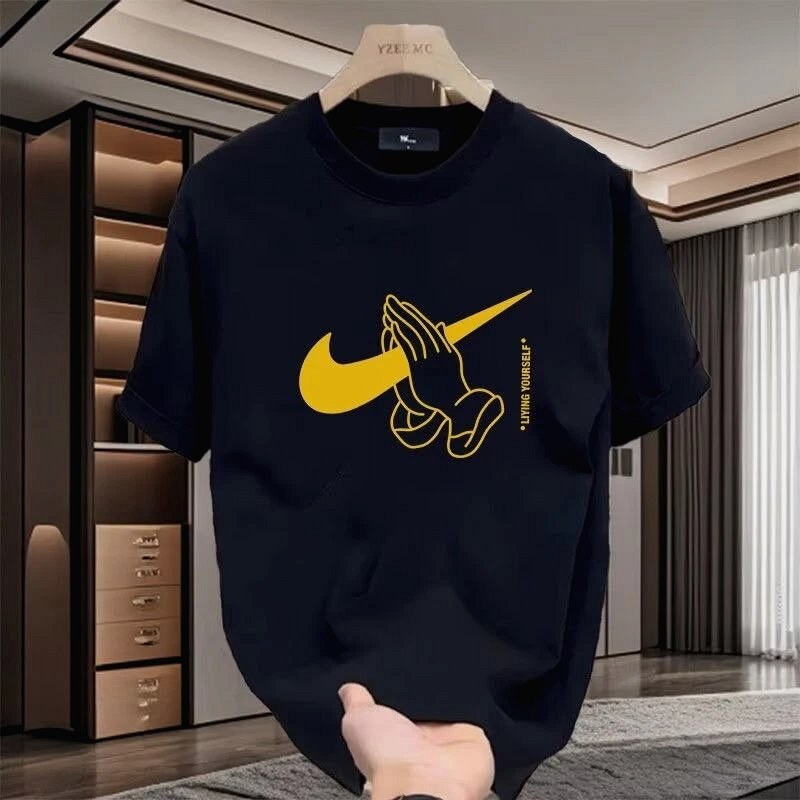
We ordered the Nike black T-shirt in casual streetwear style, SKU 7718719584, through an ordinary retail channel at $4.18 against a listed $4.78, and it arrived in stock. The variant we bought is the black body carrying the large yellow praying-hands swoosh with vertical lettering beside it, the option the seller lists as Blessed Swoosh. Our sample was a size L. The listing runs M–5XL and repeats the print family across roughly thirty white and black options.
This desk covers layered reusable sheets, but a cotton tee is still a piece of fabric, and the same bench questions apply: how much liquid it takes, how fast liquid moves through it, how much weight it gains, and what a wash does to it. So the shirt went through the same routine as everything else on the table.
How we tested the Nike graphic tee
Our testing team poured 25 mL of water onto the fabric held at a 15-degree tilt over five seconds, then timed the point at which liquid stopped passing through, to the nearest second. Retention was logged on a 0.1 g scale, each check repeated three times with the median reported. After the bench work the shirt went into a two-week everyday-use log covering oil splashes, crumbs, wet counters and metal swarf from a workshop bench, with wash checks at five, ten and fifteen days.
Bench results: absorbency, mass and shrinkage
| Check | Method | Result (median of three) |
|---|---|---|
| Pass-through time | 25 mL water, 15-degree tilt | 4 seconds |
| Liquid retained | 0.1 g scale, weighed before and after | 22.4 g of 25 mL, 2.6 g ran off the tilt |
| Dry mass, size L | 0.1 g scale | 196 g |
| Body length after a 40 °C wash | Flat measure, hem to collar | −1.6 cm |
| Chest width after a 40 °C wash | Flat measure, pit to pit | −1.2 cm |
| Print condition after five 30 °C washes | Light box, visual | Intact; slight lift at one printed letter edge |
The knit drank most of what we poured on it rather than letting it sheet away, which is what we expect from a plain cotton jersey and not something the listing claims. We are not converting our 196 g sample into a fabric-weight figure: the listing states a 180–250 gsm band, and a tee of this cut and size sits around the lighter end of that range, but we cannot verify the seller's number independently and do not treat it as measured fact.
Shrinkage was the one result that changed our advice. A first wash at 40 °C pulled 1.6 cm out of the length and 1.2 cm out of the chest. That sits inside the 1–3 cm measurement tolerance the listing allows, so it is not a fault, but it is real and it happens once. Cold washing afterward produced no further movement.
Print, seams and two weeks of wear
The digital print is the strongest part of the product at this price. Five 30 °C washes left the yellow motif and the vertical lettering sharp, with only a faint lift along one printed edge that we could see under the light box and not in normal wear. The neckline held its shape, the hem stayed level, and the shoulder seam showed no strain across a fortnight of use.
In the everyday log the shirt absorbed the same abuse as the rest of our workshop kit: a faint oil mark appeared near the hem on day six and lifted cleanly in the next cold wash. Crumb and dust pickup was normal for black cotton, and the fabric dried on the rack within a few hours.
Buyer commentary about cotton tees of this brand is worth reading with care, because it is category-level rather than specific to this listing. In a streetwear thread one buyer wrote:
Trust me it will shrink, up a size up to be safe … Nike tee's are known to be terrible quality.
We found the shrink warning accurate and the quality verdict far too broad for this sample: at $4.18 we got cotton, a working print and straight seams. Nothing in the claim list reviews this particular listing, so the quality talk stays as talk, not as a test result.
Sizing: a loose cut with a 1–3 cm wildcard
The listing describes a loose pullover silhouette, and our size L measured roomy through the body with a dropped feel at the shoulder. Community sizing guidance for this brand separates standard from loose cuts, and one explainer puts it plainly:
It will tell you if its a "Standard Fit" which means go TTS or "Loose fit for a roomy feel" which means it runs big and you should size 1 down.
That matches our sample: a size L on a 1.8 m frame with a 100 cm chest read clearly oversized. The complication is that this brand uses several different tee cuts, so two shirts wearing the same size label can sit differently on the body. Between our own measurements and the loose cut, we would either size down one step for a clean fit or keep the nominal size for the deliberately baggy look the graphics were designed around.
What the listing leaves unverified
- The seller allows 1–3 cm of measurement error, which is generous enough to change whether a size reads fitted or oversized.
- Fabric weight and fibre content come from the listing, not from a coa or a tested sample beyond our own mass and absorbency figures.
- Shrinkage behaviour is model-specific, and our single 40 °C data point describes our sample rather than every size in the M–5XL range.
- No buyer record covers this specific listing, so there is no independent durability history to check against ours.
Before ordering, ask the seller for flat chest and body-length measurements in the size you want and set them against a tee you already own and like. That single step answers the fit question faster than any size chart, and it is the step we would repeat before buying a second one.
Is this T-shirt true to size?
The listing describes a loose pullover, and our size L measured clearly roomy. Community guidance says loose cuts often suit a step down, but this brand uses several tee cuts, so treat the size label as a starting point.
What is it made of?
The listing states pure cotton, digital printing, standard thickness, a 180–250 gsm weight band, a crew neck and regular short sleeves. Our 196 g size L sample is consistent with the lighter end of that band.
Will the cotton shrink?
Ours did. A 40 °C first wash removed 1.6 cm of length and 1.2 cm of chest, inside the listing's 1–3 cm tolerance, and cold washing produced no further change. Size up if you sit between sizes.