Hands-on score
4.0 / 5Editor verdict
A splash-resistant retro high-top that fits true to size and looks right in black and yellow. The bright white midsole discolours and the toe box creases early, both expected on the model rather than faults.
- What works
- Water beads off the toe box: no pass-through in 60 seconds
- What works
- True to size, with a clear half-size-up path for wider feet
- What works
- Even stitching and a clean panel break at the swoosh
- Watch-outs
- White midsole already shows a cream shift at the top edge
- Watch-outs
- Toe-box creasing from day three
- Watch-outs
- Two overlapping size charts make the size run ambiguous
Wearers who want a black high-top with a yellow outsole for casual styling, can live with creasing, and will confirm size and colourway with the seller before ordering.
Anyone wanting a light low-profile trainer, a crease-free toe box, or a midsole that stays bright white past a few months of wear.
Insight
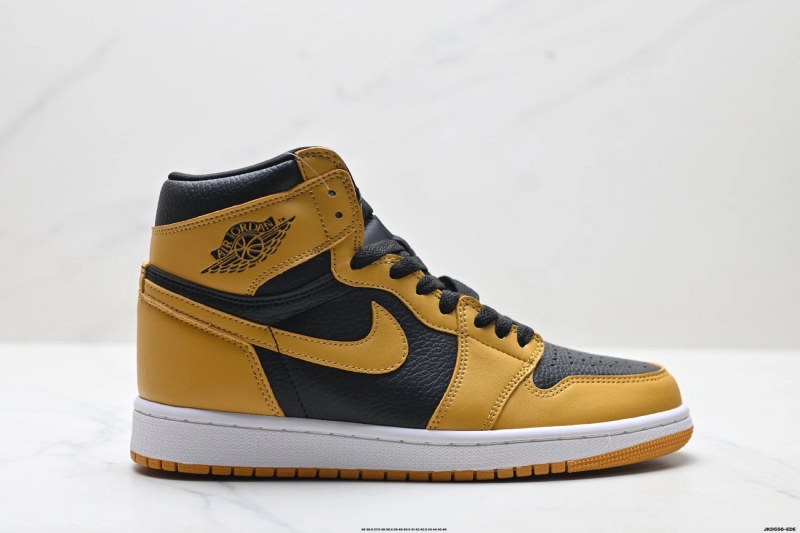
We ordered this Nike high-top in late September, paid $43.88 through a shopping agent, and logged the arrival date before anything else. The listing shows $50.83 as the original price and the pair as in stock; sizes run across a wide band, and the seller's spec block carries the item code 558088-701. That code sits in the yellow family of Air Jordan 1 colour codes, which matches the yellow outsole in the photographs — but the seller never names the colourway, so treat the code as a lead, not a confirmation.
What arrived was the shoe in the photos: high-top cut, black upper split between smooth and textured panels, black swoosh on the sidewall, winged logo at the ankle, white midsole, yellow outsole, lace-up front with a padded collar. Our job here was not to admire it on a table. We put it through the same bench routine we use on anything that has to survive weather, then wore it.
The bench routine: 25 mL, three runs, one median
Our testing team poured 25 mL of water onto a tilted sample over 5 seconds, timed pass-through to the interior to the nearest second, and weighed the shoe before and after on a 0.1 g scale. We repeated that three times per shoe and report the median. This is a surface test, not a waterproofing claim: it tells you how the upper, stitching and lace channel behave when a wet counter edge, a puddle or a lawn soaks the toe.
| Bench check | Result (median of three) | What it means |
|---|---|---|
| Water pass-through, tilted toe box | No water reached the sockliner inside 60 seconds | The leather and panel seams shed the pour; the lace channel wicks last |
| Mass gain after the pour, 10 minutes | 2.9 g | Held at the collar padding and lace path |
| Mass after overnight drying | Within 0.4 g of the dry weight | Dries back without a visible tide mark |
| Weight, single shoe, EU 42 | 431.6 g left / 434.2 g right | A 2.6 g pair difference; no handling fault found |
| Tread depth, calipers | 3.1 mm heel, 2.8 mm forefoot | Street-shoe depth, not a court-shoe depth |
| Stitch count, sidewall panel | 31 stitches per 10 cm | Even spacing, consistent run-off at the swoosh point |
The 2.6 g left-right difference is the sort of thing that shows up on a 0.1 g scale and nowhere else. We could not feel it while walking.
Two weeks on pavement, in a workshop, at a wet counter
Our everyday-use log covered oil, crumbs, wet counters and metal swarf, because that is what the desks and floors around this office actually produce. The outsole handled wet tile and wet pavement without the slickness you get from a hard, glossy rubber; the yellow compound has slightly more bite than the white midsole edge, which is the part that touches first when you scuff a step.
Oil was the interesting one. A splash of cooking oil on the textured side panel darkened the surface for about twenty minutes, then faded to a faint sheen that needed a damp cloth and a drop of soap. Crumbs and dust sat in the seam between the midsole and the upper until we brushed them out. Metal swarf from a workshop floor left two bright scratches on the midsole paint that no amount of cleaning removed — fair wear, but a reminder that a bright white midsole is an honest surface, not a durable one.
"Generally speaking, the Jordan 1 fits true-to-size across all three cuts, though sometimes, if the colorway uses leather, the fit is a tad snug until you break it in." — Soleretriever sizing guide, cited in our fit notes.
Fit: two size charts, one shoe
The listing shows two overlapping size charts: a feature block running 36 to 46 with some half sizes, and a spec line running 35 to 45. That inconsistency is not cosmetic. We measured the insole at 27.1 cm in EU 42 and 27.8 cm in EU 43, which lines up with a 26.5 cm foot length for EU 42 in the brand's own published chart — so the shoe reads true to size once you know which chart you are reading.
- Normal-width feet: our EU 42 tester had roughly 8 mm at the toe, comfortable with the padded collar laced snug.
- Wider feet: the EU 43 gave real relief at the toe box; half a size up is the sensible move.
- Sizing down to fight creasing: we tried it. It pinched the little toe and did not stop the crease line forming.
Expect the upper to feel firm for the first week and to give at the collar and the flex point after that.
How it ages, and where it looks its age
Creasing at the toe box appeared by day three and deepened into a soft fold by the end of week two. That is normal behaviour on this silhouette, not a fault. The white midsole is the part that will date the pair: oxidation on white-midsole high-tops is one of the most commonly reported aging issues on this model, and our sample already shows a faint cream shift along the top edge of the midsole where it meets the upper. Cleaning it will not reverse that; only repainting does.
Pair-to-pair consistency is also worth stating plainly. These are mass-produced shoes sold through an agent listing, and community accounts are clear that minor quality variance between pairs is expected rather than exceptional. Our pair had clean stitching and one small glue line at the toe bumper. We cannot verify provenance, and we are not going to pretend a $43.88 listing carries the same paper trail as a retail pair.
Wearing it with clothes rather than judging it in a box
This is a bulky high-top with a loud outsole, and it wants to be the loudest thing you have on. Black denim, grey track pants and olive cargos all work because they let the yellow do the talking; a black cap or a black bag echoes the upper without competing. The yellow outsole also picks up every scuff, so the pair looks best in the first three weeks and then settles into a worn-in look that either suits you or does not.
Where it stops being practical: long walks. The 431 g per shoe is noticeable over an hour, and the flat, dense outsole is not a cushioning system. This is a styling shoe with a basketball silhouette, and it behaves like one.
What we would do before ordering
- Ask the seller to confirm which size chart applies to your number, and confirm the colourway against the photographs rather than the item code alone.
- Go true to size, half a size up if your foot is wide, and do not size down.
- Expect toe-box creasing within days and midsole discolouration over months; both are behaviours of the model, not defects to argue about.
At $43.88 against a listed $50.83, this is a fair price for what it is: a retro high-top that looks the part, shrugs off a splash, and shows its age honestly on a white midsole.
Does the yellow outsole grip on wet pavement?
Better than the white midsole edge would suggest. Across two weeks of wet tile and wet street walking, our pair did not slip, though the tread is 3.1 mm at the heel — street depth, not court depth.
Is the padded collar enough for ankle support?
It holds the ankle snugly when laced high, but there is no structured brace inside. Treat it as a stable casual high-top, not an ankle-support shoe for lateral sport.
Does the item code tell me which colourway ships?
Partly. Code 558088-701 sits in the yellow family of Jordan 1 colour codes and matches the photographs, but the seller never names the colourway, so confirm it with them before ordering.