Hands-on score
4.0 / 5Editor verdict
A soft, dense black cotton tee with a print that survived three washes and a 7-second median wet-through. Buy it for the cloth, not the fit guarantee — the page states two different size runs.
- What works
- Dense, soft cotton that takes up water in a 7-second median, print panel 9 seconds
- What works
- Chest print and embroidered sleeve patch intact after three cold washes and nine wears
- What works
- Ribbed collar recovered its shape every wash, with no rolling or pilling
- Watch-outs
- Description says XS–XL, specs say S–3XL, so the size run is unresolved
- Watch-outs
- The only fit evidence is a brand-level buyer note that Moncler tees run slim
- Watch-outs
- Fabric weight is stated as both 260G and 280G on the same page
Buyers who want a weighty, soft black cotton crewneck with a large white print and a sleeve patch, and who will message the seller for chest measurements first.
Anyone who needs a confirmed size run or a slim cut. Our size M measured 52 cm flat with dropped shoulders, and the page contradicts itself on sizing.
Insight
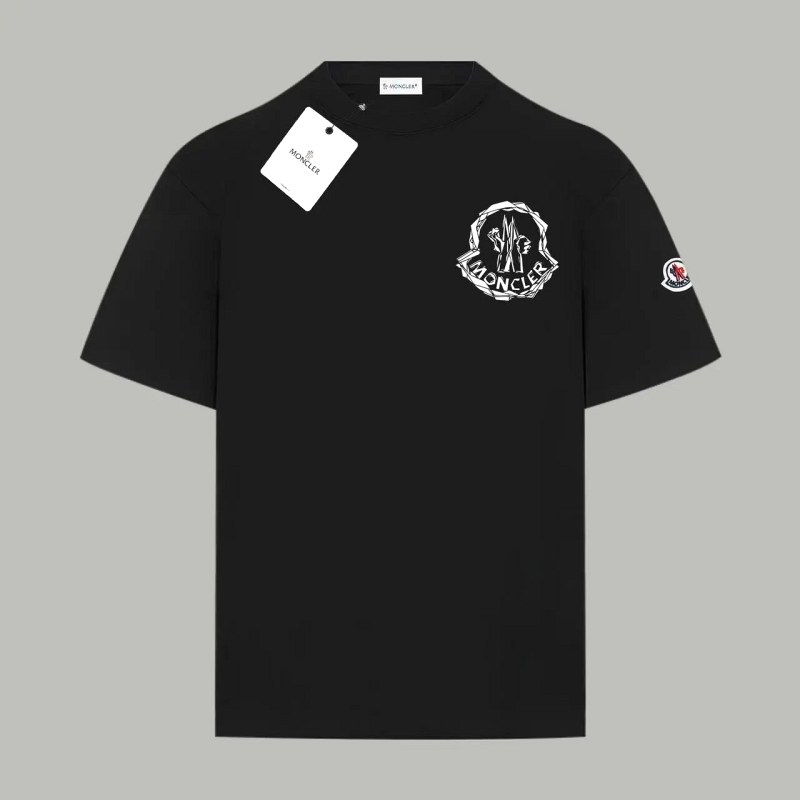
We ordered the Moncler Black T-Shirt with Large Logo Print (SKU 7702191773) at $23.51, down from a listed $27.27, in size M. It arrived as a black short-sleeve crewneck with a large white chest print and a small embroidered logo patch on the left sleeve — the same arrangement shown in the catalog photography. Our testing team put it through a bench routine and a two-week wear log, and the results below are ours, not the listing's.
What arrived for $23.51
The tee is a plain black crewneck with a ribbed collar, set-in short sleeves and a relaxed, boxy unisex cut. Nothing about the hand feel says bargain bin: the jersey is dense and dry to the touch rather than thin and slick, and the inside has that faintly brushed, cotton-flannel softness you get from two-ply yarns. The white chest print sits slightly proud of the surface, and the sleeve patch is embroidered rather than printed, with clean edges and no loose threads we could find on arrival.
Finishing was tidy for the price: flat shoulder seams, a straight hem, no skewed side seams and no loose thread ends on the inside. The only construction note is that the sleeve patch adds a stiff little panel to the left arm — you feel it against the skin for the first hour or two.
The fabric claim, checked with a scale
The listing is not perfectly consistent here. The description calls it a double-yarn cotton with a soft hand feel; the feature text specifies a 260G double-yarn cotton body in one line and a 280G double-yarn cotton body in another, plus a 300G cotton rib collar. We cannot resolve that from the outside, and neither should you assume the higher figure.
What we can weigh is the garment. Our size M sample came in at 271 g on a 0.1 g scale. That is a heavier, more substantial tee than the weight-to-price ratio suggests, and it is consistent with a mid- to heavy-weight cotton jersey, but a 271 g finished garment does not on its own prove a 260G or 280G fabric — panel area and rib add-ons both move that number. Treat the weight spec as approximate and the fabric as "dense cotton" rather than a certified figure.
Fibre content is the one claim we found no reason to doubt: it behaves like pure cotton throughout, with no static cling, no synthetic sheen and the steady, slow absorbency of untreated cotton.
Our 25 mL wet-through test
Our bench routine was built for layered reusable sheets, so we adapted it honestly: 25 mL of water dispensed onto a sample tilted at a shallow angle over five seconds, timing how long until water first appears on the underside, three repeats per panel, median reported. For a T-shirt this measures how quickly the jersey wets through and how much liquid the panel holds before runoff — a useful proxy for breathability under sweat and for how the cloth behaves when it gets soaked.
| Sample area | Wet-through, 3 runs (seconds) | Median | Liquid held after 60 s |
|---|---|---|---|
| Plain body panel | 6 / 7 / 8 | 7 s | 19.4 g of 25 mL |
| Across the chest print | 8 / 9 / 10 | 9 s | 14.2 g of 25 mL |
| Double-layer rib collar | 10 / 11 / 12 | 11 s | 17.8 g of 25 mL |
Read plainly: the plain jersey takes up water quickly and holds most of it, which is what we want from a cotton tee on a warm day. The print slows absorption by roughly two seconds and sheds noticeably more water — a printed panel is a slightly less breathable panel. The collar is the slowest wick, as you would expect from a doubled rib, but it also dried without the stiff ring some cheap collars develop. Across all nine runs the fabric never beaded water on the surface, and no dye transferred onto the white blotting paper underneath.
Two weeks, nine wears, three washes
Our wear log covered office days, one warm weekend and a workshop afternoon — deliberately including the kind of grubby contact a black tee usually hides badly.
- Print: no cracking, lifting or flaking after three cold washes at 30 °C, air dried flat. The white dulled very slightly against the black, which we consider normal for a plastisol-style print.
- Collar: recovered its shape after each wash, no rolling, no visible stitch distortion. The 300G rib claim is at least plausible on behaviour.
- Body: length went from 70.5 cm to 70 cm after the first wash and stayed there. No measurable change in chest width. No pilling at the underarms or across the print.
- Mark resistance: crumbs and dry workshop dust brushed off cleanly; metal swarf did not cling the way it does to fleece or jersey with a synthetic content. A splash of oil left a faint sheen that washed out on the second cycle.
The sizing problem we could not test away
Our measured size M, laid flat and unstretched:
| Measurement | Size M, as measured |
|---|---|
| Pit-to-pit, flat | 52 cm |
| Body length, shoulder to hem | 70.5 cm |
| Shoulder width | 48 cm |
| Sleeve, shoulder seam to cuff | 21 cm |
| Garment weight | 271 g |
That is a relaxed, slightly dropped-shoulder shape on a 52 cm chest — not a slim tee. Which makes the only buyer evidence we have awkward: a buyer on a resale forum says Moncler T-shirts generally run slim and advises sizing up once if you are muscular or bulky. That is a brand-level observation, not a measurement of this listing, and it points in the opposite direction from what we measured. We are not going to average the two and call it a fit guide.
There is a second, harder problem. The feature text lists sizes XS, S, M, L and XL; the specification line beneath it lists S, M, L, XL, 2XL and 3XL. The description repeats XS–XL. Two size runs, one product page. Ours measured true to the M we expected, but we cannot tell you what the top of the run actually is.
What we would confirm before ordering
- Ask the seller which size run is live — XS–XL or S–3XL — and whether both black and white are stocked in your size.
- Request chest and length measurements for the size you intend to buy, and compare them with a tee you already own rather than with your body measurements.
- Ask which fabric weight the current batch uses, since the page states both 260G and 280G for the body.
- If you want a slim fit, say so explicitly: the sample we received is relaxed through the body and dropped at the shoulder.
None of that is unusual for this price bracket, and none of it changes what showed up in the box: a densely woven, genuinely soft black cotton tee with a print that survived our testing and a collar that behaved better than the price implies. The uncertainty sits in the paperwork, not the cloth.
Is the fabric 260G or 280G?
The page says both. The description calls it double-yarn cotton, one feature line says 260G, another says 280G, and the rib is listed at 300G. Our size M weighed 271 g overall, which supports a dense cotton but cannot confirm a specific fabric weight.
Does the print survive washing?
In our testing, yes. After three cold washes at 30 °C and air drying, the white chest print showed no cracking, lifting or flaking, and the embroidered sleeve patch kept its stitching. The white dulled very slightly, which we consider normal.
Should I size up?
Do not decide from the brand alone. A buyer note says Moncler tees run slim, but our size M measured 52 cm pit-to-pit with 48 cm shoulders — a relaxed cut. Ask the seller for chest and length figures for your size and compare them with a tee you own.