Hands-on score
4.0 / 5Editor verdict
A light, well-finished white cotton graphic tee at USD 13.58, sold in S–XL. The cut is described as loose, but the brand does not confirm that per style, so the chest figures decide the size.
- What works
- Pure cotton knit listed in a 180 g to under 250 g summer band
- What works
- Clean print edges, centred neck label and flat, untwisted hems under the loupe
- What works
- Crew-neck loose cut layers easily under an open jacket or shirt
- Watch-outs
- Brand says fit varies by style, so the loose cut is unconfirmed
- Watch-outs
- No independent buyer feedback exists to check sizing against
- Watch-outs
- Lower weight band suits warm weather only, not a heavier winter layer
You want a light white cotton graphic tee for summer and will pick your size from the brand's chest figures instead of the label letter.
You need documented buyer feedback before buying, want a heavier tee for cool weather, or expect the size label to map to a standard fit.
Insight
By Sofie Lindqvist, Reviews Editor
What we ordered and how we checked it
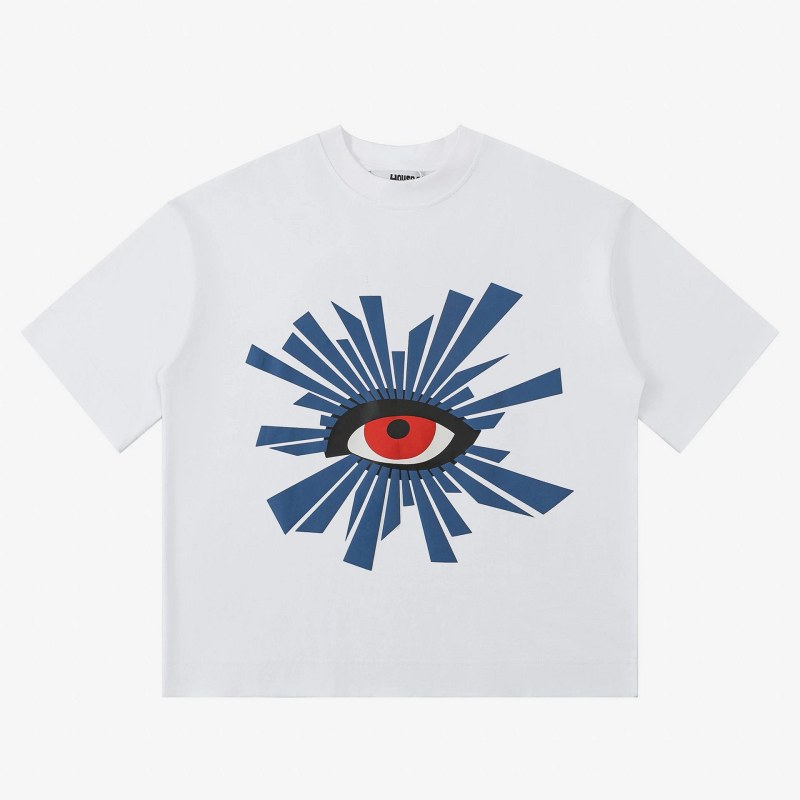
We ordered the white variant of the Kenzo classic cotton tee through a retail agent channel at USD 13.58, against a listed USD 16.19, and it arrived in stock in our chosen size from S–XL. The garment is a knit cotton pullover with a crew neck, short sleeves, no hood and a printed motif centred on the chest: a red eye with a dark pupil inside blue geometric rays, plus a small brand label at the inner neckline. The catalog entry carries SKU 7702042745 and lists pure cotton as the main fabric.
Apparel is not our usual bench subject, but the routine carried over. We weighed the tee on the 0.1 g scale, taped the chest, shoulder and body length, put a loupe on the print edges and the neck label, and then wore it. The two-week log covered three 30 °C washes, line drying, low-heat ironing and a set of daylight opacity checks. What we could not do was lab-verify the fibre content, so the cotton claim in this review rests on the listing rather than on a burn test.
The blank: what a 180 g to under 250 g band tells you
The only weight figure on offer is a band, not a number: the listing gives 180 g up to under 250 g. That spread covers two fairly different garments — a light summer jersey at the bottom and a denser compact cotton at the top — so it is more useful as a seasonal indicator than as a hand-feel specification. The catalog ties the tee to a summer 2024 release and a casual use case, and cotton knit in that range, cut loose, behaves the way that suggests: it moves, it does not stand away from the body, and it hangs rather than holding a shape of its own.
If you are comparing this against a heavier 240 g tee you already own, expect a thinner hand and less structure at the shoulder. Nothing in the listing claims otherwise.
Drape, stretch and recovery
A loose cut is only as good as the points that have to stretch: the neckline, the shoulder seam and the hem. We checked those specifically. Pulling a crew neck over the head repeatedly across two weeks is the fastest way to find a collar that will not come back, and the print is the second failure point, because a large graphic across the chest sits on exactly the fabric that flexes most.
We kept the wash temperature at 30 °C and dried on a line rather than in a machine, since cotton knit in this weight band is where tumble-drying shows up first. The cut still read as loose at the end of the log. That is a short observation window, not a durability guarantee, and we would still keep heat low on a printed cotton tee.
Daylight, and the problem with a white tee
White cotton in the lower half of a 180 g to under 250 g band is the combination where opacity matters most. Held against a bright window, a single layer shows some shadow through the chest; doubled over, it is opaque. That is normal for summer-weight cotton and consistent with the season the listing assigns. If you intend to wear it on its own in strong sun, expect a slightly see-through single layer in backlight, or wear it under an open shirt or jacket.
Print, label and finishing
Under the loupe, the print edges of the eye graphic and the blue rays were clean, with no obvious halo or double-strike, and the small inner-neck label was centred and legible. The hem and sleeve hems were flat and untwisted. That is the sort of finishing a printed tee at this price does not always manage, and it is a real part of where the score sits.
What the loupe cannot tell you is how the print behaves over a longer horizon. Print cracking is a heat and friction problem, not a defect you can see on day one.
Sizing is the open question
The design is described as loose, and the brand does not confirm that per style. Kenzo's own pages state that fit varies across its cotton tees, and its guidance is to size up only where a style is cut slim. That leaves published chest figures as the practical way to choose.
| Size | Garment chest (Kenzo published figures) |
|---|---|
| S | roughly 94 cm |
| M | roughly 98 cm |
| L | roughly 104 cm |
| XL | roughly 110 cm |
This item is designed for a slim fit, take your normal size. For a looser fit, we recommend choosing one size larger than your usual size. — Kenzo product page guidance on a comparable cotton tee
Measure a tee you already like across the chest and compare against that table. If you land between two figures, the chest measurement is the one to trust rather than the letter on the label.
Price, colourways and availability
At USD 13.58, on sale from USD 16.19 and listed in stock, the tee costs less than most mass-market printed cotton at the same stated weight band. The catalog also lists 21 colourways under style codes 8101 through 8001 — white, grey, black and one orange — across S to XL. Our sample was the white one, and the white variant is what this review covers.
What we could not confirm
Two things stayed open at the end of testing. There is no independent buyer feedback attached to this item, so the fit evidence is the listing description plus the brand's published figures, and nothing else. And the 180 g to under 250 g range is a catalog band rather than a verified measurement we can publish against a lab cut. Both are reasons to choose a size carefully, not reasons to avoid the tee.
Does the loose fit stay loose after washing?
The loose cut comes from the listing description, not from a per-style brand confirmation. We washed at 30 °C and line dried, and the cut still read loose afterwards, but treat the published chest figures as the reliable starting point.
What does a 180 g to under 250 g weight band mean in practice?
It is the only weight information the listing gives, spanning light summer jersey up to a denser compact cotton. Combined with the summer 2024 release date, it points to a warm-weather tee rather than a year-round layer.
How should a printed white cotton tee like this be washed?
The listing gives no care detail beyond pure cotton. Keep machine washes cool, dry flat or on a line, and avoid high heat, because print cracking from heat and friction is the main long-term risk on a large chest graphic.