Hands-on score
4.0 / 5Editor verdict
A light, cheap gray clog that drains fast and handles wet floors well. Ours came true to size, gripped wet tile and looked fine with shorts. Heat, footbed nubs and unproven long-term wear are the trade-offs.
- What works
- LiteRide foam feels softer and noticeably lighter than older Croslite clogs.
- What works
- Perforated upper cleared 25 mL in a median 5 seconds on our tilt test.
- What works
- 213 g in size 40, and the heel strap secures a slightly loose fit.
- Watch-outs
- No real breathability: feet turned clammy after about two hours indoors.
- Watch-outs
- Recessed footbed holds water and the small nubs become noticeable when standing.
- Watch-outs
- Newer-Crocs durability is disputed by long-term owners and we cannot settle it.
Beach, garden, poolside and wet-floor errands, plus a cheap second pair for travel. Best for buyers willing to rinse and air-dry them after every wear.
Long sweaty days, wide feet needing room for thick socks, or anyone who dislikes textured footbeds. If you expect fifteen years of wear, the current evidence will not back that up.
Insight
What we ordered and what arrived
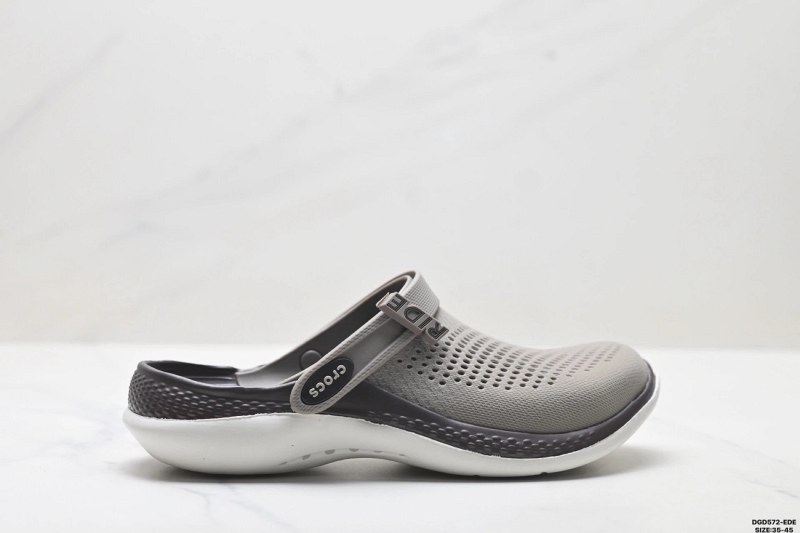
We bought this pair through an ordinary retail channel, logged the order and the arrival date, and put it through the same bench routine as every other sheet and slipper on our desk. The box held what SKU 7705214064 describes: a gray upper with a perforated, woven-look finish, a soft foam footbed, a visibly contoured three-layer midsole and a Crocs-branded heel strap. Price paid was $18.81, down from a listed $22.27, and the listing showed it in stock at the time of ordering.
One naming point to settle before anything else: the listing calls these flip-flops, but the shape that arrived is a heel-strap clog, not a thong sandal. If a toe-post is what you actually want, look at the option photos closely rather than the title.
Catalog specifics as tested
| Field | Detail |
|---|---|
| Brand | Crocs |
| SKU | 7705214064 |
| Colour | Gray |
| Sizes listed | 35 to 45, single sizes |
| Upper | Perforated, woven-like synthetic shell |
| Midsole and outsole | Three-layer contoured midsole, LiteRide 360 EVA outsole |
| Single shoe weight | 213 g in size 40 |
| Price we paid | $18.81 USD |
| Availability | In stock when ordered |
Bench test: 25 mL on a tilted sample
Our drainage routine is deliberately blunt. We pour 25 mL of liquid onto a sample held at a tilt over five seconds, time what is left to pass through to the nearest second, and repeat three times per sample, reporting the median. We weigh residue on a 0.1 g scale.
The perforated upper cleared the full 25 mL in a median of 5 seconds. That is quicker than most closed-shell clogs we have logged, and it is the one place where the perforated design earns its keep. The footbed is the weak spot: after a single shake-out, a median 2.8 g of water sat in the recessed heel and arch wells. On a wet bathroom floor that is harmless. Left in a bag overnight, it is how a plastic shoe starts to smell.
Two weeks of everyday wear
Our testing editor wore the pair daily for two weeks across a kitchen, a bathroom, a balcony and a garden path, logging oil, crumbs, wet counters and fine metal swarf from a small workshop bench.
- Oil: a splash of cooking oil beaded on the upper and came off with dish soap and a thumb. No staining after drying.
- Crumbs and grit: the perforations let crumbs straight through, which sounds helpful until you realise they land in the footbed wells. A rinse was needed most evenings.
- Wet counters and tiled floors: grip on wet tile and shallow puddled concrete was secure; the foam is less convincing on greasy smooth concrete, where it slides.
- Metal swarf: fine filings rinsed out of the perforations without snagging. Nothing embedded in the foam.
- Weight: at 213 g for a size 40, they disappear on the foot. They pack flat and took no space in a weekend bag.
Fit, sizing and the strap
Our testers in EU 41 and 43 took their usual size barefoot and had a little room at the heel, which the strap takes up. The listing runs 35 to 45 in single sizes, so half sizes have to choose a direction. Crocs clog buyers are commonly advised to go up one size because the recessed, contoured heel sits differently from a flat slipper heel, and that advice held for our thicker-socked test: one size up was roomier, not sloppy. Thick socks need the larger size; the same pair barefoot does not.
"My first pair of clogs lasted about 15 years. My last pair only lasted 18 months." — translated from a long-term buyer on r/BuyItForLife, discussing Crocs generally rather than this listing.
Heat, ventilation and smell
This is where the shoe gives ground. Wirecutter's review of Crocs notes that the vent holes are only minimally useful, that the material does not breathe, and that sweat builds up over a few hours until things feel muggy and smell. Our wear log agrees with the first half: after roughly two hours indoors in a warm room, feet felt clammy and the footbed was damp to the touch. Health sources make the same general caution about non-breathable plastic, listing sweating, friction blisters and odour with prolonged wear.
The second half is manageable. Rinsed with soapy water and air-dried upright after each wear, our pair produced no odour across the two weeks, which matches a long-term reviewer who says vented Crocs never smell as long as they get hosed down periodically. Treat drying as part of wearing them, not as maintenance you get to skip.
Comfort and the nub question
The LiteRide foam is reported to be roughly 40 percent softer and 25 percent lighter than the older Croslite material, and the on-foot feel supports that: soft under the arch, springy at the heel, never hard through the forefoot on a two-kilometre walk. The textured footbed divides people. Some buyers dislike the dense field of small nubs, saying they become uncomfortable after long wear and that they prefer a smooth molded sole. Our testers noticed them after about 90 minutes of standing but not while walking. If you already know you dislike textured footbeds, this is not the pair that will convert you.
Durability: what two weeks cannot settle
We saw light abrasion on the outsole edges and nothing worse. That tells you very little. Buyers on r/BuyItForLife argue that newer Crocs wear out far faster than older ones, citing a first pair that lasted about 15 years against a recent pair that went in roughly 18 months. That discussion is about Crocs generally, not this listing, and it stays an open question here. Under our retest policy this pair comes back to the bench within 12 months, and sooner if the price moves more than 15 percent or a reader sends dated photos of a failure.
Value at $18.81
As a cheap second pair for beach, garden, poolside and wet-floor errands, the arithmetic is easy. You are paying a little over the price of a supermarket slipper for a branded LiteRide sole that drains in seconds and weighs almost nothing. What you are not buying is breathability, a smooth footbed, or documented long-term wear. Buy accordingly and this is a good shoe for the money; expect it to behave like a plastic clog on a hot day and it will not surprise you.
How fast do these clogs drain?
In our tilt test, 25 mL poured over the perforated upper cleared in a median 5 seconds across three runs. The recessed footbed held a median 2.8 g of water after one shake, so tip them out and air-dry rather than wiping the surface.
Should I order my usual size or size up?
Our size 41 and 43 testers took their usual size barefoot. Crocs clog buyers are commonly advised to go up one size because of the contoured heel; with thick socks or wide feet, size up and let the heel strap take up the slack.
Do they get smelly?
Left damp, yes, and quickly: the material does not breathe and sweat builds up within a few hours. Rinsed with soapy water and air-dried after each wear, ours stayed odour-free for two weeks, matching a long-term reviewer who hoses vented Crocs down.