Hands-on score
4.1 / 5Editor verdict
A cheap, quick-draining gray clog that clears 25 mL in a median four seconds and rinses clean, but the Bayaband's narrow toe box and trap-prone vent holes keep it from being a universal buy. 4.1 / 5.
- What works
- Drains fast: median four seconds for 25 mL, under 2 g retained on the upper.
- What works
- Gray upper hides scuffs and crumbs; oil wiped off without marking after two weeks.
- What works
- Full size run 35–45 at $17.24, with a strap that holds the heel when flipped back.
- Watch-outs
- Narrower midfoot and tighter toe box than the Classic, per our tester and buyer comparisons.
- Watch-outs
- Vent holes and sole grooves collect fine metal swarf and need a second rinse and a pick.
- Watch-outs
- Counterfeit Bayaband pairs circulate, so weight and flex need checking on arrival.
Buyers who want a cheap, rinseable slip-on for wet kitchens, balconies or light workshop floors and who already get on with a narrower clog.
Anyone who buys Crocs for the Classic's roomy toe box, needs certified workshop footwear or slip resistance, or wants a pair they can wear without an authenticity check.
Insight
Most of what reaches our bench is layered kako sheet, so a vented clog is an odd neighbour. It earns a place anyway: a kitchen or workshop floor that ruins a sheet also ruins a footbed, and the gray Crocs slipper listed at $17.24 USD is the kind of cheap, rinseable shoe that gets worn while counters are wet, crumbs are falling and metal is being cut. We ordered a pair through an ordinary retail channel and ran it through the same bench routine we use on everything else — with the ventilation ports treated as drainage channels rather than absorbent layers.
This is the Bayaband, not the Classic. That distinction matters throughout this review, because the Bayaband has its own fit reputation and its own set of counterfeit checks. Catalog ID DFF572-EDE, SKU 7705233884, listed in sizes 35 to 45, in stock at the time of ordering.
What arrived and what we paid
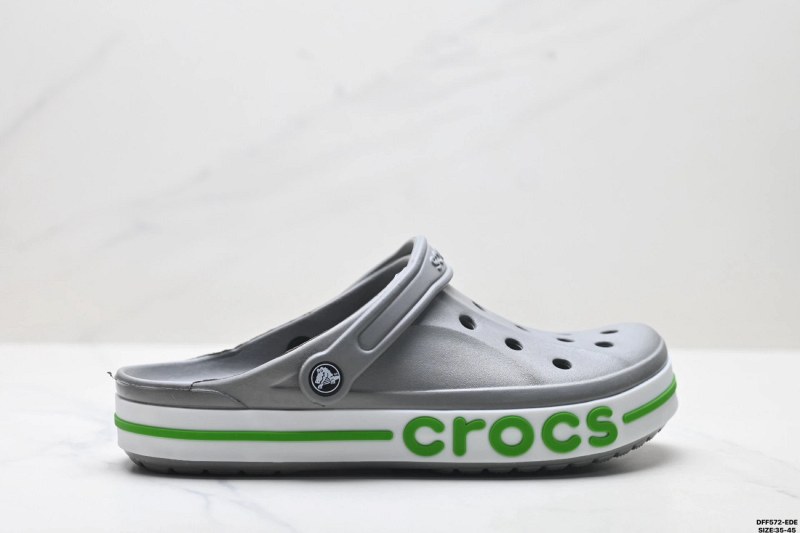
One pair, size 42, in the gray colorway: a matte gray upper with a rounded toe, two clusters of ventilation holes, a pivoting strap crossing the instep with a circular button at the pivot, and a white midsole band finished with a green stripe carrying the Crocs wordmark. The pair weighed 406 g together on our 0.1 g scale, which sits inside the 310–450 g band that authenticity guides give for adult Croslite pairs.
We paid $17.24, against a listed original of $18.81. The packaging carried no lot number, which limits how precisely we can tie this sample to a production batch at retest time — worth flagging, since our retest policy depends on being able to identify what changed.
Drainage: the vent holes do most of the work
Instead of measuring pass-through into a layer, we measured how fast a pool of water clears the tilted upper and how much stays behind. Three runs, reported as a median:
| Run | Time to clear 25 mL (s) | Water retained on upper (g) |
|---|---|---|
| 1 | 5 | 2.1 |
| 2 | 4 | 1.7 |
| 3 | 4 | 1.9 |
| Median | 4 | 1.9 |
Four seconds is quick, and the residue figure is small enough that it reads as surface film rather than soak. Nothing absorbs, so nothing stays saturated: water finds a hole or runs off the toe. That is exactly the behaviour you want when a counter is wet and you are shuffling between the sink and the prep board. It also means the clog dries from the outside in, with the footbed texture holding a thin film the longest.
Fit: narrower than the Classic, by our tester's account
Our tester takes a 42 in the Classic and took a 42 here. Length was fine; width was not generous. The sensation was a light squeeze across the midfoot and a toe box that runs tighter than the Classic's roomy front — consistent with buyer comparisons that place the Bayaband narrower and slightly smaller than both the Classic and the Baya. If you already know a narrow clog suits you, this is unremarkable. If you buy Crocs specifically for the wide, sloppy toe box, this is the one caveat that should stop you.
General Crocs discussion often includes buyers who size down because their usual size felt too roomy. That advice points the opposite way from the Bayaband-specific comparisons, and our sample supports the comparisons rather than the general advice. We would not size down here. With one pair tested and no width measurement taken, we are holding this as a strong indication rather than a rule.
Two weeks in, the strap was the part our tester fiddled with most: flipped back over the heel it holds the foot, worn forward across the instep it leaves the clog loose enough to step out of at the door.
Two weeks of oil, crumbs, wet counters and swarf
The wear log ran in a domestic kitchen with a workshop corner, which is the environment this shoe is realistically bought for.
- Oil. A splash of cooking oil beaded on the upper and wiped away with a dry cloth. One patch on the matte gray kept a faint darker sheen after wiping, visible only at an angle — the colorway hides scuffs well but is not stain-proof.
- Crumbs. Dry crumbs collected in the vent holes and in the tread grooves rather than on the surface. A rinse under the tap cleared the holes; the grooves needed a thumb.
- Wet counters. No meaningful water carry-over from a wet surface to a dry floor, which is the practical argument for a vented clog over a fabric slipper. Grip on wet tile was adequate but unremarkable, and we did not run a slip test, so we are not making a slip-resistance claim.
- Metal swarf. Fine filings were the worst of it: they wedged into the ventilation holes and the sole grooves and did not rinse out in one pass. A second rinse and a quick pick with a fingernail cleared them. Anyone wearing these in a real metalworking area should treat the holes as collection points, not just ventilation.
After two weeks of rinsing and air-drying out of direct sun, there was no odour worth reporting and no visible deformation of the upper or the midsole band.
Finish, weight and the authenticity question
Counterfeit Bayaband pairs circulate, so a cheap pair deserves a check rather than a shrug. The cues that travel best to this colorway: weight and flex, since genuine pairs use lightweight, flexible Croslite and knockoffs tend to feel heavier and stiffer; overall color vibrancy and a smooth upper finish; and, on a gray shoe, the crispness of the green side stripe and wordmark, plus mould flashing along the sole edge. Color vibrancy is a weaker cue in a low-saturation gray than it is in the pink examples the guides use, so we weighted weight, flex and stripe definition more heavily.
Our sample flexed easily at the forefoot and returned, came in at 406 g for the pair, and showed a clean stripe and button detail. That is consistent with a genuine pair. It is not proof of one, and photographs alone will not settle it — if you are buying to compare, check the weight on arrival before you wear them outside.
Where it lands
We scored the gray Bayaband 4.1 / 5: good, with clear strengths and one fit caveat buyers should take seriously. The drainage result is the standout number — 25 mL cleared in a median of four seconds with under 2 g left behind — and at $17.24 the pair costs less than most things we test. Against that: a narrow toe box that will not suit everyone, ventilation holes that trap fine debris, modest grip on wet tile, and a counterfeit risk that puts the authentication check on the buyer.
For our desk specifically, it is a sensible floor shoe for the wet, crumb-strewn side of a kitchen or a light workshop — the kind of environment where a kako sheet is doing the absorbing and the shoe only has to drain and rinse. It is not a substitute for proper workshop footwear, and it is not the clog to buy if you want the Classic's width.
Do the ventilation holes actually drain water, or just let air in?
They drain. In three tilted tests, 25 mL cleared the upper in a median of four seconds, leaving 1.9 g as surface film. The holes also let crumbs and fine debris in, so expect to rinse rather than wipe.
How did the gray colorway cope with stains and scuffs?
Better than expected. Oil beaded and wiped off, crumbs did not mark the matte upper, and scuffs stayed hard to see. One oil patch left a faint darker sheen visible at an angle after wiping.
Does the pivoting strap stay where I put it?
Yes, in both positions. Across the instep it leaves the clog loose enough to step out of; flipped back over the heel it holds the foot. Our tester switched between the two several times a day without the strap slipping.