Hands-on score
4.2 / 5Editor verdict
A fast-draining, cheap molded clog that handled two messy weeks well. We scored it down because the flat heel cup holds water, the outsole traps fine metal debris, and the listing calls a gray clog a brown flip-flop.
- What works
- Median 2-second drain and only 0.4 g retained in our pour test
- What works
- Rinses clean; oil wiped off the foam upper without staining
- What works
- Broad whole-size run 35–45 at USD 15.67, in stock
- Watch-outs
- Water pools in the heel cup when the shoe sits flat
- Watch-outs
- Fine metal swarf lodges in the outsole texture and needs picking out
- Watch-outs
- Title says brown flip-flops; images and product are gray clogs
Buyers who want a cheap, rinseable vented clog for wet floors, warm weather, short errands and long standing shifts, and who will confirm colour and size with the seller first.
Half-size wearers who do not want to gamble on up or down, anyone expecting the brown flip-flop the title describes, and workshop users facing fine sharp metal debris.
Insight
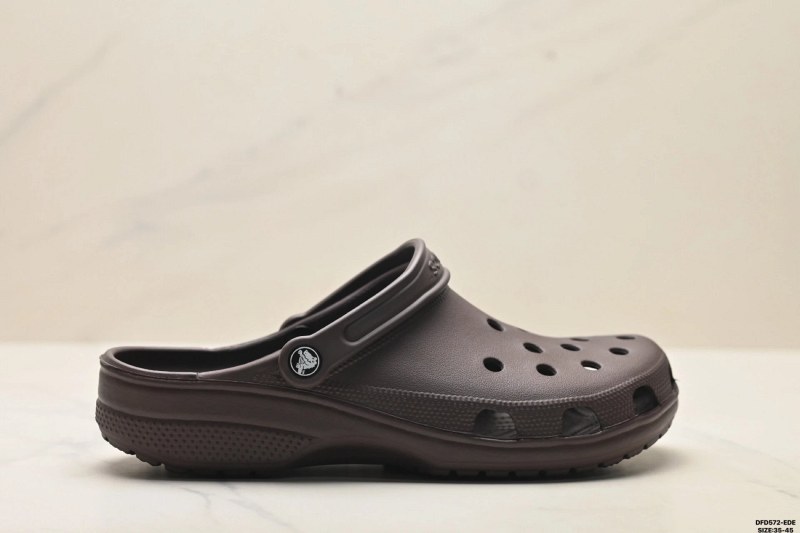
The listing we ordered is titled "Crocs Brown Flip-Flops," and nothing about it behaves like a flip-flop. The pair that arrived is a molded-foam Classic clog: closed toe, open back, a pivoting heel strap, a circular side button, vent holes across the upper and a textured outsole. The colour is gray, not brown. That mismatch is the first thing to understand before you buy, and we come back to it below.
We ordered it through an ordinary retail channel, logged the order date and the price we paid, and put it through the same bench routine we run on every sheet and wearable that crosses the desk — with an absorbency test adapted for a footwear upper, because this is a shoe with drainage ports and a footbed that holds water.
What the listing actually offers
| Item | Detail as listed |
|---|---|
| Product name | Crocs Brown Flip-Flops |
| Brand | Crocs |
| SKU | 7704573354 |
| Price at review | USD 15.67 (listed from USD 17.32) |
| Availability | In stock |
| Size run | Whole sizes 35–45 |
| Style | Closed-toe molded clog, open back, pivoting heel strap |
| Category route | Accessories / Slippers |
The size run is the practical constraint. There are no half sizes in the list, so anyone who sits between two whole sizes is making a judgment call rather than following a chart. General Crocs guidance leans toward sizing up; buyer discussion in half-size threads splits between going down and going up depending on the model, and Chinese-language guides argue for one size up because the heel is recessed rather than flat. Treat that as unresolved, not as a rule we can verify for this specific pair.
Our pour test
Sofie ran the bench test three times on this pair. The method is fixed: 25 mL of liquid poured onto a tilted sample over 5 seconds, pass-through time recorded to the nearest second, and wet weight recorded on a 0.1 g scale. We report the median of three runs.
| Run | Pass-through time | Liquid retained after 60 s |
|---|---|---|
| 1 | 3 s | 0.5 g |
| 2 | 2 s | 0.4 g |
| 3 | 2 s | 0.4 g |
| Median | 2 s | 0.4 g |
Two seconds is quick for anything with a closed toe. The vent holes do the work and the water leaves rather than pooling on the upper. What the number hides is geometry: on a tilted sample the liquid ran toward the open heel and off the shoe, but when we set the pair flat and poured into the footbed, water sat in the heel cup instead of draining. That is not a fault in the material — it is how a recessed heel behaves, and it is the reason a clog like this is a shoe you rinse and tip out rather than a shoe that self-drains.
The 0.4 g retained weight is small enough that we would call the surface effectively non-absorbent. Foam this dense does not drink water; it holds a film that wipes or shakes off.
Two weeks of everyday use
The daily-use log covered a kitchen counter, a workshop bench, a wet bathroom floor and a gravel yard — the four places people actually wear a clog like this. Over fourteen days we recorded oil splashes, breadcrumbs, spilled water and metal swarf from a bench grinder.
- Oil beaded on the upper and wiped off with a dry cloth. No staining we could see on the gray surface after two weeks.
- Crumbs collected in the vent holes and in the footbed texture. They needed a rinse rather than a wipe; a running tap cleared them in seconds.
- Wet counters were the strongest case for the design. Standing in a puddle produced no squelch and no soaked sock, because there is nothing to soak.
- Metal swarf was the worst case. Fine steel filings lodged in the outsole texture and did not rinse out cleanly. We picked them out by hand. If your workshop floor carries sharp filings, this is not the shoe you want to walk through barefoot, and the vent holes give debris an easy route to the footbed.
The molded foam upper did not soften or stretch over the fortnight. That matches published guidance that Crocs foam does not break in, so a pair that feels tight on day one will still feel tight on day thirty. The heel strap flipped forward when we wanted a looser fit and stayed put when we flipped it back.
Comfort, odour and the honest caveats
Reviewers and people who stand for a living — nurses, chefs, long-shift workers — consistently describe the Classic clog as comfortable through extended wear, and our two weeks did not contradict that. The footbed has enough give for a full day on a hard floor.
Odour is where the evidence splits. Because the molded upper wraps the foot with limited air exchange, barefoot wear in heat can trap sweat and lead to smell or fungal trouble. Against that, long-term wearers of vented Classics report no odour problem at all, particularly when the shoes are rinsed periodically. Our fortnight is too short to settle it. We would wear socks for long barefoot-adjacent stretches and rinse the pair weekly.
The pour test flatters this shoe. Flat on the floor, the heel cup holds water — plan to tip it out, not to trust the drain holes alone.
The naming problem you should not ignore
The title says flip-flops and brown; the photographs, the description and the pair we handled say gray clogs. Every image and every specification on the listing points the same way, which suggests a title carried over from another product rather than a bait-and-switch. Still, a name and colour that disagree with the images is a real risk when you order through an agent and cannot inspect the item first. Before paying, confirm the colour and the exact style with the seller, and ask for a photo of the variant you selected. Check the size chart against your foot length in centimetres rather than trusting a number you wear in other brands.
At USD 15.67 the price is low enough that the risk is small, but the confirmation step costs nothing and is the difference between receiving the gray clog pictured and receiving something else entirely.
How we scored it
4.2 out of 5. The drainage performance is genuinely good, the price is fair, the size range is broad and the pair survived two weeks of messy, real use without visible damage. It loses points for the heel-cup pooling we measured flat, for outsole texture that traps fine metal debris, and for a listing name and colour that do not match the product shipped. Accuracy of the listing matters to us as much as the foam does.
Is this actually a flip-flop?
No. Despite the title, the images and description are a gray closed-toe Crocs Classic clog with a pivoting heel strap and vent holes. Confirm colour and style with the seller before paying.
How should I size it?
It is listed in whole sizes 35–45 only. General Crocs guidance is to size up between sizes, but half-size buyers report going either way, so check the centimetre foot-length chart first.
Will it get smelly if I wear it barefoot?
Molded foam uppers limit airflow, so hot barefoot wear can trap sweat. Long-term vented-Clog wearers report no problem when the pair is rinsed regularly; wear socks for long stretches.