Hands-on score
4.0 / 5Editor verdict
A cheap, genuinely water-shedding moulded clog that drains in a median 3 seconds and wipes clean of oil, but the soft tread grips metal swarf and there are no half sizes.
- What works
- Drains fast: median 3 s pass-through, 1.9 g retained in the footbed dimples.
- What works
- Oil and crumbs wipe or rinse off the one-piece upper with no staining.
- What works
- Simple pivoting heel strap converts it to a slide for quick slip-on use.
- Watch-outs
- Fine metal swarf embeds in the soft tread and needs a magnet, not a brush.
- Watch-outs
- Slides on detergent-wet tile, and the strap shifts off the heel.
- Watch-outs
- No half sizes and conflicting buyer fit reports make measuring essential.
Buyers who will measure their foot length against the EU-to-US chart and want a $17.24 rinse-clean slip-on for kitchens, garages, camping and garden work.
Anyone who wants a predictable fit without measuring, needs grip on greasy or detergent-wet floors, or walks through metal filings and glass grit.
Insight
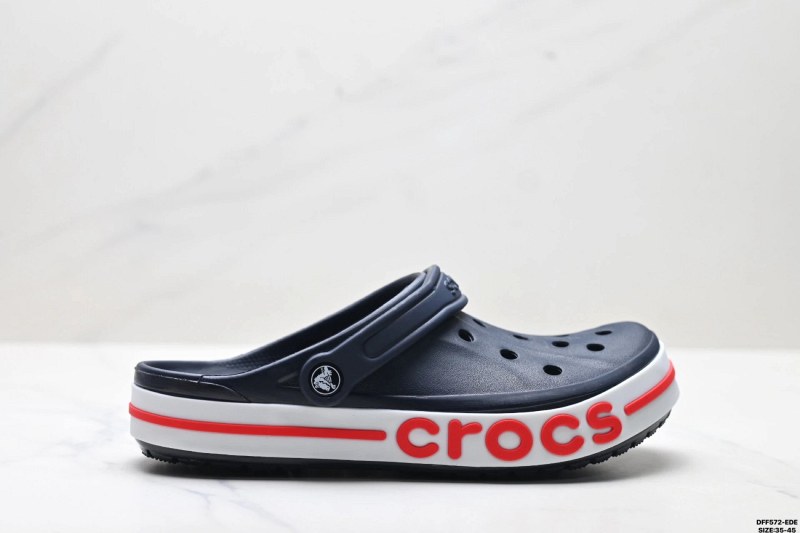
The listing calls this pair Crocs Blue Flip-Flops. The box does not. What reached our bench was the Bayaband clog: closed toe, open back, ventilation holes punched through the blue upper, a pivoting heel strap, and a white midsole carrying a red stripe and the Crocs wordmark along the side. We ordered SKU 7705226072 at $17.24 in the blue colourway, size 42, and the size run on the listing covered 35 through 45 at the time of purchase. On our 0.1 g scale a single size 42 clog weighed a median 214.6 g across three weighings.
The mismatch matters more than it sounds. A flip-flop is a between-the-toes sandal; this is a moulded slip-on that you can shuffle into with a strap holding your heel. If you are shopping from the title alone, expect the wrong shoe to arrive.
What the product photographs do not show
The upper is one moulded piece with no lining, no stitching and no tongue, so there is nothing to chafe at the instep. The heel strap pivots forward far enough to sit over the top of the foot, which converts the clog into something closer to a slide. The sole unit is solid — there are no drainage ports through the footbed — so any water that gets inside has to leave over the heel or back out through the upper's vents. The footbed is a field of shallow dimples rather than a smooth surface.
Three details are worth checking within the first five minutes, because the buyer and authenticity guides we read use them as markers. The wordmark should be fully formed and crisp on the side of the sole rather than smeared. Press a thumb into the footbed foam and it should spring back, slowly but completely. Guides describe counterfeit pairs as using ordinary EVA that rebounds sluggishly or stays dented; our sample recovered, though it took a visible second or two.
The 25 mL spill test
We poured 25 mL of water over five seconds onto the clog, tilted so the liquid ran toward the heel opening and the vent line. Timed to the nearest second and repeated three times:
| Run | Pass-through time | Liquid retained after 60 s (0.1 g scale) |
|---|---|---|
| 1 | 3 s | 2.1 g |
| 2 | 4 s | 1.8 g |
| 3 | 3 s | 1.9 g |
| Median | 3 s | 1.9 g |
Almost all of the liquid left immediately down the heel opening and out of the vents. The 1.9 g that stayed was sitting in the footbed dimples — a thin film, not a puddle. In practice that means a rinse under the tap is over in seconds; drying takes longer than draining because the dimples hold water against the foam. Left in a warm room the pair was dry to the touch in a little over ten minutes, and noticeably slower in a cold workshop.
Two weeks on the bench: oil, crumbs, wet counters and metal swarf
We kept a daily log with the pair in the same working space as our spill bench, moving between a kitchen counter and a small metalworking corner.
- Day 3, cooking oil. A splash across the blue upper wiped off with a dry cloth and left no dark patch. The moulded surface does not absorb the way a textile upper would.
- Day 6, crumbs and flour. Dry debris collected in the ventilation holes and along the footbed dimples. Running water cleared the holes; the dimples needed a fingernail or a brush.
- Day 8, wet floor. On plain wet tile the tread held. With a film of detergent on the same tile, both feet slid a few centimetres on turns and the heel strap shifted off the heel. This is not a shoe for a wet commercial kitchen floor.
- Day 11, metal swarf. This was the failure point. Fine steel filings from a swept floor embedded themselves in the soft tread and in the shallow pattern at the heel. They did not shake out, and a stiff brush only removed part of them. A magnet was more effective than the brush. The softness that makes the clog comfortable is the same softness that traps grit.
- Day 14, wear. A shallow imprint had formed under the heel in the footbed, visible in raking light but not felt underfoot. The upper showed no cracking at the vent edges.
Fit: our measurement against the size chart
The size 42 footbed measured 27.0 cm long and 10.3 cm wide at the ball. Against a tester's 26.5 cm foot that left roughly half a centimetre behind the heel with the strap up — usable, but not roomy, and the closed toe means toes sit close to the front wall. Wider feet will feel the sides.
Buyer reports on this style genuinely conflict. Some reviewers say the length runs short and that their toes hit the front once the heel strap is up; others say the same marked size fits almost an extra foot and runs wide. One side-by-side comparison of the Classic and the Bayaband found the Bayaband a touch snug and sized up in it, while the Classic fit true to size. General sizing guidance for Crocs is to measure your foot length in centimetres first and convert through the EU-to-US chart rather than reaching for your usual number. There are no half sizes here, which makes that measurement step more useful, not less.
Buyer reports on the same product page run in opposite directions: "cute but small in the length… I would say size up," and "these can fit another foot in them." Both are worth reading before you pick a size. (Translated from buyer reviews.)
Where the $17.24 goes, and where it does not
The money is in the mould, not the finish. One piece of foam, no lining, no hardware, no laces: there is very little to fail and very little to adjust. That is why the lack of half sizes is the main practical limitation rather than a minor annoyance — fit is the only variable you cannot tune afterwards.
Material claims from the authenticity guides describe the Crocs sole compound as slip-resistant, wear-resistant, waterproof and antibacterial. Our own results support the waterproof and easy-clean part plainly, and the wet-tile test showed the slip resistance has limits once detergent is involved. We cannot verify the antibacterial claim at the bench, and we treat it as a guide-level description of the material rather than a property of this pair.
Cleaning routine that worked for us: rinse the vents and footbed under a tap, shake out, wipe the tread with a stiff brush, then check the tread for metal with a magnet before taking the pair back into a workshop. Store them heel-down so the dimples drain.
The pair was in stock at $17.24 against a listed original price of $18.74 when we ordered, and the discount is not what makes it worth buying or not buying. What matters is that you measure your foot, accept a single moulded fit, and know that the same soft tread that cushions a long shift will pick up every sharp thing you walk over.
Is this the flip-flop or the clog?
The listing title says flip-flops, but the product we received is the Bayaband clog: closed toe, open back, ventilation holes in the upper and a pivoting heel strap. Expect a moulded slip-on, not a between-the-toes sandal.
How much liquid stays in the shoe after a rinse?
In our three repeats, median pass-through was 3 seconds and 1.9 g remained in the footbed dimples after 60 seconds. The pair was dry to the touch in a little over ten minutes in a warm room.
Does oil or metal swarf damage the foam?
Cooking oil wiped off with no stain. Fine steel filings, however, embedded in the soft tread and needed a magnet plus a stiff brush rather than rinsing alone.