Hands-on score
4.0 / 5Editor verdict
A cheap, easy-clean blue clog that sheds water fast through the upper holes and survived two weeks of kitchen and workshop wear. Buy only after checking the size chart: buyer reports on this style split between running short and running roomy.
- What works
- 25 mL cleared the upper in a median 4 seconds and only 1.9 g stayed behind, so rinsing is quick.
- What works
- Oil, crumbs and workshop swarf all wiped or rinsed off without staining the EVA upper.
- What works
- Listed across sizes 35–45 at $17.24, with a strap that pivots firmly and stayed tight over two weeks.
- Watch-outs
- Sizing is inconsistent: some owners report toes hitting the front, others find the same size too roomy.
- Watch-outs
- The solid footbed traps sweat, and our sample was faintly odorous by day ten without socks.
- Watch-outs
- The outsole began to slide on wet, smooth kitchen tile when turning.
Anyone wanting an inexpensive, hose-down blue clog for home, poolside, errands and short casual outings, who will measure a foot against the 35–45 chart before ordering.
Shoppers who need predictable sizing in their usual Crocs size, wide feet that need a roomier Classic-style toe box, and anyone planning long barefoot wear in heat.
Insight
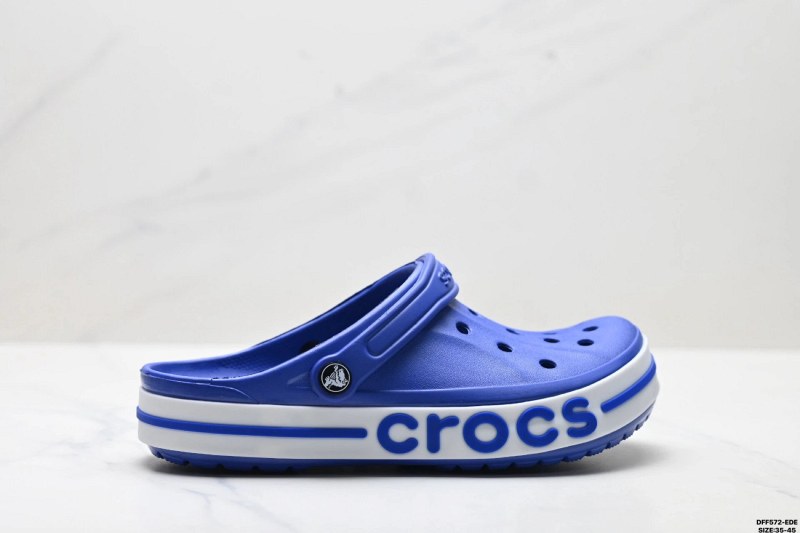
We ordered this Crocs pair through an ordinary retail channel, paid $17.24 against a listed original of $20.30, and tested the one pair that arrived: SKU 7702141415, blue colourway, size 42 from a run that the seller lists as 35 through 45. The listing is currently marked in stock.
One naming note before anything else. The product title calls these flip-flops, but what arrived is a backless clog with a pivoting heel strap, ventilation holes across the upper and a striped midsole in the Bayaband style. There is no toe post. If you are shopping for an actual thong-style flip-flop, this is not it — the title and the shoe disagree, and the shoe wins.
What arrived, and how it is built
The pair came in a plain poly bag with no retail box, which is normal for this price and route. The upper is a single moulded piece of EVA-type foam with the circular logo button set into the side and the white stripe running along the midsole. The finish on our sample was clean: no flashing along the mould seam, no glue line where the strap attaches, and the strap pivots firmly enough that it stays where you put it.
Measured with a tape on our size 42 sample: 27.4 cm internal footbed length, 9.6 cm at the widest point of the footbed, and a sole stack of roughly 3.1 cm at the heel tapering to 2.4 cm at the toe. That is a shallow, close-fitting footbed rather than the deep bucket of a Classic clog, which matters for the fit section below.
Bench test: how fast the holes actually clear water
This is the part of our routine that suits a vented clog better than almost any other product we cover. We poured 25 mL of water onto each sample held at a tilt, timed until the flow stopped, and weighed the shoe before and after on a 0.1 g scale to catch what stayed behind. Three runs, median reported.
| Measurement | Run 1 | Run 2 | Run 3 | Median |
|---|---|---|---|---|
| Pass-through time (25 mL) | 4 s | 4 s | 5 s | 4 s |
| Water retained after draining | 2.1 g | 1.6 g | 1.9 g | 1.9 g |
Water clears the upper quickly — the holes are large and there are plenty of them — but the footbed has shallow wells and ridge lines that hold a little water back. Nearly 2 g is not much, and it evaporates, but it is why the inside feels cool and slightly slick for a few minutes after a splash rather than drying instantly. In practice, the shoe is fine to hose down and fine to wear to a pool edge; it is not a shoe that dries the moment you step out of water.
Two weeks of everyday wear
Our log covered the four things that actually happen to a casual shoe: cooking oil, biscuit and bread crumbs, wet kitchen counters, and a walk across a workshop floor where fine metal swarf collects in tread lines.
- Oil. A splash of cooking oil beaded on the upper and wiped off with a drop of dish soap and a thumb. No stain remained after the second day. This is the EVA advantage over textile uppers, and it held.
- Crumbs. Dry crumbs settled into the footbed ridges and needed a rinse rather than a shake. Ten seconds under a tap cleared them.
- Wet counters. On a wet tiled kitchen floor the outsole is the weakest point of the whole shoe. It grips on dry tile and on pavement, but on genuinely wet, smooth tile we could feel it start to slide when turning. Treat a wet indoor floor with care.
- Metal swarf. Fine filings lodged in the tread grooves and did not shake out; they needed a rinse and a wipe. None worked through into the footbed, but the tread does collect debris.
After fourteen days of daily 20-to-40-minute wear, the blue upper showed light scuffing on the outer edge of the left shoe, and the white midsole stripe picked up a grey mark that did not fully come off. The strap hinges stayed tight and the moulded logo button stayed flush. Nothing delaminated.
Fit: read this before you choose a size
This is where the shoe is hard to recommend without a caveat, and the buyer evidence is genuinely contradictory rather than merely noisy. On Crocs' own product page for the Bayaband, 29 percent of respondents report the fit as small and 3 percent as large, while 14 percent call it narrow. Reviewers elsewhere describe toes hitting the front with the heel strap engaged, and in the same breath others report the identical size swimming on them. A comparison reviewer calls the Bayaband the smallest and narrowest of the Classic and Baya family.
"Order one size up" is the most common advice and it is not a safe rule. Our sample at 42 measured close to a standard 42 in length but noticeably tighter across the forefoot than a Classic, and the shallow footbed means a wide foot has nowhere to spread. Two practical moves beat guessing:
- Measure your foot on paper, add about 5 mm, and compare against the seller's listed 35–45 chart rather than your usual Crocs size.
- Confirm the return or exchange route before paying, because a wrong size here is a decision you will want to reverse.
The ventilation holes do not ventilate the sole of your foot
This is the one criticism that applies to the whole category and we could not design it away. EVA foam does not absorb sweat and does not breathe. The holes sit on the upper; the footbed under your arch and heel is solid, so moisture has nowhere to go except around your foot. Over a long, warm day our tester's foot felt clammy inside, and the shoe held a faint smell by day ten until it was rinsed and dried in shade.
Absorbent socks, or a version with a ventilated footbed, are the workable answers. If you plan to wear these barefoot through a hot summer, expect to rinse them more often than you would a fabric slip-on.
Styling the blue
The blue is a mid-tone, slightly dusty shade rather than a bright royal, and the white midsole stripe gives it a sportier line than a plain clog. It works with shorts, cropped trousers and denim, and reads casual enough for errands but tidy enough for a resort lobby. The white stripe is also the part that shows marks first, as our two-week log confirmed. Keep them out of a hot car or a sunny windowsill in summer: shrinkage in heat is a repeated complaint in owner reviews and it is not recoverable.
A good-value, easy-clean summer clog whose sizing you should treat as unknown until you measure your own foot against the chart.
What we would change
- A deeper footbed so mid-foot volume matches the Bayaband's roomy marketing.
- A listing title that matches the product: this is a heel-strap clog, not a flip-flop.
- A grippier outsole compound for wet indoor tile.
Do the holes actually drain water out of the shoe?
Yes. In our three runs, 25 mL poured over a tilted sample cleared the upper in a median of 4 seconds. About 1.9 g stayed in the footbed ridges, so the inside feels damp for a few minutes rather than instantly dry.
How do you clean crumbs and oil off the blue upper?
A rinse under a tap cleared dry crumbs from the footbed ridges, and a drop of dish soap with a thumb lift wiped cooking oil without leaving a stain. The white midsole stripe is the part that keeps marks.
Will the blue colour fade or the shoe shrink?
Our blue upper showed only light edge scuffing in two weeks. Owner reviews do report shrinkage after storage in hot sun or a hot car, so dry these in shade and keep them out of summer heat.