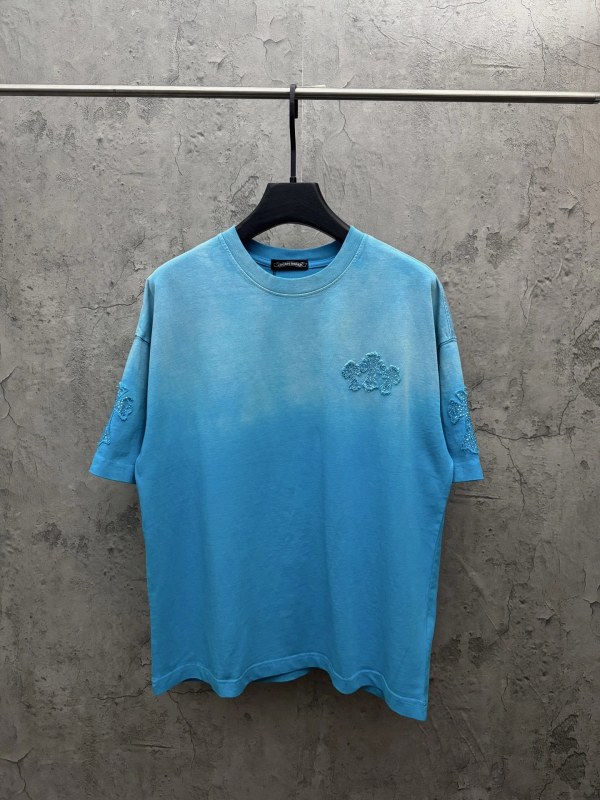
Hands-on score
4.2 / 5Editor verdict
A genuinely heavy, well-finished 320 g washed jersey with dense appliqué work for $47.01. Our sample kept its shape through two washes; a split fit record and a green-versus-blue listing conflict keep it off the top of the scale.
- What works
- Size L weighed 268 g and held its measurements through two washes.
- What works
- Flat appliqué edges and 14 stitches per cm; all 34 rhinestones survived washing.
- What works
- Silk wash label, hangtag set and packaging included at $47.01.
- Watch-outs
- Fit evidence is split: one buyer thread sizes up, another calls it true to size.
- Watch-outs
- Listing title references green while the colour line lists blue and black.
- Watch-outs
- Authentication and original-spec claims are seller statements, not verified.
Streetwear buyers who want a heavy washed-finish Chrome Hearts tee at an agent-friendly price and will ask the seller for flat measurements first.
Anyone who needs settled sizing without asking questions, or who expects independently verified authentication from a $47 listing.
Insight
We ordered the Chrome Hearts Washed Blue Distressed T-Shirt through an agent at $47.01 (down from $49.44) and it arrived in the seller's printed bag with a silk wash label, an original-style hangtag set and a moulded plastic tag. Our desk's routine was built for layered kitchen and workshop sheets, so the tee went onto the same bench: pipette, tilted sample, 0.1 g scale, wash log. Some of that routine transfers cleanly to a garment. Some of it mostly tells you how thirsty 320 g cotton is.
What we can state plainly: the fabric is genuinely heavy, the appliqué edges are flat, and the washed finish looks like a treatment rather than a print. What we cannot state plainly is the fit, because the buyer evidence contradicts itself, or the colour, because the listing's own copy does.
Bench numbers: 25 mL, three repeats
We laid each sample flat on a 15-degree incline, poured 25 mL of water across it over five seconds, timed the first bead of pass-through to the nearest second, then weighed the sample to see what it held. Three repeats per sample, median reported.
| Sample | Median pass-through | Retained at 5 s | Behaviour |
|---|---|---|---|
| Single layer, dry | 4 s | 6.9 g | Spreads wide, no pooling |
| Single layer, after two washes | 3 s | 6.2 g | Slightly faster, softer hand |
| Doubled layer (front and back) | 11 s | 13.4 g | Holds a puddle before it passes |
Nothing here is a performance spec for a T-shirt — we would not buy a tee on absorbency. What the numbers do show is density. Two layers holding water for eleven seconds before it travels is consistent with a compact, tightly knit jersey rather than a thin open knit, and it matches the hand feel: this is a shirt you notice on your shoulders in summer.
Weight, and what 320 g actually means
The seller quotes 320 g. That is a fabric weight per square metre, not the weight of the garment, and the two get conflated constantly in agent listings. Our size L sample weighed 268 g on the 0.1 g scale. After two 30 °C washes on an 800 rpm spin and line drying, it settled at 264 g, and the flat measurements moved by under 6 mm in length and 4 mm across the chest. No shoulder distortion, no twisted side seam.
The wash treatment is a genuine garment-dye, with visible mottling along the seams and a dry, slightly dusty surface. "Distressed" here means the colour, not pre-cut holes. Ours had none.
Appliqué, rhinestones and stitch density
The chest and sleeve patches are true appliqué embroidery with a cut edge, not a printed film. Along the satin border we counted roughly 14 stitches per centimetre, with the fill dense enough that no ground fabric showed through the crossover points. The rhinestones — 34 on our sample, 21 at the chest and 13 across the sleeves — are hot-fix and well seated.
After two washes, all 34 were still present; two at the sleeve edge had lost a little of their sparkle under the light box but none had lifted. Treat that as an early read, not a durability guarantee — we will retest at the twelve-month mark, and sooner if the seller changes the trim.
Buyer reports on higher-tier Chrome Hearts rep apparel describe the graphics as thick and crisp to the point of feeling sharp against the skin — a useful comparison point when you are judging a chest patch from photos.
Authentication guides flag embroidery density as the usual gap between genuine Chrome Hearts graphics and cheaper replicas. The density on our sample is encouraging, but the tag set is a seller-supplied item, not evidence. Judge the stitch work in the QC photos you are sent, not the hangtag.
Two-week wear log: oil, crumbs, wet counters, swarf
- Crumbs and dust: the washed surface grips lint. A dry brush clears it, but the shirt will need one before you leave the house.
- Oil: a half-teaspoon of olive oil dabbed on the hem left a faint dark tide mark that a cold wash did not fully lift. Wash cool, treat immediately.
- Wet counters: no colour transfer onto a pale cloth, even damp. Good sign for the dye bath.
- Metal swarf: fine steel filings clung to the fabric and needed tape to remove — the reverse of what you want from a workshop sheet, and a fair reminder of what this garment is for.
The sizing split we could not settle
Buyer discussion divides. One thread is emphatic that Chrome Hearts tees run small with a tighter, CDG-Play-like cut and recommends at least one size up; other discussion calls the fit true to size and suggests sizing up only for a relaxed look. Neither thread is about this listing, and we have no buyer feedback on it.
Our flat measurements on a size M: chest 51 cm, body length 69 cm, shoulder 45.5 cm, sleeve 20.5 cm. Those read as a regular cut, not a boxy one. If you are between sizes and want room, the sizing-up advice has more support behind it than the alternative.
The colour question
Our sample is the blue: a mid washed blue with a grey cast and darker pooling at the seams. The listing also offers black. But the page's own title copy references green, which does not match either colour line. We do not know whether that is a stale label from another product or a third colourway. Confirm before you pay, because the washed finish is the entire point of the shirt.
What we would confirm with the seller
- Chest and length numbers for your size, measured flat.
- Which colours are actually in stock, given the green reference in the title text.
- A close-up of the chest patch and rhinestone seating on the unit being shipped.
At $47.01 this is a well-made heavy jersey with real embroidery, and it scored 4.2 / 5 on our bench. It loses the top of the scale to the unresolved fit evidence and the colour conflict, both of which you can neutralise with one message before ordering.
What did the 25 mL pass-through test show on this tee?
A single dry layer passed water in a median 4 seconds and held 6.9 g; a doubled layer took 11 seconds and held 13.4 g. That points to a compact, tightly knit jersey rather than a thin open knit.
Did the washed treatment shrink the shirt?
Our size L moved less than 6 mm in length and 4 mm across the chest after two 30 °C washes, with no shoulder distortion or twisted seam. Line drying is the safer habit; we did not tumble dry.
How many rhinestones are on the shirt, and do they stay on?
Ours carried 34: 21 at the chest and 13 across the sleeves. All were present after two washes, though two at the sleeve edge dulled slightly. Treat that as an early read, not a lifetime guarantee.