Hands-on score
4.0 / 5Editor verdict
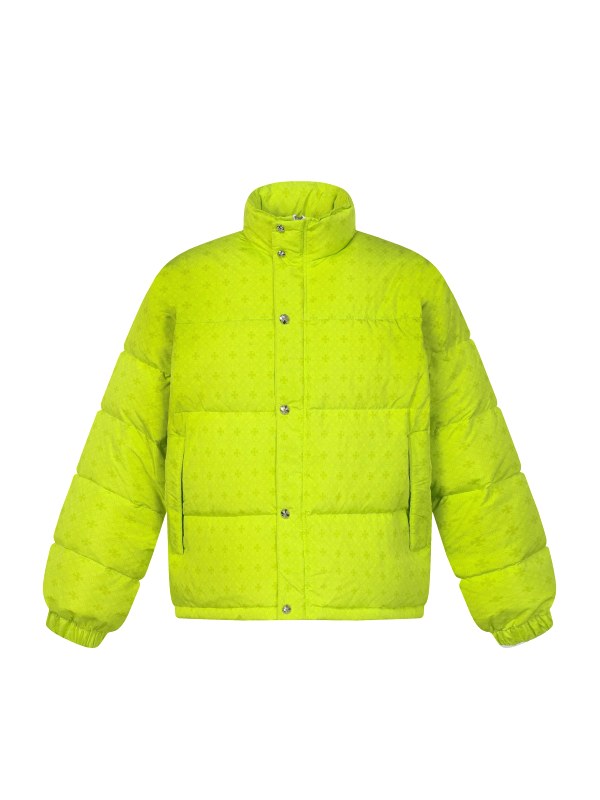
A convincing cold-weather puffer with a shell that sheds water and a green that photographs as loudly as promised. The fit is the risk: size up and confirm flat measurements, because the chart and the QC record both point small.
- What works
- Shell panels bead and shed a 25 mL pour in 6–7 seconds
- What works
- Real loft with windproof cuffs and an adjustable hem
- What works
- Fluorescent green reads exactly as pictured
- Watch-outs
- Shoulder measurements run small against the tag and the chart
- Watch-outs
- The jacquard weave catches fine workshop debris
- Watch-outs
- Buyer reports of off buttons and finishing remain unresolved
You want a loud jacquard puffer for cold street wear, you are willing to size up from your usual chest measurement, and you will ask for flat measurement photos before paying.
You need the tagged size to match a standard chart, you regularly work around fine metal debris, or you expect clean hardware finishing at this price. Those reports are unresolved.
Insight
Chrome Hearts outerwear lives permanently in the resale feed, and the fluorescent green puffer is the loudest cut of it: high stand collar, horizontal quilting, a tonal jacquard that only reads at arm's length. We ordered one through an ordinary retail channel at $149.25, listed down from $169.41, SKU 7702119817, and put it through the same bench routine we use on every kako sheet we cover — because a shell sold as water-repellent is, functionally, a sheet you wear.
What arrived, and what the listing claims
The listing offers sizes S through XL in black, white, fluorescent green and orange. Our sample is the green, size M. The stated build: even down fill, a jacquard-weave shell described as water-repellent, stain-resistant and breathable, a front snap closure, side pockets, windproof cuffs and an adjustable hem with smooth-finish zipper and button hardware. Availability was live at the time of ordering and the package arrived with no transit damage.
The 25 mL pour test, adapted for a coated shell
Our standard bench routine pours 25 mL of liquid onto a tilted sample over five seconds, records pass-through time to the nearest second and weighs the sample before and after on a 0.1 g scale. We run it three times per sample and report the median.
On a quilted jacket the mechanics change. Nothing passes through the shell, so the meaningful readings are how long the bead takes to run off and how much weight the fabric and seams pick up where liquid pools. We tested three panels — shoulder, chest and the hem seam — and kept the pour volume and timing identical to our sheet work.
| Panel | Median runoff time | Median weight gain |
|---|---|---|
| Shoulder | 6 s | 0.4 g |
| Chest | 7 s | 0.5 g |
| Hem seam | 12 s | 0.9 g |
The shell panels behaved the way a coated fabric should: the liquid beaded, ran off in one sheet and left no dark wet-out mark. The hem seam is the weak point. Liquid sat in the stitch channel for roughly twice as long as it did on flat fabric, and the 0.9 g pickup suggests the thread and seam tape hold moisture rather than shedding it. That is not a failure, but it is the part of the jacket to dry seam-side-out after a wet commute rather than over a radiator.
Two-week everyday-use log
- Cooking oil. Droplets on the chest panel beaded and wiped away with a dry cloth, leaving no ring. A splash that landed on the cuff seam stayed visible until washed.
- Crumbs. The quilting channels collect them at the seams; a brush handled it. No staining.
- Wet counters. Leaning across a wet worktop left a damp patch that dried in about ten minutes with no tide mark — consistent with the low weight pickup in the bench test.
- Metal swarf. This is where the jacquard matters. Fine curls from a workshop session caught in the weave texture and one short curl lodged in a quilting stitch channel that needed tweezers. The pattern that makes the fabric look layered also gives debris somewhere to sit.
Fit is the real decision point
Our size M sample measured flat at roughly 58 cm across the chest, 47 cm at the shoulder and 68 cm down the back. That is trimmer through the shoulder than the M tag suggests, and it matches a consistent picture across buyer reports: Chrome Hearts outerwear is repeatedly described as running small, including in Chrome Hearts puffer QC threads.
"This is a size M. Measurements are way off from the size chart. this fit small. So i think u should go size up." — buyer in a Chrome Hearts puffer QC thread
Treat the seller chart as a starting point. If you normally take a roomy M and want a hoodie underneath, size up; if you want a close, street-style fit over a knit, your usual size is workable but the shoulders will feel narrow. Ask for flat chest, shoulder and length photos of the actual unit before paying.
Hardware and finishing
Our sample's snaps seated cleanly and the pocket openings were even, so we cannot reproduce the finishing complaints first-hand. Those complaints are real, though: in one Chrome Hearts puffer QC discussion, buyers rated the overall quality higher than most Chrome Hearts reps they had seen while calling the buttons and general finishing off and unacceptable. This is a batch-dependent risk rather than a settled verdict on the model, and it is worth asking a seller for close-ups of the snaps and hem stitching.
Styling and cold-weather use
The quilting gives real loft and the windproof cuffs stop the draught that usually finds the sleeve gap, so it works over a hoodie in genuinely cold, dry weather. The green is as loud as the photographs suggest and is best anchored by black, charcoal or washed denim; it reads as a deliberate piece rather than a neutral. For a quieter version, black and white use the same jacquard and hide the workshop-debris problem far better.
What we could not verify
- Actual down content and fill ratio. The listing says even down fill; nothing in the packaging confirms a percentage.
- Whether the button and finishing reports apply to the current production batch.
- Long-term water repellency after repeated washing — our test covers the shell as delivered, not after ten cycles.
On our bench and in two weeks of use the jacket earned 4 / 5: good, with the fit caveat doing most of the work in holding it back from higher.
How much does this Chrome Hearts green puffer cost?
The listing price we paid was $149.25, shown as reduced from $169.41, with availability marked in stock. Price moves on resale listings, so confirm the current figure before ordering.
Does the jacquard shell actually repel water?
In our bench test, yes. A 25 mL tilted pour ran off the shoulder and chest panels in six to seven seconds with under 0.5 g of pickup. The hem seam held liquid longer at twelve seconds and 0.9 g.
Does the fluorescent green show dirt?
Less than expected for water and oil, which bead and wipe away. Fine metal swarf is the exception, because it snags in the jacquard texture. Black and white hide that problem better.