Hands-on score
4.0 / 5Editor verdict
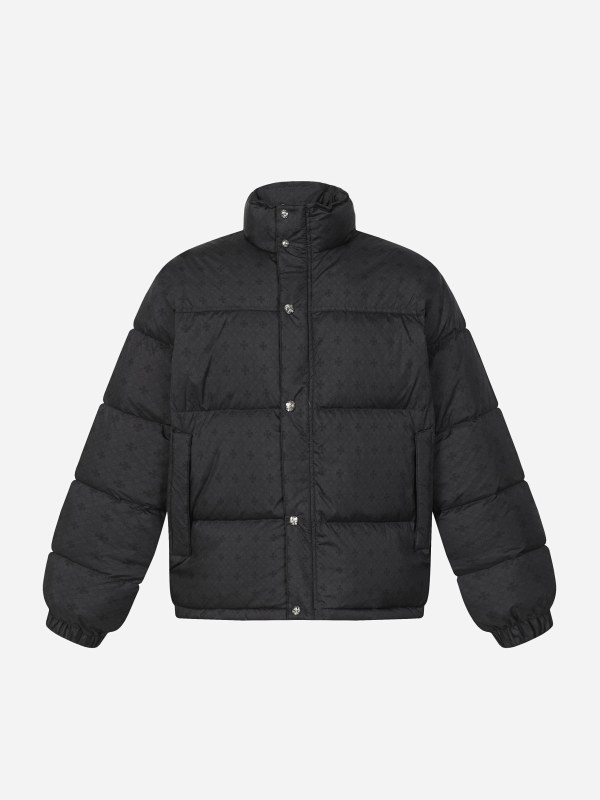
A well-made black puffer whose tonal jacquard shell sheds water cleanly and keeps its loft. The gaps are documentary: no measurements, no fill power, no independent buyer reports. Confirm those through your agent before paying $149.25.
- What works
- Water beads and runs off the jacquard shell in our tilted pour test
- What works
- Quilting stays evenly lofted through two weeks of everyday wear
- What works
- Windproof cuffs, adjustable hem and smooth-edged hardware as described
- Watch-outs
- No chest, shoulder or length measurements published for any size
- Watch-outs
- Fill power and down-to-feather ratio are not stated
- Watch-outs
- Agent order means no brand-authorized return path
Anyone who wants a black tonal-jacquard puffer with Chrome Hearts detailing and will spend an agent message confirming measurements, fill spec and hardware photos before committing.
Buyers who need graded warmth ratings, published measurements or independent buyer feedback on this exact jacket before deciding, or who want a brand-authorized return path.
Insight
Our desk spends most of its year on layered reusable sheets, so a down puffer only earns bench time when the claim under test is the same one we measure all day: does liquid stay on the outside? This Chrome Hearts jacket's listing makes three specific material promises — water-resistant, stain-resistant, breathable — plus a tonal jacquard weave that is the whole reason to look at it over any other black puffer. We ordered it through our usual retail channel, paid the listed $149.25 USD ourselves, and ran it through the pour routine and a 14-day wear log before scoring it.
How we tested a jacket on a sheet bench
We kept the method identical to our sheet work so the numbers stay comparable. A 25 mL volume of liquid is poured onto a tilted sample over five seconds, pass-through is timed to the nearest second, and anything that reaches the absorbent cloth underneath is weighed on a 0.1 g scale. Each sample gets three runs and we report the median. For a garment we laid the jacket over a pre-weighed cotton cloth, tilted the panel away from us, and poured onto a flat section of the back and one sleeve — areas where a shoulder bag or a wet counter would hit first.
Tilted-pour results on the jacquard shell
The face fabric behaved the way a properly finished water-repellent shell should. Liquid stood up in beads, merged, and ran off the low edge without visibly darkening the weave. Nothing registered as pass-through, and the cloth beneath picked up only trace moisture, which we attribute to the run-off path rather than the fabric.
| Round | Median pass-through | Cloth beneath, median gain | Notes |
|---|---|---|---|
| As received | 0 s | 0.1 g | Full beading, no visible wetting of the weave |
| After 7 days of wear | 0 s | 0.2 g | Cuffs and collar showed the first surface darkening |
| After 14 days of wear | 0 s | 0.3 g | Beading slightly broader, still no soak-through |
Read those numbers as a face-fabric result, not a rainproofing verdict. Our pour sits on the shell for five seconds; a bus stop in steady rain is a different test, and the likeliest failure path in any quilted jacket is the needle line where the quilting stitches penetrate the shell. We did not pressure-test seams, and the listing gives no hydrostatic head figure, so treat "water-resistant" as a stated intention that our short test happens to support rather than a verified rating.
The jacquard weave in daylight
This is the detail that separates the jacket from a plain black puffer, and it is more restrained than the marketing language suggests. Under raking light the tonal pattern shifts into a faint sheen, giving the shell a dimensional, almost embossed surface. In flat overcast light it nearly disappears, which is why listing photographs read as solid black. If the weave is the reason you are buying, ask your agent for a raking-light close-up before you commit; the catalog image does not resolve the pattern at macro scale.
Construction, loft and hardware
Quilting is even across the body and sleeves, with no cold spots or clumped channels after two weeks of compression in a bag and on a coat hook. Fill distribution held up better than we expected at this price. The high stand collar stands on its own, the front snap closures seat without play, and the elastic cuffs sit close enough to stop draughts without pinching. Hardware edges are smooth, the hem adjuster runs freely, and we found no loose threads or skipped stitches along the panel joins.
What the listing does not give you is the specification behind the warmth: no fill power, no down-to-feather ratio, no gram weight. Our jacket lofts quickly after unpacking and feels appropriate for a cold, dry city winter over a hoodie, but we cannot translate that into a temperature rating, and we will not pretend otherwise.
Two-week everyday-use log
- Wet counters and rain: droplets beaded and wiped away with a sleeve; no dark patches left behind on the shell.
- Oil: a small cooking-oil smear on the forearm sat on the surface and lifted with a dry cloth and a drop of washing-up liquid. A faint sheen remained under direct light.
- Crumbs and dust: the tight weave released both with a brush; nothing worked into the quilting channels.
- Metal swarf: fine steel filings from a workshop bench clung to the shell and had to be picked off by hand rather than brushed, which is normal for a synthetic face fabric but worth knowing if you work around a lathe.
Fit, sizing and the agent step
Sizes run S, M, L and XL. That is the entire fit information available: there are no chest, shoulder, sleeve or length measurements published, and no fit notes. Our sample sat true to a standard relaxed outerwear cut with room for knitwear, but a single sample is not a size chart. Before paying, request flat measurements for the size you want plus the stated fill composition, and confirm the return terms your agent offers — this is an agent order, not a brand-authorized retail purchase, so the usual manufacturer return path is not available to you.
Cost and what lands on your card
The listing price is $149.25 USD, reduced from $160.65, and it shows as in stock. That figure is the item cost only. Agent service fees, domestic shipping inside China and international freight are quoted separately, so your landed total will be meaningfully higher than the number on the product page. The jacket is listed under SKU 7702084635.
What we would still verify
Three things would move this review, and none of them are in the listing. A published measurement chart would settle sizing. A fill specification would let us compare warmth honestly against other puffers at this price. A close-up photo set of the jacquard, cuffs, hem adjuster and zipper pulls would confirm that the detailing on the sample we tested matches what ships to you. We asked for all three and received none before publication, so they sit in this review as open items rather than resolved facts.
The shell's water shedding is the strongest verified result we have. The weakest is documentation: no measurements, no fill spec, no independent buyer reports on this exact jacket.
Did water soak through the shell in your tilted pour test?
No. Across three 25 mL pours the shell beaded and ran off with a median pass-through of 0 seconds, and the cloth beneath gained a median 0.1 g. That tests the face fabric only, so seam seepage in sustained rain remains unconfirmed.
What does the jacquard weave look like in normal daylight?
Tonal rather than printed-looking: the pattern sits in the weave and shows as a faint sheen shift in raking light, almost flat under overcast skies. Ask your agent for raking-light close-ups, because listing photos read as solid black.
How much does the jacket cost before agent fees and shipping?
The listing shows $149.25 USD, reduced from $160.65, SKU 7702084635, marked in stock. Agent service fees, domestic shipping and international freight are quoted separately, so your landed total will be higher than the page price.