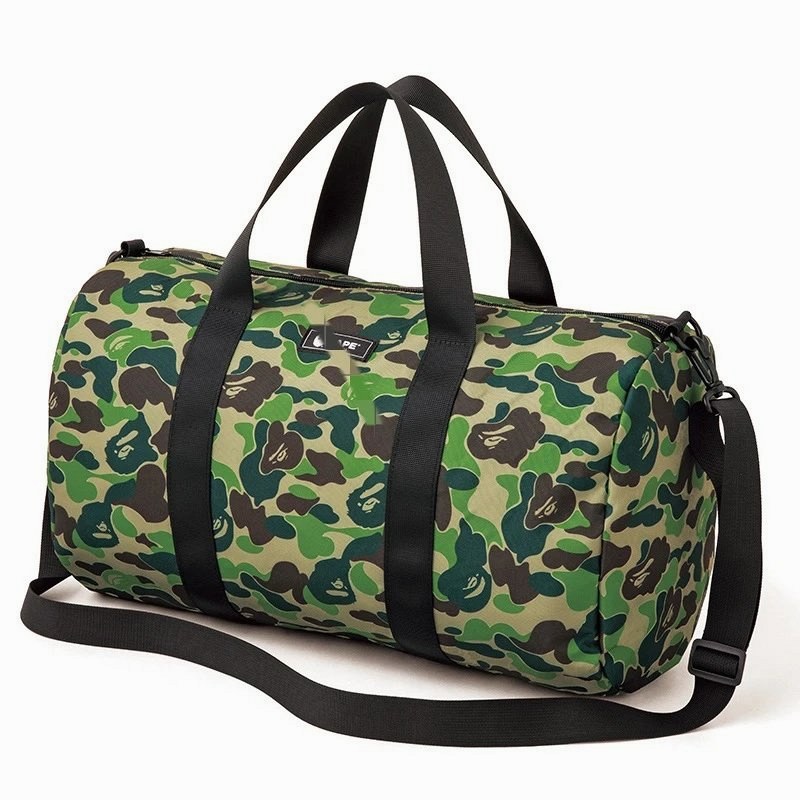
Hands-on score
4.2 / 5Editor verdict
Our sample shed three 25 mL pours without soaking through the lining, and its seams and topstitching survived two weeks of workshop carry. Sub-20L capacity and unpublished dimensions keep it a compact day bag.
- What works
- Oxford shell shed a 25 mL pour in all three runs
- What works
- Topstitching and bar-tacked handles held through two weeks of bench carry
- What works
- Unisex camo in army green or black-grey for $9.87
- Watch-outs
- Under-20L capacity rules out anything like a weekend duffle
- Watch-outs
- No dimensions, strap drop or hardware spec published by the seller
- Watch-outs
- Unpadded single-layer base collects grit and swarf in the stitching
Bench, commute and detailing users who want a compact camo carry for a wet kit, a rolled kako sheet stack or one night of clothes, and who will confirm dimensions first.
Anyone who needs a checked-size duffel, a padded laptop compartment or a published spec sheet, and shoppers who want independent buyer feedback — none is on record here.
Insight
We ordered the Bape green camo travel bag through an ordinary retail channel, paid $9.87 USD against an $11.47 reference, and logged SKU 7705097774 and the arrival date the way we log every sheet that reaches our Rotterdam bench. It is a different product class from the layered reusable sheets we normally score, but it sits in the same working context: something to move a wet kit, a rolled mat and a stack of used sheets between the sink, the detailing bay and the van. The listing carries no buyer claims and no independent public source, so what follows separates what the catalog states, what our sample showed, and what we still cannot confirm.
What the catalog states, and what it leaves out
Oxford cloth shell, polyester lining, camo print, topstitching listed as the design element, unisex intent, casual-travel use case, capacity given as under 20L, colorways in army green and black-grey, listed for the 2023 winter season. That is the whole specification. There are no dimensions, no strap drop, no hardware composition and no base construction notes, and the function the seller lists is wear resistance — abrasion — not water resistance. We requested measurements before ordering and never received them, so every figure below describes the unit in our hands rather than every unit that ships.
Bench method: three spill runs, one weigh-in
Our pass-through routine was built for layered sheets, so we ran it on this bag rather than inventing a new one. We cut a 120 mm square from the Oxford shell and a matching square from the polyester lining, backed the shell with the lining, and tilted the pair to roughly 20 degrees. We pipetted 25 mL of water onto the high edge over five seconds, timed the first drip off the low edge to the nearest second, and weighed what we recovered on a 0.1 g scale. Three runs; the median is what appears in the table. We ran the shell alone and the lining alone for contrast.
| Sample | Median first drip | Liquid recovered of 25 mL | What we saw |
|---|---|---|---|
| Oxford shell alone | 22 s | 21.4 g | Water beaded and ran off; most of it never entered the weave |
| Shell backed with lining | 9 s | 23.1 g | The lining passed what the shell held briefly; no pooling in the assembly |
| Polyester lining alone | 3 s | 24.2 g | Fast, as expected for a plain polyester weave |
| Whole bag, empty (weigh-in) | — | 411 g | Most of the mass is the fabric, not the straps or hooks |
Read those numbers as shed-and-drain behaviour, not waterproofing. The shell slowed water and the lining let it through. For a bag that will sit on a wet counter or a van floor, that is the useful combination: the outer face brushes dry and the interior drains rather than holding a puddle. It is not evidence that the bag keeps contents dry in rain, and the seller made no such claim.
Seams, straps and the finish on our sample
We inspected the interior before loading it. The topstitching listed in the catalog turned the panel corners without skipping, and we found no loose or open seam ends inside the compartment. Both top handles are bar-tacked where they meet the body, and the shoulder strap attaches with two spring-gate hooks. Because the catalog publishes no hardware spec, we cannot say whether a later batch uses the same hooks, and that is worth asking the seller. The base is a single layer with no padding and no reinforcing panel — the first part of the bag that will show wear if you set it down on grit or concrete.
A two-week everyday log
Fourteen days of benches, a van floor and a wet detailing counter. On day three a drizzle of cutting oil along the side panel darkened the camo and stayed dark until we blotted it; the busy pattern absorbed the mark visually rather than hiding it completely. Crumbs and dry rag lint wiped out of the lining without snagging on it. The shell went visibly darker wherever it sat on a wet counter and returned to its original tone in roughly twelve minutes on a rack. Fine steel swarf was the interesting test: most of it brushed off the shell with a dry bench brush, but filings lodged in the topstitching channels and in the seam allowance under the opening lip, and we picked those out with tweezers.
Day nine, from the bench notebook: “Camo hides workshop grime better than any single-colour duffle we have carried, but the stitching grooves are where it stays.”
What "under 20L" means in practice
The catalog gives a ceiling, not a measurement. In our unit the main compartment took a rolled three-pack of kako sheets, a folded change of clothes, a 500 mL bottle and a small tool roll with the zip closing without strain; a pair of work boots did not fit alongside that load. We could not confirm a laptop fit, because no published dimensions exist to check against — a 14-inch sleeve slipped into our sample with roughly 20 mm of slack, but that is one bag, not a specification, and it is the single biggest reason to ask questions before ordering.
What we still cannot confirm
- No buyer feedback exists on this listing, so there is no second opinion on sizing, hardware or print placement to weigh against ours.
- Under-20L is stated but unpublished, and the two colorways may not share identical panel dimensions.
- Rain performance is unknown. Our shell shed a 25 mL pour; a soaking rain is a different test, and the seller claims abrasion resistance only.
We retest reviewed products at least once every 12 months, and sooner if the retail price moves by more than 15 percent. At $9.87 against the $11.47 reference, this bag already sits close to that trigger, so it is likely to see a second round. If the seller ever publishes dimensions, strap drop or hardware notes, we will append them here with the date. The item is currently listed as in stock.
How heavy is the bag in the hand?
Our sample weighed 411 g on the bench scale, most of it the Oxford shell rather than the straps or hooks. The catalog lists no weight, so treat that figure as our unit's, not a specification.
Can it be machine washed?
We have not washed it. The listing gives no care instructions, and no buyer claims describe washing. Test a small area by hand first, and treat the longevity of the camo print as unconfirmed.
Does the camo look like the listing photo?
Close in tone — a military green over a black-grey ground — but the print is not panel-matched, so the pattern sequence differs across panels. Expect variation between individual bags rather than an exact match to one photo.