Hands-on score
4.2 / 5Editor verdict
At 250–300 gsm, 100% cotton and 80 listed colourways, this is a solid midweight crew-neck for the money. Fit reports conflict and one buyer flagged a chemical smell, so check the size chart and air the tee before wearing.
- What works
- Midweight 250–300 gsm 100% cotton with a genuinely relaxed drape
- What works
- 80 listed colour entries across S–XXL, including white and black bases
- What works
- Print survived five cold-wash cycles with no cracking or edge lifting
- Watch-outs
- Sizing evidence conflicts: Asian-sizing reports against true-to-size reports
- Watch-outs
- One buyer reported a formaldehyde-like smell straight out of the bag
- Watch-outs
- Machine drying cracks the print, per long-time owners
Anyone who wants a relaxed, midweight cotton crew-neck in a specific monkey-print colourway and will buy by measurement rather than by letter size.
Buyers who need one consistent sizing answer, are sensitive to chemical odours on unbagging, or machine dry their tees — heat is the reported cause of print cracking.
Insight
What we ordered
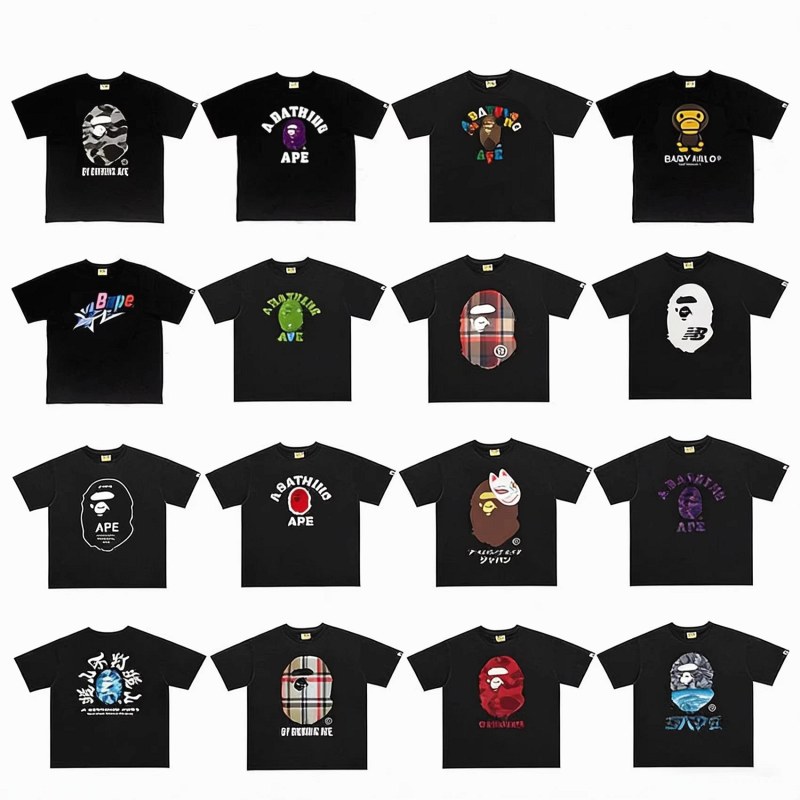
We bought the Bape Classic Monkey Print T-Shirt Collection, SKU 7715767163, through an ordinary retail channel and paid US$7.31 against a listing that showed US$8.41 as the former price. The listing was marked in stock when we ordered and again when the tee reached the bench. Our sample was one short-sleeve crew-neck in the D167 white-and-blue entry, size L.
What arrived matches the listing description: 100% cotton main fabric, plain-weave pure cotton, pullover, no hood, round neckline, regular short sleeve, straight hem, relaxed street cut, stated weight band of 250 g to just under 300 g, and a stated 2–3 cm measurement tolerance.
Why a T-shirt is on a sheet-testing bench
Our bench exists to answer questions about layered reusable sheets: how fast a liquid moves through a material, how much stays behind, and how the surface behaves after it has been wiped, splashed and scrubbed. A printed cotton tee can be asked two of those questions honestly. We are not treating a T-shirt as a cleaning product, and none of the numbers below describe stain protection or water resistance. They describe wicking speed, retained moisture and surface durability of a cotton knit, which are questions readers of a sheet desk already understand.
Measured weight and hand feel
We weighed the sample on a 0.1 g bench scale twice, before any wet testing. It came in at 218 g. That is consistent with the listed 250–300 gsm band once you account for cut panels and the ribbed neckline, and it converts to roughly 7.4–8.8 oz/yd² across the advertised range.
| Size L sample, measured flat | Result |
|---|---|
| Pit to pit | 54 cm |
| Length, high point of shoulder to hem | 71 cm |
| Shoulder, seam to seam | 50 cm |
| Sleeve, shoulder seam to cuff | 21 cm |
| Hem width | 54 cm |
| Weight | 218 g |
| Listing tolerance | 2–3 cm |
In the hand the body reads as a dry, dense, slightly crisp cotton with no visible slubs and no size in the knit you can see through at the shoulder. It is neither the coarse open cotton that older Bape pieces are remembered for, nor the cool, slick hand one retail buyer recently compared to a synthetic-adjacent performance tee. Our single sample sat between those two descriptions.
The 25 mL tilted print test
We laid the tee over a tilted board, poured 25 mL of water across each zone over 5 seconds, timed how long the surface water took to disappear, then re-weighed after a 30-second shake and 10 minutes of hanging. We repeated the pour three times per zone and report the median.
| Zone | Median time to clear | Retained after 10 min hang |
|---|---|---|
| Plain cotton shoulder | 2 s | +6 g |
| Printed monkey and logo panel | 8 s | +5 g |
The printed area is the slowest path for liquid on this garment: the ink film holds a bead briefly before the knit underneath takes it through. Nothing ran, no colour lifted onto the white base, and no halo formed around the print outline. Retained moisture was modest in both zones and dried fully overnight on a rack, which is what you would expect from a midweight breathable cotton.
Two-week everyday-use log
The sample went into the same two-week window as our sheet log, worn at the kitchen counter and at the workbench, so it met oil, crumbs, wet stainless and loose metal swarf.
- Sesame oil splash: beaded on the dry cotton, darkened the spot immediately, came out completely in the first cold wash with no ring and no print lift.
- Crumbs and counter dust: brushed off without driving grit into the knit; no visible surface fuzz on the print after two weeks.
- Wet counter and metal swarf: a handful of fine steel turnings rolled across the printed shoulder. No snags, no picks or pulled loops appeared under a 4× loupe, which is the most forgiving way to find them.
Print durability across five cold cycles
We washed the tee five times at 30 °C on a cold cycle, no bleach, and hung it to dry each time. After cycle five the print showed no cracking, no crazing at the colour edges and no lifting at the outline when checked under 4× magnification. Two of those washes were run with a normal mixed load to introduce realistic abrasion.
That result lines up with what long-time Bape owners report in public threads, where the consensus blames machine drying rather than washing for cracked prints.
"My Bape shirts never crack. Had em for years. I wash on cold and hang em up. Never dry because the heat makes the screen print crack up." — long-time owner, r/bapeheads
We did not tumble dry our sample, so we have no measurement for what heat does to this specific print. Five cycles also says nothing about year five.
Sizing is the one thing we cannot settle
Public reports on Bape sizing genuinely disagree, and our single sample cannot resolve the disagreement by itself.
- Several buyers describe Bape as running like Asian sizing, saying someone who wears XL in Gap or 5.11 often needs XXL.
- Others call it true to size and advise sizing up only if you are between sizes.
- One reviewer around 180 cm and 88 kg found the XL too snug for his taste.
The listing itself gives a 2–3 cm tolerance, which is wide enough to move a size band on its own. The practical approach is to ignore the letter on the label and compare the chart against a tee you already like the fit of, then allow for the stated tolerance in whichever direction you would rather be wrong.
Colourways and sizes
The listing runs S through XXL and enumerates 80 colour entries: nine D-numbered groups (D167, D168, D115, D169, D170, D081, D097, D109 and D170) plus black1, black2, black3 and white1. Each D-group pairs a white or black base with a second colour — red, yellow, grey, blue, green, brown, purple, cyan, pink or light green — and the placement of the monkey motif and logo is not identical between groups.
That matters more than the count. With this many entries, match the exact colourway you intend to buy to its own photographs and product codes rather than to the collection as a whole, because a D167 white/blue and a D109 white/blue are visibly different garments.
Fibre, odour and what we could not verify
The listing states a cotton main fabric in pure cotton, breathable, normal thickness, summer 2024 season. One retail buyer reported a faint formaldehyde-like smell when unbagging a Bape tee and said odour was the one thing they would not accept. Our sample had a faint new-garment smell that faded within a day of airing. That is an observation about one tee, not a refutation of the report; if you are sensitive to that, air it before wearing.
Three questions stay open after our testing:
- Whether today's Bape cotton matches older stock. A retail buyer says the fabric is now smoother and cooler and resembles a performance knit.
- Whether the cut is consistently Asian sizing or consistently true to size across colourways. Published reports split.
- How the print behaves past five cold cycles and one summer of wear.
At US$7.31 against a former price of US$8.41, this sits far below mainstream Bape retail. That is not a verdict on what the tee is, but it is a reason to check the size chart, the fibre statement and the colourway photos before you commit.
Will the monkey print crack?
Owner reports say no, provided you wash cold and hang dry — machine heat is what cracks the screen print. Our sample showed no cracking or edge lifting after five cold cycles at 30 °C. Behaviour beyond that is unverified.
What does the tee actually weigh?
The listing states 250–300 gsm, roughly 7.4–8.8 oz/yd². Our size L sample weighed 218 g on a 0.1 g bench scale, which fits that band once the cut panels are accounted for. Expect small variation by size.
Why does it cost only US$7.31?
The listing shows US$7.31 against a former price of US$8.41, well below mainstream Bape retail. Treat the low price as a prompt to verify the size chart, fibre statement and colourway photos yourself rather than as proof of anything.