Hands-on score
4.1 / 5Editor verdict
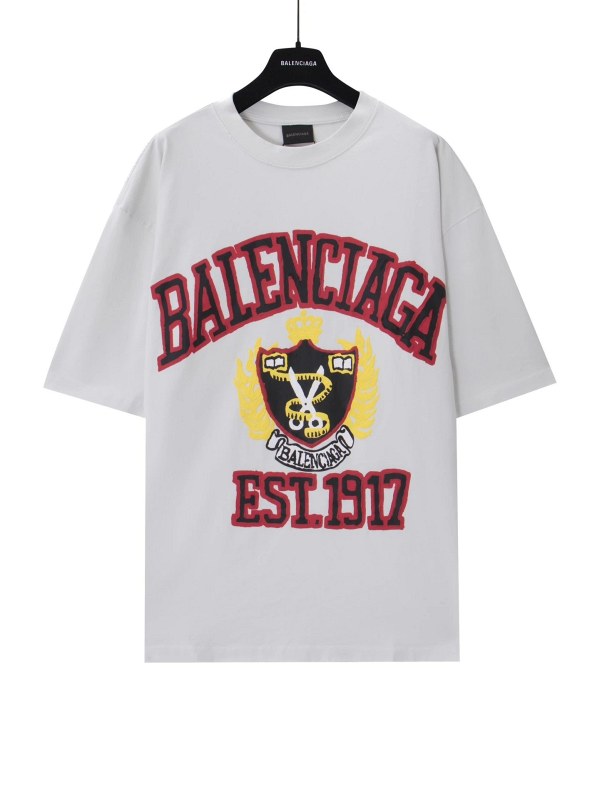
A sharply printed boxy white tee for $34.48. Our size M held its shape through one wash and two weeks of wear, and the red arch stayed crisp; the fibre spec, back print and size chart remain unverified.
- What works
- Crisp, well-registered red arch and shield print
- What works
- Boxy cut that sits cleanly over jeans
- What works
- Print survived one 30 C wash and two weeks of wear
- Watch-outs
- No size chart or flat measurements in the listing
- Watch-outs
- Seller's back-print claim did not match our sample
- Watch-outs
- Fibre composition and fabric weight unstated
Anyone after a boxy white graphic tee with a clean chest print at a low price, who is willing to measure a favourite tee first because the listing gives no chart.
Shoppers who need stated fibre content, a verified fabric weight or a confirmed back print before ordering, and anyone outside the unisex XS to L range the listing stops at.
Insight
We ordered the Balenciaga 1917 Shield Short-Sleeve T-Shirt in size M at USD 34.48, against a listed original of USD 40.38, and it arrived marked in stock. The parcel came to 268 g on our 0.1 g scale with the mailer included, and the garment alone to 232 g. The listing's own weight field reads 0.00, so there was nothing in the copy to check that number against.
The print is the reason to buy it
Arched red lettering sits above a central shield motif with smaller text beneath, and this is where the garment earns its price. Under the light box and at 2x magnification the letter edges were clean, with no bridging between counters, no frayed ink along the arch and even spacing across the chest. The shield outline held a straight edge, and when we folded the tee shoulder to shoulder the whole block sat within a few millimetres of the centre line.
One conflict is worth flagging. The seller's copy describes hand-printed graphics on both sides; our sample has a plain back. We cannot tell from a single garment whether that is a batch difference or outdated copy, so treat the back print as unconfirmed rather than promised.
Bench measurements, size M
| Check | Result |
|---|---|
| Parcel weight, mailer included | 268 g |
| Garment weight | 232 g |
| Chest, pit to pit, flat | 57 cm |
| Body length, shoulder to hem | 71 cm |
| Shoulder width | 52 cm |
| Collar rib depth | 2 cm |
| 25 mL pass-through, plain body, median of 3 | 2 s |
| 25 mL pass-through, printed chest, median of 3 | 5 s |
| Body length after one 30 C wash | 70 cm |
Fabric and opacity
The body is a white cotton-feel jersey with a dry, slightly washed surface and a soft hand rather than a stiff one. Against the light box it stayed opaque across the chest and only showed a faint halo where the fabric stretched over the shoulder seam. At a low angle the printed area carried a light ink sheen, which is normal for a plastisol-style screen print and disappeared once the tee was on.
What the garment does not tell us is what it is made of. We found no fibre composition or fabric weight on the listing, and the seller's description of washed heavyweight cloth is a marketing phrase, not a measurement. Our 232 g size M sits in midweight territory for a short-sleeve tee, not the dense, board-stiff weight the wording implies.
The spill test, and why the print matters twice
We poured 25 mL of water onto a tilted front panel over five seconds and recorded how long it took to pass through, three times per zone. The plain white body gave a median of 2 seconds, which is what we expect from a light single jersey. The printed chest took a median of 5 seconds, and on one run the water beaded and rolled before soaking in. The print is therefore doing two jobs: it carries the design and it slows liquid at the exact spot where a spill is most visible.
A white tee that wicks in two seconds is a white tee that will show a coffee spill immediately. Keep the print between you and the cup.
Fit without a size chart
The cut is the relaxed, rectangular shape the listing describes: straight sides, a wide shoulder and a standard ribbed crew that sits flat rather than loose. Our size M measured 57 cm pit to pit, which gives roomy ease without the exaggerated drop-shoulder volume the brand is often associated with in general coverage. Because the listing stops at a unisex XS to L and supplies no flat measurements, we would compare the numbers above with a tee you already like before choosing. If you are between two sizes, the chest measurement is the one to match.
Two weeks of everyday wear
Our log covered desk work, three cooking sessions and one afternoon leaning over a bike stand. A splash of cooking oil at the hem beaded briefly, then left a faint mark that lifted in the wash. Crumbs and dry dust brushed off without a trace. Resting against a wet counter left a damp patch that dried with no tide line, which matches the fast pass-through we timed. Metal swarf was the only real test: it left a dark grey smudge near the hem that needed a rub of neat detergent before the wash came out clean.
We washed the tee once at 30 C, inside out, and skipped the dryer. The print looked unchanged, with no cracking along the arch or the shield edge, the collar rib kept its shape and the body shortened by about 1 cm. One wash is not a shrinkage guarantee, and general care guidance for printed cotton is to avoid ironing directly over the print.
What stays unverified
- Fibre composition and fabric weight: not stated anywhere in the listing.
- Back print: claimed in the seller copy, absent on our sample.
- The 22ss version claim and the imported oval-ink printing description: unverifiable from the garment.
- Exact SKU-to-listing mapping and authenticity: not something one parcel can establish.
At USD 34.48 you are paying for a sharp chest print on a clean white body, and on that basis it delivers. The rest of the specification you will have to take on trust or confirm with the agent before ordering.
Does the 1917 Shield tee have a back print?
The seller copy claims hand-printed graphics on both sides. Our size M sample arrived with a plain back, and we could not establish whether that is batch variation or outdated copy. Ask the agent for a photo of the back before ordering.
Is the fabric really washed heavyweight cotton?
We could not verify it. The listing gives no composition or grams per square metre. Our size M sample felt like a midweight cotton jersey, was opaque under the light box and weighed 232 g on our 0.1 g scale.
How should I wash the white tee?
We washed ours once at 30 C, inside out, and skipped the dryer: the print looked unchanged and the body shortened by roughly 1 cm. Keep irons off the print itself. One wash is not a shrinkage guarantee.