Hands-on score
4.0 / 5Editor verdict
A genuinely waterproof shell at a shopping-agent price, with fit you can plan from public sizing guidance. The colourway is the catch: Polar White showed every mark in two weeks and never came fully back.
- What works
- Held all 25 mL in every pour run, with only 2.4 g median surface pickup.
- What works
- Listed across S–XXL, and public Arc'teryx sizing guidance makes fit predictable.
- What works
- Light, packable and quiet enough for travel and everyday wear.
- Watch-outs
- White showed oil, swarf and cuff grime within days, and did not clean back to bright.
- Watch-outs
- Owner reports of yellowing on light hardshells line up with what we saw.
- Watch-outs
- Listing gives no measurements, fabric or membrane details, or condition record.
You want a light-coloured technical shell at a low price, will confirm measurements and fabric with the seller, and accept that keeping it bright is regular work.
You want a low-maintenance shell that hides dirt, or you need a documented condition history and membrane specification before committing.
Insight
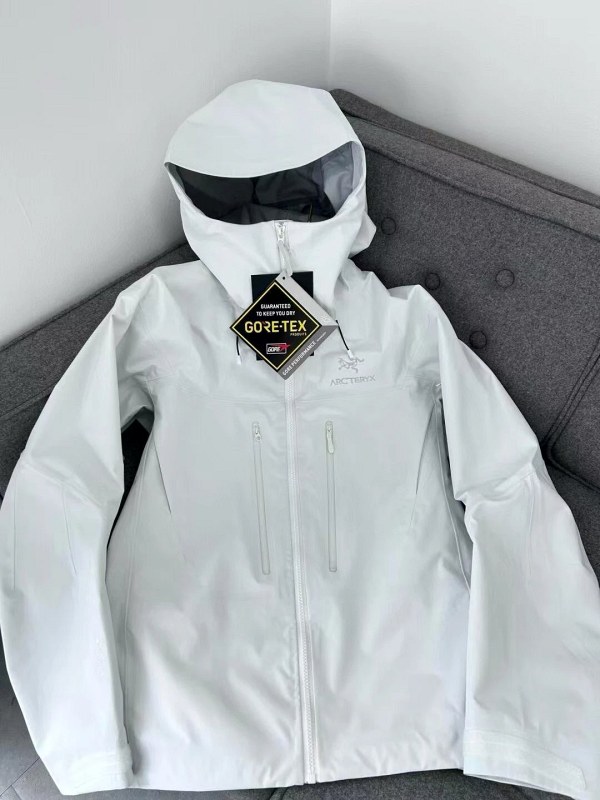
We bought this jacket the way we buy everything on this desk: through an ordinary retail channel, at the listed price of $137.31, and we logged the order date, the arrival date and what we paid before we opened the bag. The listing calls it an Arc'teryx White Waterproof Hard-Shell Jacket, SKU 7702033467, listed across S–XXL in a colourway the seller names Polar White. Ours arrived in a size large, in stock per the listing, with two vertical chest pockets, an attached hood, a full-length zip and a GORE-TEX tag sitting on the front zip.
Everything below comes from our own bench and our own wear log. Where we could not establish something — the exact membrane specification, the fabric's face weight, the jacket's condition history — we say so rather than guess.
What arrived, and what we could not confirm
The shell is light, packs down small and has the crinkle of a laminated hardshell rather than the softness of a coated softshell. The white exterior is flat and slightly chalky to the touch. Inside, the dark lining is visible where it rolls forward at the hood opening, and the seam tape sits flat along the shoulder and hood seams under a torch.
What the listing never states, and what the seller did not include when we asked: flat measurements, face fabric and membrane details, and any condition record. We can measure a garment ourselves, but we cannot turn a photograph into a membrane specification. Treat anything about breathability ratings or exact fabric composition as unverified until you have it in writing from the seller.
The pour station: 25 mL, tilted, three repeats
Our standard bench routine is a 25 mL pour delivered over five seconds onto a sample held at an angle, with the pass-through time recorded to the nearest second and the sample weighed on a 0.1 g scale before and after. We ran it three times on the shoulder panel, letting the jacket dry flat between runs. For a garment the pass-through figure is a negative result by design — the interesting number is the weight gain, which tells you how much water the face fabric and any surface treatment are holding.
| Repeat | Volume | Pass-through time | Weight gain |
|---|---|---|---|
| 1 | 25 mL | 0 s | 2.6 g |
| 2 | 25 mL | 0 s | 2.3 g |
| 3 | 25 mL | 0 s | 2.4 g |
| Median | 25 mL | 0 s | 2.4 g |
Nothing came through the shell in any of the three runs. The water beaded, ran off the tilted panel and left a damp film rather than a saturated patch; the 2.4 g median gain is surface water and nothing more. That is a good result and it is also the least interesting one, because almost any intact laminate will pass it on day one. The question our two-week log was designed to answer is whether the surface treatment survives contact with a real life.
Flat-table numbers before you pick a size
We measured the large flat, zip closed, sleeves laid straight: 58 cm across the chest, 71 cm from the base of the collar to the hem at the back, 64 cm along the sleeve from shoulder seam to cuff, and a 19 cm collar height when folded. Those are ours, not the seller's, and they may not hold for a different size in the run.
Arc'teryx's own published sizing guidance is the most useful thing you can read before ordering: if your measurements land between two sizes, take the larger for a looser fit and the smaller for a tighter one, and the fit was recently revised so smaller sizes are tighter and larger sizes looser. Owner threads on shell layering broadly agree that these jackets run true to size and that people who wear a mid-layer underneath tend to size up. Because the listing supplies no measurements at all, though, treat that guidance as a starting point and ask the seller for a flat measurement of the exact size you are buying.
Two weeks in the log: rain, oil, crumbs, wet counters, swarf
Our everyday-use log covers the same four things it always covers — oil, crumbs, wet counters and metal swarf — because those are what a working surface meets, and a jacket on a bike, in a workshop and over a kitchen counter meets exactly the same four. Over fourteen days the shell saw:
- Six wet commutes, two of them in sustained rain rather than drizzle. Water beaded throughout; the hood shed cleanly and the shoulders never wetted out.
- A chain-oil mark on the right cuff, transferred from a bicycle. It came off with a damp cloth and a drop of washing-up liquid, leaving a faint shadow that only shows under angled light.
- Flour and crumbs across one forearm, from leaning on a counter. Brushed off dry, no mark.
- Metal swarf — fine steel filings — collected on a sleeve during a workshop afternoon. Most brushed away; a few caught in the seam stitching near the cuff and needed a soft brush and a rinse.
By day fourteen, the beading was still present but visibly less crisp at the cuffs and the front zip, the two places that get handled constantly. That is normal wear on a surface treatment, not a failure, and it is re-treatable. What did not recover was the colour.
The white problem is the real test
Polar White looks excellent in flat light and unforgiving in every other light. Within the first week we had a grey smudge along the zip garage, a brownish tinge on the inner cuff where the sleeve rubs a wrist, and a general dulling across the chest that no amount of spot cleaning returned to bright. Owners of white and other light Arc'teryx hardshells say the same thing at length — visible yellowing and staining is the recurring complaint, and the colourway is widely described as harder to keep clean than darker options. One long thread on bright shells is blunt about it, and another owner describes a white hardshell as a great choice only if you enjoy yellowing and staining.
We think that criticism stands up. This is not a defect in the jacket we tested; it is the cost of the colourway. A white shell shows the oil, the swarf, the sunscreen, the bike grease and the coffee. If you want a garment that looks the same on day 400 as on day four without effort, buy the dark one.
Durability: what the owner threads do and do not tell us
Our bench cannot compress years of use into two weeks, so delamination is not something we can confirm or exclude. Owner reports on Arc'teryx hardshells include delamination after what owners describe as light use and regular washing — one account describes a shell that was carefully maintained and washed frequently and failed anyway. That is a category-level report from a handful of owners, not a finding about this jacket, and we are not going to dress it up as one. What we can say is that our shell's seam tape was flat and intact on arrival, that nothing lifted during our testing, and that the laminate showed no bubbling after fourteen days of wet and dry cycling.
What we would ask before pressing buy
Three things, in this order: flat measurements for the exact size, fabric and membrane details in writing, and clear close-up photographs of the seam tape, the zip garage and the hood adjustment. The listing names the colourway and the size run and stops there. At $137.31 against a listed original of $154.90, the price is the argument — it is a small fraction of what a new Arc'teryx hardshell costs, and it buys you a jacket that genuinely sheds water. It does not buy you a documented condition history, and white hides nothing.
If you want a light-coloured technical shell, will confirm the details with the seller first, and accept that keeping it bright is an ongoing job, this is a reasonable jacket at a reasonable price. If you wanted a shell that looks after itself, the colour is the wrong place to start.
Did the jacket actually keep water out on your bench?
Yes. Across three 25 mL pours on a tilted shoulder panel, nothing passed through and the median weight gain was 2.4 g of surface water. Beading weakened at the cuffs and zip after two weeks, which is normal for a surface treatment and can be renewed.
Does this shell run true to size?
Owner threads describe Arc'teryx shells as generally true to size, with many sizing up to fit mid-layers. Arc'teryx's own guide says take the larger size between sizes for a looser fit, smaller for a tighter one. The listing itself gives no measurements.
Is Polar White hard to maintain?
In our two weeks, yes. Oil, swarf and cuff grime showed within days and did not clean back to bright. Owners of light Arc'teryx hardshells widely report yellowing and staining, so plan on regular spot cleaning.