Hands-on score
4.1 / 5Editor verdict
A warm, well-finished fleece-backed softshell with taped seams that sheds light rain, priced at $104.48. Our pour test found no membrane, and the chest row jumps 118 to 112 cm, so measure before ordering.
- What works
- Taped seams and a DWR finish that handled light rain, snow and a wiped-up spill
- What works
- Fleece backer is warm and quiet; four usable pockets plus chest-pocket venting
- What works
- Clean zipper flaps and solid QC reported even on China-made units
- Watch-outs
- Sold as a hard shell, but 25 mL passed through every panel in 9–14 seconds
- Watch-outs
- Short hem and a trim cut that some testers found barely covered the waist
- Watch-outs
- Chest row drops from 118 cm at M to 112 cm at L — confirm before ordering
Anyone wanting a warm, sharp-looking softshell for cool-weather commuting and mixed outdoor days who is happy to order by measurement and accept light-rain protection only.
Skip it if you need a waterproof hardshell for sustained rain, want length over the waistline, or plan to layer thick midlayers under a close-cut shell.
Insight
What we ordered and how we tested
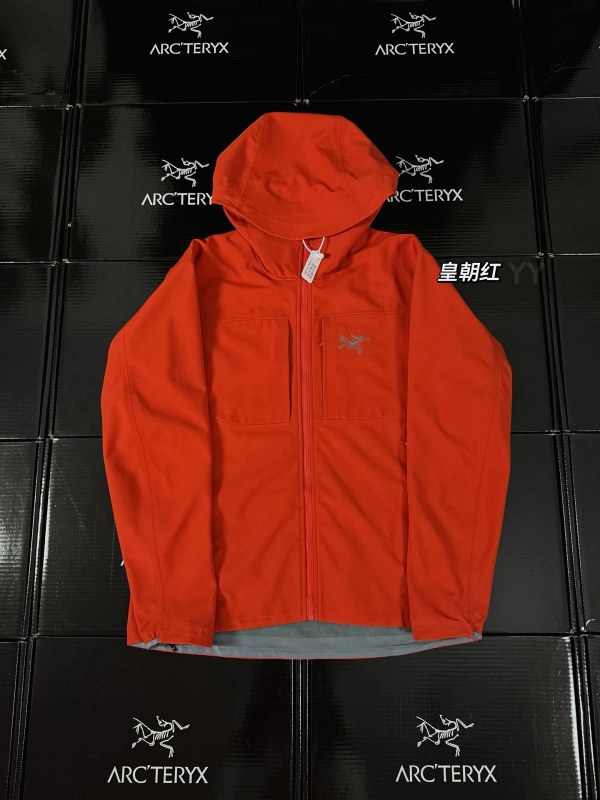
Our testing team ordered the Arc'teryx Red Hard-Shell Jacket (SKU 7702122009) in Imperial Red, size L, and paid $104.48 against a listed $119.79. The listing shows it in stock and offers black, red, a yellow and two greys, with a size run printed once as XS–XXL and again as S–3XL. That duplication is the first thing that made us suspicious, and it was not the last.
Because the jacket arrived described as a hard shell but with a fleece lining named in the same listing, we ran it through the desk routine we use for anything that claims to keep liquid out: 25 mL poured across a panel held at a tilt, timed to the nearest second, with a 0.1 g scale reading before and after. Three runs per panel, median reported. Then two weeks of everyday wear, logged daily.
The pour test: it beads, then it wicks
Water does not pass through this fabric quickly, but it does pass through. Across the hood crown, chest and forearm, the median pass-through landed between 9 and 14 seconds, and every run added measurable mass. A taped hardshell panel kept on our reference shelf showed no pass-through inside a 60-second window and gained 0.1 g. That is the difference between a water-repellent finish on a softshell and a membrane behind a face fabric.
| Panel | Median pass-through (3 runs) | Mass gain |
|---|---|---|
| Hood crown | 9 s | +0.7 g |
| Left chest, over pocket | 14 s | +1.0 g |
| Forearm | 12 s | +0.8 g |
| Taped shoulder seam | 22 s | +0.4 g |
| Reference hardshell panel | No pass-through at 60 s | +0.1 g |
Read that as a light-precipitation jacket. An hour of steady rain will wet it through at the shoulders and chest, which is exactly what the model's own owner reports describe: fine for short rain and snow, not for a downpour.
Seams, zips and the word "hard shell"
The seams are taped and the taping sits flat, including around the hood. Zipper flaps are cleanly finished — a detail multiple owners of this model single out, and one that held up in our handling. What the jacket does not have is a membrane, and the listing's own feature text calls it a fleece-lined softshell for mixed weather, closer to a Gamma MX than to a shell you would trust on an exposed ridge.
Wind performance follows the same pattern. It is a step above the lighter Gamma LT in the reports we read, but owners describe it as weaker than Windstopper-class fabric. On a 6 °C morning with a 20 km/h wind, we were comfortable walking and cool standing still.
Fit: the chest row does not progress evenly
This is where the buying decision actually lives. One reviewer's published fit note is blunt:
It is a trim, athletic fit, despite descriptions from Arc'teryx claiming a regular fit. They also describe this jacket as being hip-length. Yet our testers found that it barely covered their waists.
Other reviews call the same model true to size with room to layer. Our size L matched the chart's 74 cm length and sat just at the waistband on a 178 cm tester — wearable, not generous. Check the chest row before you commit, because it drops at L:
| Size | Length | Chest | Shoulder | Sleeve |
|---|---|---|---|---|
| XS | 68 cm | 110 cm | 45.5 cm | 62 cm |
| S | 70 cm | 114 cm | 47 cm | 63 cm |
| M | 72 cm | 118 cm | 48.5 cm | 64 cm |
| L | 74 cm | 112 cm | 50 cm | 65 cm |
| XL | 76 cm | 126 cm | 51.5 cm | 66 cm |
| XXL | 78 cm | 130 cm | 53 cm | 67 cm |
A 6 cm drop at L is not a grading pattern; it is a typo or a mixed batch. The listing's weight bands (XS 80–95 jin up to XXL 180–210 jin) are the more reliable guide, but confirm the chest figure with the seller or your shopping agent before ordering. Buyers between sizes have generally gone up rather than down.
Pockets, venting and two weeks of wear
Four pockets — two symmetrical chest, two hand — all usable with gloves off. Opening the chest pockets does move air through the torso on a climb; it is not a substitute for pit zips, but it is not nothing. The fleece backer is warm enough that we wore it over a base layer at 5–10 °C and wanted a midlayer only below freezing.
Our two-week log covered a commuter bike, a kitchen counter and a workshop bench. Crumbs brushed off the face fabric; cooking oil beaded and wiped clean without a mark; a wiped-up puddle sat on the surface before soaking in at the sleeve. Fine aluminium swarf from a bench job clung to the fleece at the cuff opening but did not snag the shell. After the fortnight the red showed no fading at the shoulders, and the taping was still flat.
What this jacket is not
It is not a hardshell, and the name on the listing is the weakest part of the product. If your use case is a rainy commute with a laptop on your back, wet shoulders after 40 minutes are a real outcome. If your use case is a warm, quiet, good-looking softshell for cool mixed weather — and you order by measurement rather than by label — this is a well-finished piece at a fair price. The red is genuinely easy to wear, which is more than we can say for the chest row.
What did the 25 mL pour test actually show?
Water beaded briefly, then reached the underside of every panel we tested in 9–14 seconds, adding 0.4–1.0 g of mass. A taped hardshell reference panel showed no pass-through in 60 seconds. This is a water-repellent softshell, not a membrane.
Will it keep me dry on a wet commute?
For short showers, snow and splashes, yes. For 40 minutes of steady rain, expect wet shoulders and chest; owner reports describe the same limit. Carry a compact shell if your commute is long and exposed.
Why is the size run listed twice?
The listing prints XS–XXL and S–3XL in different places, and the chest row drops from 118 cm at M to 112 cm at L. Treat the weight bands and per-size measurements as a starting point and confirm the chest figure with the seller.