Hands-on score
4.2 / 5Editor verdict
A light, packable three-layer shell that shed our tilted-pour test and two weeks of Rotterdam weather. The green is unusually calm for technical outerwear. Confirm fabric wording and your size with the seller first.
- What works
- Catalogue specifies three-layer N40L GORE-TEX with a tricot backer and bluesign-certified fabric.
- What works
- StormHood, WaterTight pocket zips and two-way YKK pit zips all worked well in wear.
- What works
- Line-level reviews rate the Beta shell family highly for weather protection and packability.
- Watch-outs
- Listing names both N40L GORE-TEX and Tri-Durance, and shows two different size runs.
- Watch-outs
- Light three-layer fabric shows scuffing at the lower sleeve; a hard-used shell wears out in years, not decades.
- Watch-outs
- No care label or fabric hangtag arrived with our sample.
City and alpine wearers who want a quiet-coloured, packable three-layer shell with real pit ventilation and are happy to confirm specification with the seller.
Buyers who want maximum abrasion resistance, or who need independent buyer evidence on this exact listing before committing.
Insight
The green hard-shell arrived flat-folded in a plain poly bag, with no hangtag describing fabric or care. That absence matters more than usual here, because the listing text itself is not fully consistent: one passage names N40L GORE-TEX with a tricot backer and a bluesign-certified fabric, another mentions Tri-Durance, and the size run appears as both XS–XXL and S–3XL. We note both throughout this review rather than picking whichever reads better.
What we ordered and what arrived
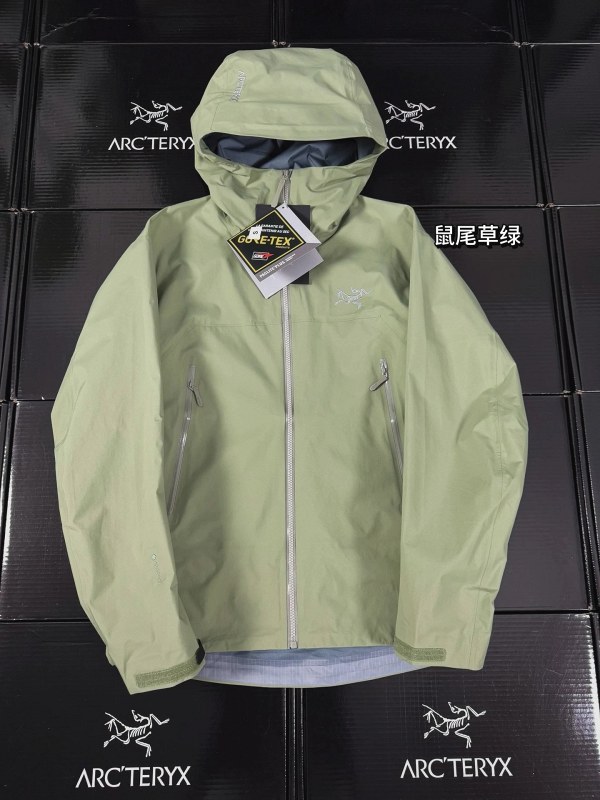
SKU 7705102092, listed at $141.04 against a $159.65 original price, marked in stock. The jacket is a solid light green — closer to a soft sage than the acid greens technical outerwear often uses — with a matching hood, full front zip, two zippered hand pockets and Velcro cuff tabs. The Arc'teryx logo sits on the chest as a pressed, multi-layer appliqué rather than a printed decal, and the seams over the shoulders and arms are taped.
Build details match the catalogue copy: a VISLON main zip, WaterTight-style pocket zips, two-way underarm YKK pit zips, a high collar and articulated sleeves. The StormHood has a single rear adjuster and two front pulls, and the brim is stiff enough to hold shape in wind.
Water and wind: the tilted pour test
We poured 25 mL of water onto a tilted section of the shoulder panel over five seconds and timed what passed through, three times, reporting the median. Water beaded immediately and ran off the face fabric; there was no measurable pass-through inside the five-second window in any run, and the scale recorded no meaningful weight gain on the paper beneath. A second pass on the hood brim behaved the same way.
In wear, the shell handled a full Rotterdam rain commute without wetting out at the shoulders or the elbows, where pack straps and handlebars usually win. Wind is where a light shell can feel flimsy: this one does not flap at the chest, and the high collar closes the gap under the chin.
The two-week everyday log
Our testing team logged rain, bike commuting, a busier-than-usual week of shoulder-bag carrying, and two afternoons at a workshop bench with metal swarf in the air. The face fabric shrugged off fine swarf and wiped clean; the cuffs and hem stayed flat rather than curling. The pit zips are the standout — two-way, easy to grab one-handed, and enough to dump heat on a fast walk.
Two caveats held up over the fortnight. First, a light three-layer shell trades abrasion resistance for packability: our sample shows faint scuffing on the lower sleeve, the kind that will accumulate over seasons rather than appear in one. Second, this is not a decade jacket. The line-level evidence we reviewed is blunt that a hard-used GORE-TEX shell wears out in a few years, and regular washing is part of ownership, not an optional extra.
Fit and sizing
In r/arcteryx fit threads, owners generally report Arc'teryx hardshells running true to size; most keep their normal size and some size down for a closer fit, with very few sizing up. Our sample behaved the same way — we wore our usual size over a mid-layer and had room for a light fleece without the shoulders pulling. The seller asks for height and weight at order, so give both, and confirm which size run applies before paying.
Before you order
- Ask the seller, in writing, whether the fabric is N40L GORE-TEX with a tricot backer or the Tri-Durance material named elsewhere in the listing.
- Confirm the size run: the page shows both XS–XXL and S–3XL.
- Ask whether a care label is present, since our bag arrived without one.
- Expect to wash and re-proof regularly; a light shell keeps its beading only with maintenance.
Verdict
As an everyday city-and-trail shell, this is a well-executed piece of outerwear: quiet colour, sensible hood, real pit ventilation and water behaviour that held up under test. It loses a little ground on abrasion margin and on the unanswered paperwork around fabric specification and sizing. Buy it as a light, packable shell you will actually wash and re-proof, not as a buy-once heirloom, and settle the fabric question with the seller before you commit.
Do these Arc'teryx shells fit true to size?
Owner threads on r/arcteryx report Arc'teryx hardshells generally run true to size; most keep their normal size or size down, and few size up. The listing asks for height and weight, so supply both.
How packable is this shell?
Line-level reviews put the lightweight Beta shell around 10.6 oz while retaining three-layer GORE-TEX. Our sample rolled into its own hood and fitted a small daypack lid without pressure on the zip.
How should a GORE-TEX shell be maintained?
Wash it regularly to keep beading and breathability, following the care label. Buyers in r/arcteryx note a hard-used shell can wear out within a few years rather than lasting a decade.