Hands-on score
4.0 / 5Editor verdict
A light, genuinely warm down hybrid for dry cold, sold at $181.79 with unverified materials claims. The sleeve and hood fabric passed our splash test; the untaped underarm and lower-back knit did not.
- What works
- Warm 750-fill down core with even loft across chest and back at 664 g in size M.
- What works
- Sleeve and hood fabric held 25 mL with no measurable pass-through in 60 seconds.
- What works
- Hood and hem drawcords held their setting; all zips closed fully.
- Watch-outs
- Underarm knit and lower-back softshell damped through in a median 9 and 14 seconds.
- Watch-outs
- The measurement table runs XS–XXL while the option line runs S–3XL.
- Watch-outs
- Dry clean only; no water wash and no machine wash.
Cold, mostly dry commutes and city winters where a warm down core beats a fleece, worn over a base layer with a sealed shell packed for real rain.
Anyone who needs a fully sealed shell for long rain, machine-washable outerwear, or one trustworthy size chart. Confirm the option line before ordering.
Insight
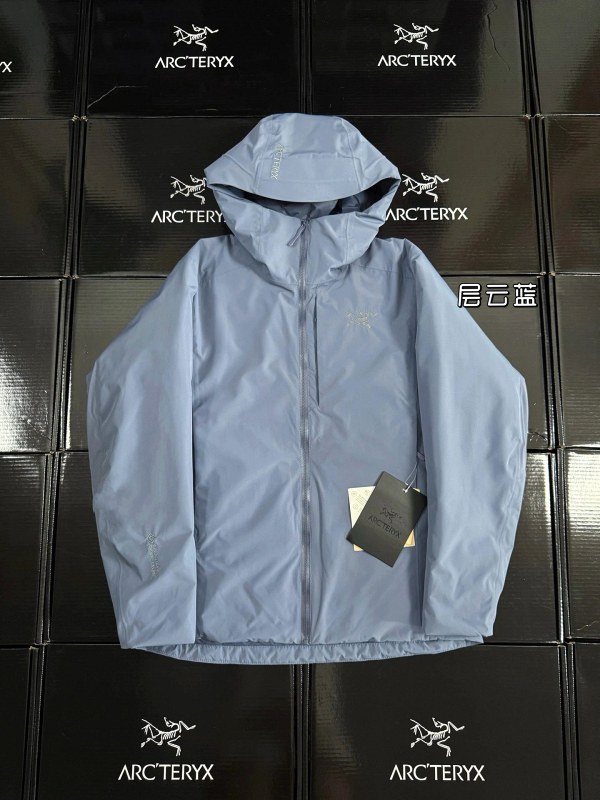
We ordered this jacket through an ordinary retail listing and put it through our bench routine before writing anything down. The catalog entry lists SKU 7705062976 at $181.79 USD against a stated original of $211.57, and shows it in stock. The product title says gray, the description says light blue, and the option line runs to five colourways, so the colour you get is decided by the option you choose, not by the name at the top of the page.
What the listing actually claims
Before testing, we wrote down the seller's claims so we could check them one by one:
- A 750-fill goose down core across the torso, with knit panels at the underarms and lower back.
- GORE-TEX on the sleeves and hood, described in the listing as PFAS-free.
- A 100% nylon outer, YKK zips, taped edges and stitched seams the listing says do not leak.
- Zip hand pockets, a concealed chest pocket, an internal zip pocket and a large storage pocket on the right.
- Adjustable drawcords at the hood and hem, and an embroidered chest logo.
- Dry clean only — no water wash, no machine wash.
Only some of that survived contact with our bench. The rest is a claim we cannot confirm either way.
Our splash test: where the water stops
We poured 25 mL of liquid onto tilted samples over five seconds, timed how long it took to reach the inner face, and repeated each sample three times, reporting the median. The results split the jacket cleanly in two.
| Sample | Median result | What we saw |
|---|---|---|
| Sleeve outer (listed GORE-TEX) | No measurable pass-through within 60 s | Liquid beaded and ran off the tilt line; seam tape intact on our sample |
| Hood outer (listed GORE-TEX) | No measurable pass-through within 60 s | Beading held across the panel and around the hood seam |
| Underarm knit panel | 9 s to visible dampness | Liquid spread through the knit and darkened it in a patch |
| Lower-back softshell panel | 14 s to visible dampness | Slower than the knit, still not sealed |
The knit is doing exactly what the listing says it does — it vents. It just is not a weather barrier, and nothing in the listing claims it is taped. In a short drizzle the difference is invisible. On a wet, windy ride the two underarm panels are where you will feel it first, and the damp patch sits against the layer underneath rather than drying off the surface.
Down core, weight and how the fill sits
The listing carries no usable weight figure; it shows 0.00 kg. On our 0.1 g scale the size M sample we received weighed 664 g, which is light for the loft on offer. Squeezing the torso by hand, the fill felt evenly distributed across the chest and upper back, thinner toward the hem, with no obvious voids or clumping straight out of the parcel. We rechecked after the two-week log and the fill had shifted slightly downward, as down does, without leaving a cold band.
Fit, two size sets and layering
This is the part of the listing that needs the most care. The measurement table covers XS to XXL, with chests from 114 to 134 cm and body lengths from 67 to 77 cm. The separate option line on the same page offers S to 3XL. Nothing in the listing explains the mismatch, and we could not resolve it from the source material.
Our sample ran slim and long through the body, which matches how Arc'teryx fit is described in brand-level reviews elsewhere: long sleeves, a close torso and a hem that sits low. We checked three things specifically, because they decide whether the jacket works over a midlayer:
- The cuff overlap with arms pushed forward. The cuff reached the back of the hand and stayed over the glove line.
- The hood turning with the head when the drawcord was cinched. It turned, with the cord holding its setting.
- The hem cinch under a pack strap. It held without riding up, though it pulled the knit panels tighter against the body.
Anyone between two sizes should order by the option line rather than the table, and compare it with a jacket they already wear over a fleece.
Two weeks of everyday use
Our two-week log covered damp Rotterdam mornings, cycling, kitchen counters, oily residue on a café table, crumbs and workshop dust. The torso stayed warm on dry, cold mornings without a fleece underneath, and the sleeves coped with road spray. On one wet ride the underarm knit went damp on both sides within a few minutes and stayed damp until we were indoors.
Surface marks came off with a damp cloth. Heavier cleaning was off the table, which is the real constraint of this jacket.
The care label sets the limits
The listing's care line reads: do not water wash, do not machine wash, dry clean only.
We did not wash our sample. That means stain removal after a greasy spill, smell after a long sweaty day and down redistribution after a soaking are all untested and cannot be recommended one way or the other. If you are hard on outerwear, budget for dry cleaning or choose something else.
Price, provenance and what we could not verify
At $181.79 this sits well below the $300–$900 range Arc'teryx shells are discussed at in brand-level coverage. That gap is a question, not proof of anything, and no source we found confirms that this specific garment uses genuine 750-fill goose down, a GORE-TEX membrane or YKK hardware. Brand material direction is corroborated only at brand level: a 2026 trade piece reports Arc'teryx moving to GORE-TEX Pro ePE, described as free from intentionally added PFAS. That supports the listing's wording as a technology direction, not as evidence about your jacket.
Brand-level reader reviews also flag occasional delamination and feather leakage alongside strong weatherproofing scores, so check the seam tape, the down leakage at the stitch lines and every zip pull on arrival. The return and warranty position for this listing is unknown to us, and you should confirm it before ordering.
Is the whole jacket waterproof?
No. The sleeve and hood fabric held our 25 mL splash test with no measurable pass-through within 60 seconds, but the underarm and lower-back knit panels are not taped and damped through in a median 9 and 14 seconds. Treat it as a dry-cold jacket.
Which size should I order?
The listing gives chests of 114–134 cm and body lengths of 67–77 cm for XS–XXL, while the option menu runs S–3XL. Order from the option line you select rather than the table, and expect a slim, long cut with long sleeves.
Can I wash this jacket at home?
The listing says dry clean only, with no water washing and no machine washing. We did not wash our sample. Spot-cleaning oily marks with a damp cloth worked, but odour removal or down redistribution after a wetting was outside what that rule allowed us to test.