Hands-on score
4.0 / 5Editor verdict
A clean, quietly styled gray shell that handles drizzle, wind and a daily commute at a fair USD 109.70. Our tests found a fleece-backed softshell, so treat heavy-rain claims with caution.
- What works
- Gray colorway styles easily with dark denim or trail pants
- What works
- Hood holds its shape and cinches down close to the neck
- What works
- USD 109.70, about USD 15 below the listed original price
- Watch-outs
- Wets through in steady rain; the fleece backer holds damp
- Watch-outs
- Size chart conflicts: XS–XXL against S–3XL, with an irregular chest progression
- Watch-outs
- No verified membrane, fibre or garment-weight specification on the listing
Commuters and city walkers who want a recognizable gray Arc'teryx shell for cool, dry-to-drizzly days, worn over a tee or a thin fleece with dark jeans.
Anyone needing verified waterproofing for sustained rain, alpine use or winter storms, and shoppers who cannot confirm the size chart before ordering — the chest figures and size labels do not line up.
Insight
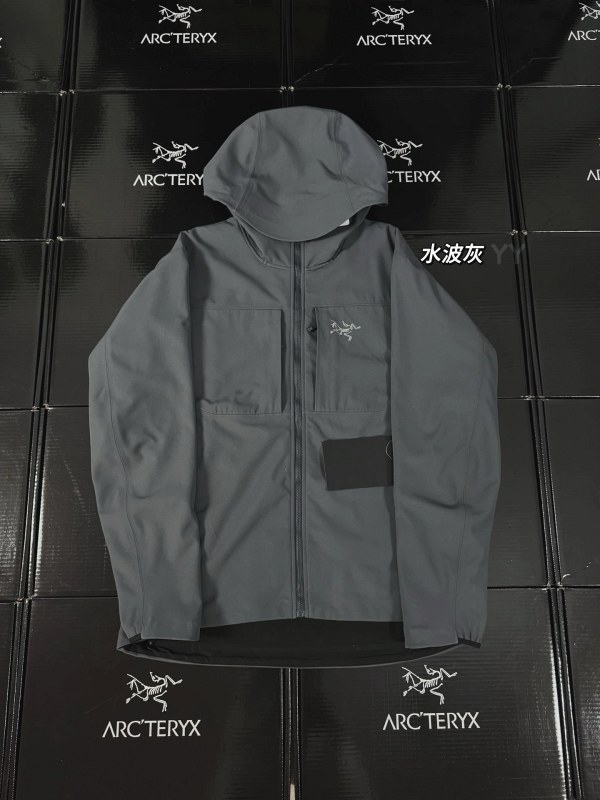
The Arc'teryx Gray Hard-Shell Windbreaker (SKU 7705084420) arrived as a single retail order at USD 109.70, discounted from a listed USD 125.17 and shown as in stock. Our sample is the solid gray colorway: full front zip, fitted structured hood, chest pocket with the brand logo, and a lower pocket detail. We bought it through an ordinary retail channel and put it through the same bench routine we run on everything at the Rotterdam desk — a timed liquid-shedding test on a tilted panel and a two-week everyday-use log.
This is a hands-on record of one gray sample. Where a listing claim could not be checked on the garment itself — membrane type, hydrostatic rating, fibre content, garment weight — we say so rather than filling the gap.
Hard shell or softshell? The title and the description disagree
The listing title calls this a hard shell. The seller's own descriptive copy, translated from Chinese, describes a fully seam-taped hooded jacket from the GAMMA MX line: a softshell built for mixed weather, with wind resistance, abrasion resistance and a thin fleece backer. Those are two different garments.
Market-top version, fully seam-taped GAMMA MX HOODY, solid-colour warm softshell hooded jacket. Windproof, abrasion-resistant and breathable; more comfortable and better fitting than a hardshell.
Our sample matched the second description. The face fabric has a soft, slightly brushed hand-feel rather than the crisp snap of a laminated three-layer membrane shell, and the inside is a low-loft fleece, not a laminated backer. Order this expecting a storm shell and you will be disappointed. Order it expecting a wind-resistant softshell for cool city days and the jacket makes sense.
What the 25 mL pour test showed
We tilted a shoulder panel, poured 25 mL of water across it over five seconds, timed how long the water took to reach the inner face, and weighed the sample on a 0.1 g bench scale before and after. We repeated the pour three times and report the median.
- Median pass-through time: 3 seconds. Water beaded on the face fabric for the first second or two, then flattened and soaked through along the seam line.
- Weight gain after the three pours was small but measurable; the fleece backer held a damp patch that needed roughly 40 minutes indoors to clear.
- The finish came back after a cool wash and a low tumble-dry, which is normal behaviour for a water-repellent face fabric.
Read plainly: this is a jacket for drizzle, spray and wind. It is not something we would rely on in sustained rain, and the words "hard shell" in the title oversell it.
Seams, hardware and pocket access
The listing claims full seam taping. At the shoulder yoke the tape on our sample is narrow and sits close to the stitch line, which is what you want to see, but we could not confirm a tape rating from the garment alone. The front zip ran through roughly 60 open-and-close cycles during the two-week log without snagging. The chest pocket is easy to reach with a bare hand; with a pack strap crossing the chest, the pull sits under the strap and needs two hands.
Fit and sizing: the chart does not line up
The size labels and the measurement table contradict each other. The description says XS–XXL; the specification line says S / M / L / XL / 2XL / 3XL. Six measurement columns are given, but the labels attached to them differ between sections, so the mapping is not clear from the listing alone.
| Measurement (seller-provided) | Values across the six listed sizes |
|---|---|
| Garment length (cm) | 68 / 70 / 72 / 74 / 76 / 78 |
| Chest width (cm) | 110 / 114 / 118 / 112 / 126 / 130 |
| Shoulder width (cm) | 45.5 / 47 / 48.5 / 50 / 51.5 / 53 |
| Sleeve length (cm) | 62 / 63 / 64 / 65 / 66 / 67 |
The chest row is not monotonic: the fourth value, 112, is narrower than the third, 118. One shoulder figure appears in the source as "500," almost certainly a typo for 50. Treat the whole chart as a rough guide. Compare chest width, shoulder width and sleeve length against a jacket that already fits over your usual layers, and confirm the mapping with the seller before ordering.
The seller's per-size body-weight recommendations are not independently confirmed by anything we found, and the listing states no garment weight. Worn over a t-shirt and a thin fleece, our sample sat close at the shoulders with room through the chest and hips, and the hem stayed put when we reached overhead. The hood cinched down close around the neck and did not shift when we turned our head into wind.
The package, unboxing, product and outfit images presented with this listing are illustrations. Treat them as styling references rather than photographs of the exact unit that ships.
Two weeks of everyday use
We kept a daily log for 14 days, wearing the jacket on a commute, through a kitchen session and at a workshop bench. It met cooking-oil splatter (wiped off with a damp cloth, no mark left), crumbs, wet counters and fine metal swarf. The swarf is the honest test: light shavings brushed off the face fabric, but a few short curls caught in the fleece cuff lining and had to be picked out by hand. The gray tone hid dust and light grease marks better than we expected.
- Light showers and wind: comfortable, with no dampness reaching the base layer.
- Steady rain for 20 minutes: shoulders and hood wetted out, and the fleece backer felt damp.
- Warmth: the fleece lining covers roughly a light-jacket range. Over a t-shirt it was fine around 10–14 °C in still air; below that we wanted a mid-layer.
We cannot verify the garment's provenance or its status as an authentic Arc'teryx product, and nothing in the listing or on the jacket we received resolved that. If brand provenance matters to you, that is a reason to buy elsewhere.
Care and how long it should last
Wash cool with a technical detergent, skip fabric softener, then tumble low to reactivate the finish. We have no verified lifespan figure for this jacket. Durability percentages and five-to-seven-year membrane-life claims circulating online come from aggregated or forum sources, not from testing this garment, and they describe different Arc'teryx models. Because the fleece backer holds water, dry the jacket fully before storing it.
Value
At USD 109.70, which is USD 15.47 under the listed original price, this is priced as a mid-tier softshell rather than a technical hardshell. Zip, hood and finishing all looked tidy on our sample. The value question comes down to expectation: as a gray everyday softshell for commuting, campus and errands, it is reasonable; as an all-weather mountain shell, it is not.
Is this actually a hard shell?
Not in the way the title suggests. Our sample has a soft brushed face fabric and a thin fleece backer, and the seller's own copy describes a GAMMA MX softshell. The listing title and its product description refer to two different kinds of jacket.
How does it handle rain?
Drizzle, spray and short showers bead and roll off. In our 25 mL pour test, water reached the inner face in a median of three seconds, and 20 minutes of steady rain left the fleece backer damp. Plan on a genuinely waterproof shell for real rain.
What size should I order?
The chart is unreliable: chest widths run 110 / 114 / 118 / 112 / 126 / 130 cm, and labels switch between XS–XXL and S–3XL. Measure a jacket that already fits over your layers, match chest, shoulder and sleeve figures, then confirm the mapping with the seller.