Hands-on score
4.0 / 5Editor verdict
A tidy $104.48 fleece-lined softshell with effective DWR and a helmet-first hood. It is not the seam-sealed hardshell the name promises, and the chest chart needs seller confirmation before ordering.
- What works
- DWR beaded strongly on sleeve and chest; only the hood seam passed water.
- What works
- Fleece backer and regular shoulder cut suit changeable weather and layering.
- What works
- Clean blue finish, tidy zips and useful hand pockets at a mid-range price.
- Watch-outs
- Not waterproof: no taped seams, and the hood seam passed water in 48 seconds.
- Watch-outs
- Chest chart lists L (112 cm) below M (118 cm); shoulder row shows "500".
- Watch-outs
- Helmet-compatible hood is flappy bareheaded; narrow through the midsection.
Commuters, climbers and workshop users who want a fleece-lined softshell for short showers and changeable weather, and who will verify the size chart first.
Buyers who need seam-sealed waterproofing for sustained rain, a trim bareheaded hood, or a cut with room through the midsection.
Insight
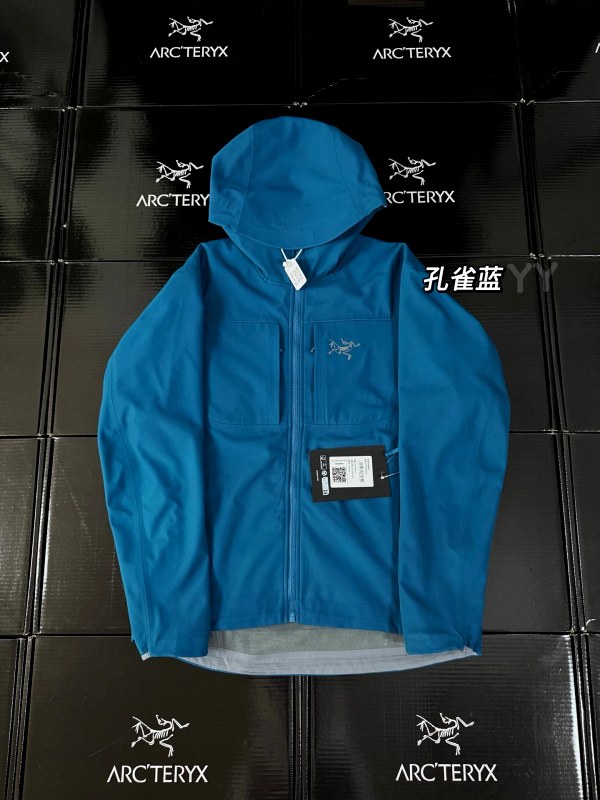
We ordered the Arc'teryx Blue Waterproof Hard-Shell Jacket (SKU 7705058876) through a retail channel, paid $104.48 against a $110.08 original price, and it arrived in stock. The name on the listing is the first thing to test, because the jacket in the box is a fleece-lined softshell — a Gamma MX-style piece with a DWR face — rather than a seam-sealed hardshell. That gap between label and construction shapes everything below.
What the $104.48 buys
The sample is solid blue with a full-length front zip, an attached hood, a vertical zippered chest pocket and two hand pockets. Inside there is a thin fleece backer and a branded tag on the main zipper. We found no seam tape on the interior. The listing offers ten colourways and sizes XS–XXL, while a second spec line says S–3XL. The face fabric is soft and quiet rather than stiff, which is the first clue that this is a softshell.
Bench test: 25 mL on a tilted panel
We ran the same liquid-shed test we use at the desk. A 25 mL measured pour is released onto a tilted panel over 5 seconds; we record pass-through time to the nearest second and weigh the panel before and after on a 0.1 g scale. Each area gets three repeats and we report the median. We tested the sleeve face, chest face and hood crown seam without cutting the garment.
| Panel | Median pass-through | Median mass gain | Observation |
|---|---|---|---|
| Sleeve face | None within 120 s | 0.4 g | Water beaded and ran off; face stayed dry to touch |
| Chest face | None within 120 s | 0.5 g | Beaded well; slight darkening along the zip edge |
| Hood crown seam | 48 s | 1.3 g | Water tracked the seam; fleece inside felt damp |
Those are strong DWR numbers on the panels and a weak result at the seam. A hardshell depends on a membrane and taped seams; a DWR finish only makes water bead on the surface. The hood seam is the honest tell. We could not find a hydrostatic-head rating or a named membrane in the listing, so there is no number to compare against a proper rain shell.
Two weeks in the log
Our everyday-use log ran for 14 days across commutes, a workshop bench and two short crag evenings. We tracked oil, crumbs, wet counters, metal swarf and rain.
- Oil. Drops beaded on the sleeve and wiped away with a dry cloth. A patch on the cuff went dark and needed a technical wash to come clean.
- Crumbs and dust. Brushed off the face fabric without marking it. The fleece cuff collected lint and a little sawdust.
- Wet counters. A 60-second press against a wet counter left a small damp patch on the inside of the forearm. That is normal for a softshell and a reminder that pressure defeats DWR.
- Metal swarf. Fine filings brushed off the face. A few caught in the fleece cuff and had to be picked out; sharp swarf is not this fabric's friend.
- Rain. A 15-minute walk in steady rain beaded and stayed dry. At around 30 minutes the shoulders wetted out and the fleece felt damp at the collar.
The log matches the bench: effective against splashes and short showers, not a sustained-rain garment. The hood is helmet-compatible and therefore roomy; bareheaded, it sits loose and flaps in wind. Buyers on the Gamma MX line report the same trade-off. Venting comes from opening the front zip and the hand pockets.
Fit and the chart problems
The cut is regular through the shoulders and elbows and narrow through the midsection; buyers with a belly report tightness. The listing's chest row runs 110, 114, 118, 112, 126 and 130 cm from XS to XXL, so L is listed 6 cm smaller than M. That is almost certainly a typo for 122, but it is still a typo you should not guess at. The shoulder row includes "500" where 50.0 belongs. Body length runs 68–78 cm and sleeve 62–67 cm. Weight guidance is given in jin: XS about 40–47.5 kg through XXL about 90–105 kg. Ask the seller to measure the chest of the size you are buying, flat, before you pay.
Details worth knowing
The product copy mentions one vertical chest pocket, while Gamma MX line references describe two symmetrical chest pockets. Our sample has a single vertical chest zip and two hand pockets. If pocket count matters to you, check the seller's current photos rather than the line description. The main zipper carries a branded pull and tag; the interior lining is visible and soft against a base layer. The blue is a flat, clean shade that does not read shiny in daylight.
Care and the DWR clock
DWR is a wear item. Wash with a technical cleaner, skip softener, and tumble on low or iron warm per the care tag to reactivate the finish. When water stops beading and starts darkening the face, reapply a spray-on DWR. Fresh DWR will not turn this jacket into a hardshell; it will restore the short-shower performance we measured. Store it dry and clean, because workshop dust and oil reduce beading faster than rain does.
Open questions before you order
- No hydrostatic-head figure or membrane name appears in the listing.
- The L chest measurement and the "500" shoulder value need seller confirmation.
- Pocket count differs between the product copy and the Gamma MX line.
- Authorization is not something we can verify from a marketplace listing; our score covers the sample we bought.
At $104.48, the jacket sits in mid-range softshell money, well below the Gamma MX line it references. The stitching, zips and fleece backer look tidy for the price; the label and the size chart are where the risk sits. If you need a rain shell, the 48-second hood-seam result is the number to remember. If you need a softshell, the sleeve and chest panels held their beading through the full test.
Is the Arc'teryx blue shell jacket actually waterproof?
No, not in the hardshell sense. Our sample has a DWR face and a fleece backer but no taped seams. It sheds short showers; the hood seam passed water in our 25 mL test and steady rain wetted the shoulders.
Which size should I order?
Start with the weight bands, then confirm the chest figure with the seller: the chart lists L at 112 cm, below M at 118 cm. Buyers report a regular shoulder fit and a narrow midsection, so size up if you carry weight there.
Can I wear it for workshop tasks?
Yes, for light duty. Oil beaded and wiped off, crumbs brushed away, and fine metal swarf mostly brushed off the face fabric. It is not chemical-resistant, and sharp swarf can catch the fleece cuff, so keep it away from cutting benches.