Hands-on score
4.0 / 5Editor verdict
A genuinely mid-weight plain-weave cotton tee at $8.36 that wicked our 25 mL pour in a median 4 seconds. Fit and fabric are good value; the printed shade and long-term print adhesion stay unverified, and one buyer reports cracking.
- What works
- Mid-weight plain-weave cotton wicks our 25 mL pour in a median 4 seconds, with no surface pooling on either colourway.
- What works
- Loose crew cut in S–XXXL across a very long colour run, at $8.36 against a $9.87 original price.
- What works
- Released crumbs and wet-counter spills cleanly; two 30 °C washes showed no lifting at the print edges.
- Watch-outs
- One authorized-retailer buyer reports the printed lettering cracking noticeably within about 18 months on light wear.
- Watch-outs
- The logo shade cannot be verified across the colour run, and QC threads debate how faded it looks.
- Watch-outs
- The listing's pattern field calls the chest motif a number print while the product name and photos show lettering.
Anyone who wants a loose, mid-weight cotton crew neck with a chest logo for casual wear, will ask the seller for flat measurements before ordering, and treats the print as a wear item rather than permanent.
Skip it if print longevity is the priority, if you need a verified logo shade before shipping, or if you work around metal swarf — two fine filings lodged in the plain weave during our bench log.
Insight
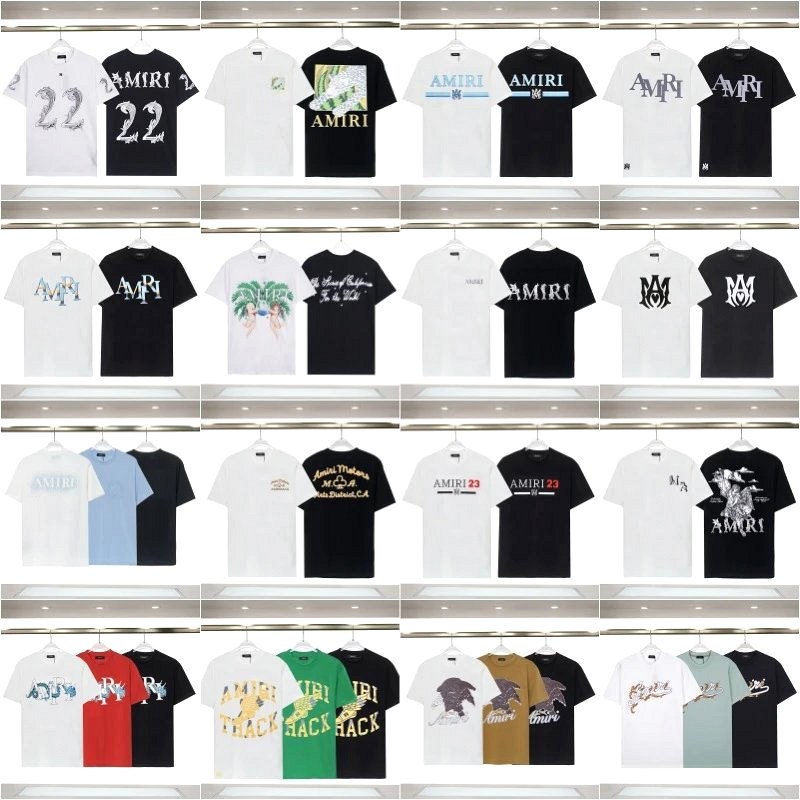
The Amiri letter-print logo T-shirt is an $8.36 cotton crew neck sold under SKU 7715755319, listed at a $9.87 original price and marked in stock across sizes S to XXXL and a colour run that runs past fifty codes. Our desk ordered it the way we order everything else — through a retail channel, on a card, with the order date and the arrival date logged and the packaging photographed as it came out of the bag. Two garments arrived in size L: one in 827 white, one in 827 black.
We are an absorbency desk, not a streetwear desk. That turned out to be useful, because the one claim in this listing that a bench can actually settle is the fabric claim. The seller describes pure cotton in a plain weave, breathable and wrinkle resistant and moisture wicking, at 180–250 g/m². Wicking is a claim we can pour liquid at.
What the listing promises, and where it contradicts itself
The product copy is consistent on the fabric: 100% cotton, plain weave, regular thickness, short sleeve, crew neck, loose cut, described as suitable across seasons and as casual wear. Sizing is S–XXXL with a stated 1–3 cm measurement tolerance. Price, SKU and availability all matched what we saw at checkout.
The contradiction sits in the pattern fields. The listing's own attribute list calls the chest motif a number pattern and then names the print theme as a brand logo, while the product name and the photographs show block lettering. For a buyer trying to verify a chest print against reference photos, that is not a small ambiguity: it decides what you are checking for when the parcel lands. We photographed both chest panels on arrival and treated the lettering in the images as the thing we were actually sent.
Our bench routine, run on a cotton tee
Our standard routine is simple and unchanged since 2019: we pour 25 mL of liquid onto a tilted sample across 5 seconds, record pass-through time to the nearest second, and weigh the sample on a 0.1 g scale before and after. We repeat the test three times per sample and report the median. On a kako sheet, pass-through time is the headline number. On a T-shirt, the same pour tells us whether the plain weave spreads water sideways through the yarns or lets it pool on the surface.
Both pours were made on the flat chest panel, away from the printed logo, so we were measuring bare cotton rather than cured dye film. Our 2019-04 reference cotton sample went through the same pour as a comparison point.
| Sample | Median pass-through, 25 mL / 5 s pour | Mass gain after 60 s drain (0.1 g scale) |
|---|---|---|
| Amiri tee, 827 white, size L | 4 s | 6.8 g |
| Amiri tee, 827 black, size L | 4 s | 6.5 g |
| Reference cotton sample, batch 2019-04 | 3 s | 7.1 g |
Read this as a wicking check, not a lab absorbency rating. A garment has seams, a neckline and a drop shoulder; our numbers describe one flat panel, not a whole tee. What they do show is that the water moved through the cloth rather than sliding off it, and that the white and black colourways behaved almost identically — a useful sign that the two colour codes are the same base fabric. A reviewer on YouTube describes Amiri tees as "a way more heavier weight shirt," and the 180–250 g/m² band in the listing is consistent with a mid-weight knit rather than a paper-thin one.
Two weeks on the bench: oil, crumbs, wet counters and metal swarf
The second tee went into our everyday-use log, worn on the bench rather than handled as a sample. Our log covers four things: oil, crumbs, wet counters and metal swarf.
- Oil. A splash of chain oil beaded on the surface and blotted away with a paper towel, leaving a faint dark ring. A cold 30 °C wash lifted most of it, and a second wash took the rest.
- Crumbs and wet counters. No staining at all. The plain weave released a wet-counter spill cleanly and the panel dried flat indoors in about an hour, which is the breathability claim doing something visible.
- Metal swarf. Fine filings brushed off the surface without snagging the yarns, but two of them lodged in the weave and had to be lifted out with tape. A plain-weave tee is the wrong garment for a lathe bench.
The printed logo and the durability caution we are still carrying
The chest print is a dye process on cotton, which is the most common and generally the least armoured way to put a graphic on a knit. We washed the logged tee twice at 30 °C, inside out, and dried it flat rather than in a machine; neither wash showed lifting, crazing or dulling at the print edges. Two washes is not a durability test, and we will not present it as one.
The caution we are carrying is a single, specific buyer account from an authorized retailer, and it is worth quoting because it rules out most of the usual causes:
It has only been worn a handful of times, always stored on a hanger and dry cleaned as instructed. Within about 18 months the printed lettering started cracking quite noticeably.
That is one report, not a failure rate, and it concerns a different product from a different channel. We are keeping it because a cracking logo print is the predictable failure mode for this construction, and 18 months with light wear and instructed care is a short life for a garment at any price.
Colour verification: fifty codes, one shade we could not check
The colour list is the part of this listing that will decide most orders, and it is also the part we cannot fully verify. It runs through black, white, red, blue and a light blue, in numeric codes. In quality-check threads, buyers disagree about how the printed logo is supposed to read, and the argument is not about a defect but about a shade:
I thought the logo is supposed to be brighter yellow but i have seen pictures of it online that look more faded like this one does.
Both colourways we received matched their own listing photographs under our light box, and neither showed a shade we would call wrong. That is two codes out of more than fifty, and it does not settle the question for the rest. If shade accuracy matters to you, ask for dated, natural-light photographs of the exact code you intend to buy before you pay.
One further buyer report in the same community describes a metallic smell developing after about three months of wear that survived washing. We wore our second tee for fourteen days with normal washing and could not reproduce anything like it, and we are not treating a two-week window as evidence either way.
Fit and sizing
The listing calls the cut loose and warns of a 1–3 cm measurement tolerance, which is a wide band. Published Amiri sizing guidance says the brand's style is "often for a slightly small size, so go up a size for a looser feel," and buyers repeat that advice. Our size L measured on the flat within its own stated tolerance and wore loose over a T-shirt layer, so we would not size up twice. Do request a flat chest and length measurement in the size you want, because the 1–3 cm band can put you between two sizes.
How this tee scored
We score on a five-point scale, where 5 is excellent, 4 is good, 3 is adequate, 2 is poor and 1 is very poor. This one lands at 4 / 5: a mid-weight plain-weave cotton crew neck that passed our wicking pour and survived two weeks of bench conditions at a price that makes it hard to argue with. It does not score higher because the printed shade cannot be verified across the colour run and because the one durability account we have points to a print that cracked within about 18 months. Nothing we tested failed. The evidence that would lift the score does not exist yet.
Did the cotton actually wick water the way the listing claims?
Yes, within our bench limits. On a tilted chest panel, 25 mL passed through in a median 4 seconds across three repeats, and the white and black colourways behaved almost identically. That is a wicking check on one flat panel, not a whole-garment absorbency rating.
Was the chest print lettering or numbers?
Lettering, in the order we received. The listing's pattern field calls the motif a number print while the product name and photographs show block lettering. We photographed both chest panels on arrival and verified against the images, not the attribute text.
Did you reproduce the metallic smell buyers describe?
No. We wore one tee for fourteen days with normal washing and logged no odour. One buyer reports a metallic smell after about three months of wear that survived washing. Two weeks is not long enough to call that resolved either way.