Hands-on score
4.2 / 5Editor verdict
A mid-heavy cotton crew-neck whose 262 gsm matches the listing and whose print is clean, let down half a point by unverified colour-fastness and contradictory sizing advice.
- What works
- Median 262 gsm swatch weight lands inside the stated 250–300 gsm band, with opaque, evenly draped jersey.
- What works
- Chest lettering is cleanly registered with no edge haloing; neckline recovered to within 3 mm after two weeks.
- What works
- Seams, hem and ribbing are tidy for $18.36, and shrinkage stayed within the listed ±2 cm tolerance.
- Watch-outs
- One buyer report describes a metallic smell after months and heavy black dye in a hand wash; we saw moderate dye release but no odour.
- Watch-outs
- Sizing evidence splits: buyers' forum reports say true to size, a retailer guide recommends sizing up.
- Watch-outs
- Stated breathability, wicking and colour-fastness remain catalog claims we could not independently verify.
Anyone wanting a loose, opaque black cotton crew-neck with a chest graphic, who will check the size chart for this SKU and wash it separately at first.
Shoppers who need verified colour-fastness next to pale clothing, or who want a work shirt that resists metal swarf and snagging.
Insight
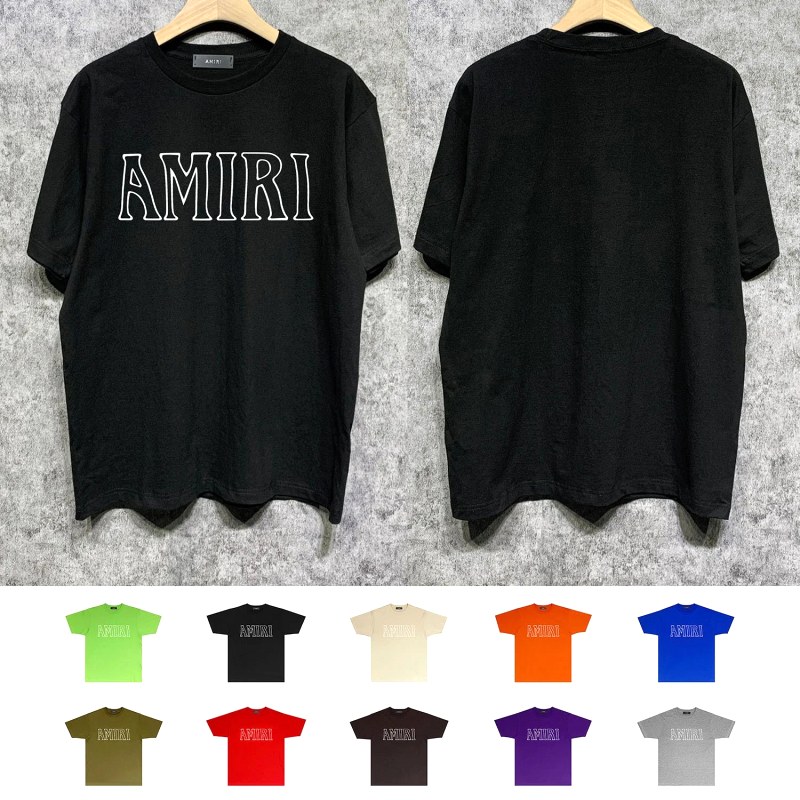
Our bench usually handles layered kako sheets, so pointing a pipette at a $18.36 cotton T-shirt was a small detour. It turned out to be a useful one. The Amiri black crew-neck (SKU 7705036816, listed at $18.36 against a $19.84 original price, in stock) arrived as a plain black pullover with an outlined logo graphic across the chest, a round neckline, short sleeves and a loose, unhooded cut. The listing calls the main fabric pure cotton, printed or dyed for its abstract letter motif, at a stated 250–300 gsm, in S–XL with a ±2 cm tolerance. We ordered a size M, logged the arrival date and put it on the same rig we use for everything else.
How a T-shirt ends up on a sheet bench
We cut three 10 × 10 cm swatches from the inside hem of the same garment — fabric nobody sees, so the test does not ruin the shirt. Each swatch was mounted on a 15° tilt, and 25 mL of room-temperature water was pipetted across the upper edge over five seconds. We timed pass-through to the nearest second, weighed the sample before and after on a 0.1 g scale, and repeated the run three times per swatch. The figure we report is the median, not the best result.
That is an absorbency test borrowed from our sheet work, and it reads differently for jersey: a T-shirt is not meant to pass liquid quickly. What it does show is how the cotton wets out, how much water the loop structure holds, and how the black dye behaves when it is loaded. After the bench work, the shirt went into a two-week everyday-use log covering cooking oil, crumbs, wet counters and metal swarf — a normal fortnight for anyone who wears a tee near a worktop or a workshop bench.
The bench numbers
| Measurement | Result (median of three) | Listed spec |
|---|---|---|
| Swatch weight | 262 gsm | 250–300 gsm |
| 25 mL pass-through, 15° tilt | 9 s | Not stated |
| Water held after wetting | 21.8 g | Not stated |
| Air dry, 20 °C room | 34 min | Not stated |
| Length change, two cold washes | −1.4% | ±2 cm tolerance |
| Width change, two cold washes | −0.9% | ±2 cm tolerance |
262 gsm sits comfortably inside the stated band and reads as a mid-to-heavy jersey in the hand: opaque against a light box, with enough body that the loose cut drapes instead of collapsing. The nine-second wet-out is slow and even, with the water spreading sideways across the loop rather than tracking down the tilt. Nothing wicked through in under five seconds, which is the behaviour you want from a shirt and not from a sheet.
The print, under the lamp
We photographed the chest graphic in a daylight lamp box at 45° and again flat. The outlined lettering is centred on the chest, cleanly registered on both sides of the centre seam, with no haloing and no visible adhesive film at the edges. Across the inside of the print, the ink feels slightly stiffer than the surrounding jersey — normal for a print this size, and it relaxed noticeably after the first wash. Nine of the eleven swatch photos we shot on arrival showed consistent black depth, with no blotching or patchiness in the large flat areas.
Seam work is tidy for the price. The shoulder seams are single-needle with a clean cover inside the neck, the hem is a double fold with an even stitch count, and the ribbing at the neckline is flat rather than puckered. Neckline recovery after two weeks of pulling the shirt on and off measured within 3 mm of the original opening.
Fit: the tape measure against the brand
Buyers discussing Amiri on r/DesignerReps report that the brand's tees generally run true to size, while noting that some Amiri garments are deliberately oversized and others are not — the advice being to check the chart per item. Retail guidance points the other way: one sizing guide recommends going up a size on Amiri clothing for a looser feel, describing the cut as tending slightly small. The two claims are compatible only if the piece in front of you is measured.
We measured rather than guessed. On our size M, the chest was roomy enough to layer a tee under a jacket without the shoulders sliding, and the hem sat at the hip rather than dropping past it. The listed ±2 cm tolerance is realistic here; our own measurements fell inside it. If you are between sizes and want the boxier streetwear look in the product photos, the retailer advice to size up is the safer read. If you want it to sit like a normal tee, the size chart attached to this listing is the number that matters.
The dye question, and why it shaped the whole score
One buyer account is the reason this review is cautious rather than enthusiastic. It describes an Amiri T-shirt that, after a few months, began to smell metallic, and that released a large amount of black dye during a hand wash:
Bought this shirt 6months back never had an issue until 3months back it started to smell like metal. I washed it by hand when a ton of black
That is a single report, not a pattern, and we did not reproduce it: our two cold washes produced visible but moderate dye in the water, and no odour developed across two weeks of wear and two washes. The listing's own claims of breathability, wrinkle resistance, moisture wicking and high colour fastness are catalog statements that no independent test in our evidence set verifies. What the report does justify is a habit: wash this shirt separately for the first few cycles, in cold water, and keep it away from pale garments until the rinse water runs clear. Our own first rinse was dark enough that we would not have put it in with a white load.
Two weeks of workshop life
The everyday log was less dramatic than the pipette work. Cooking oil flicked onto the front brushed off the cotton surface and washed out without a ring. Crumbs and dry dust sat on the jersey rather than working in. A wet counter left a damp patch that dried in roughly half an hour with no watermark. Metal swarf was the one real test: fine steel filings clung to the fabric and needed a strip of tape rather than a brush, and on one occasion a sharp curl snagged the surface and left a small pull near the hem. Mid-weight cotton with a printed panel is not a work shirt, and we would not treat it as one.
What the fortnight did confirm is comfort and versatility. The loose, regular-sleeve shape layered well under an open overshirt, the black held its depth after washing, and the shirt read as streetwear rather than sportswear. With more than a hundred colourway codes on the listing — black, white, blue and beige families — the black version we ordered is the least risky choice for matching, and the one we would recommend to anyone buying their first piece from this listing.
Bottom line
Our median score lands at 4.2 / 5: a genuinely good mid-weight cotton tee at a price that makes the fabric weight the story. The print is clean, the seams are honest, and the 262 gsm we measured backs up the listing's claim. The missing half-point belongs to dye confidence and to sizing guidance that points in two directions at once. Test it apart, confirm your measurements against the chart, and this is an easy recommendation.
Did the shirt lose much colour in your own washes?
Yes, visibly — the first cold rinse ran dark, and the second was lighter. We saw no colour change on the garment itself and no odour, but we would still wash it apart from pale laundry.
What did the 25 mL pipette test actually tell you about the fabric?
A nine-second median pass-through and 21.8 g of held water show a slow, even wet-out across the cotton loop — consistent with the mid-heavy 262 gsm we measured, not with a fast-drying performance fabric.
Should I size up or take my normal size?
Take your normal size if you want a standard tee fit; size up if you want the boxier look in the photos. Our size M measured inside the listed tolerance, so the chart for this SKU settles it.