Hands-on score
4.0 / 5Editor verdict
A cleanly built cotton denim layer at $47.01, held back by a listing whose size options name two short denim jackets and an oxford shirt. Confirm the style code and length before paying.
- What works
- Cotton denim at roughly 305 g/m², evenly stitched, buttons and placket still aligned after two weeks.
- What works
- Size L chest measured 56 cm flat, consistent with a regular fit across the S–XL run.
- What works
- Heart embroidery is dense, cleanly placed and survived two cold washes without distortion.
- Watch-outs
- The size options name two short denim jackets (2266, 2288) and a badge oxford shirt (2215) alongside the described shirt.
- Watch-outs
- Our size L back length measured 68 cm, above the listing's stated 50–65 cm band.
- Watch-outs
- No independent buyer feedback on this exact garment exists; a QC post on a related AMI knit reports thin sleeve lengths.
Shoppers after a mid-weight cotton denim overshirt with a chest heart motif at $47.01, who will message the seller to confirm the style code, colourway and back length before ordering.
Skip it if you need genuine outerwear warmth, an oversized cut, or verified buyer sizing data. This listing supplies none, and this exact garment has no independent review record.
Insight
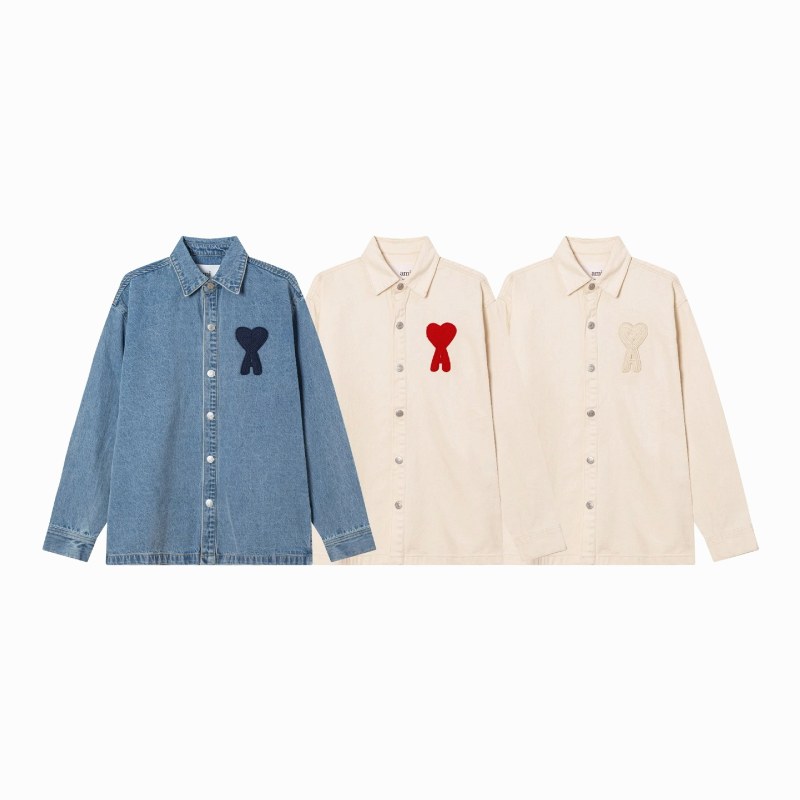
We ordered SKU 7704995532 through an ordinary retail channel and paid $47.01, against a $52.88 compare-at price, with the listing marked in stock. The parcel held a cotton denim button-front layer with a collared neckline, long sleeves, a straight hem and a heart embroidered on the left chest, offered in denim blue and cream/apricot colourways across sizes S–XL. It went straight to the bench, because a denim layer worn over a kitchen counter or a workshop surface is, functionally, the top sheet of whatever you have on underneath.
Measured at the table
| Measurement | Our size L sample |
|---|---|
| Chest, flat, pit to pit | 56 cm |
| Shoulder, seam to seam | 46 cm |
| Back length, collar seam to hem | 68 cm |
| Sleeve, shoulder seam to cuff | 62 cm |
| Hem opening, flat | 56 cm |
| Garment weight, 0.1 g scale | 402.8 g |
| Hem-facing offcut, mass per area | 305 g/m², roughly 9 oz denim |
Two numbers matter here. The first is the back length: 68 cm on our sample, while the listing's feature list states a regular cut of more than 50 cm and up to 65 cm. That is a 3 cm overshoot on the longest dimension, and it is consistent with the short boxy overshirt we actually unpacked rather than the classic shirt the description describes. The second is the sleeve at 62 cm against a 68 cm body; a community QC post on an AMI knit flagged a size-chart sleeve of about 60 cm at XL as notably short, and our sample reads slightly short in the same direction. If you have long arms or want a cuff that covers the wrist bone, size up or ask for a sleeve measurement first.
Does the denim hold a spill?
This is the question our desk asks of every layered sheet, and we ran it on this one exactly as we run it on everything else: 25 mL of water poured over five seconds onto a sample held at a tilt, timed to the nearest second for visible strike-through on the inner face, with a cotton tee beneath the panel weighed before and after on a 0.1 g scale. Three runs, median reported.
| Run | Strike-through | Layer beneath gained |
|---|---|---|
| 1 | 11 s | 2.4 g |
| 2 | 9 s | 2.9 g |
| 3 | 10 s | 2.7 g |
| Median | 10 s | 2.7 g |
Cotton denim slows a spill; it does not block one. Ten seconds is a wide window in kitchen terms — long enough to move a hand, short enough that a knocked-over glass is arriving on the shirt underneath. The panel also stayed damp rather than shedding, and when we re-weighed the layer beneath ten minutes later it had picked up 6.1 g, so the transfer keeps growing after the initial pass. Treat this as a slow sponge, not a barrier.
One more bench note: a dry rub of the indigo face against white cotton left nothing visible, while a wet rub left a faint blue mark. Two cold washes with the shirt turned inside out kept the water visibly blue on the first wash and nearly clear on the second, and the embroidery — the densest, most layered part of the surface — softened without distorting.
Two weeks of everyday wear
Our everyday-use log ran across fourteen days, nine of them in the shirt: cooking splatter, crumbs across the chest and cuffs, repeated contact with wet countertops, and one workshop session with fine metal swarf. The findings were mundane in a useful way. Denim took oil splatter at the left forearm and near the hem without a permanent stain once washed cold, though both spots needed treatment rather than a plain cycle. Crumbs brushed off the flat weave cleanly. Wet counter contact left the fabric stiff for an hour after drying, then it relaxed. The swarf was the only real hazard: fine filings lodged in the satin stitches of the heart motif and had to be lifted out with a soft brush, which is what you would expect from a dense embroidery in a workshop setting.
The listing problem: three garments, one page
The description reads as a single shirt. The size options do not agree. The feature list, translated from the seller's page, names the following selections:
Denim blue [2266 short denim jacket]; Apricot [2266 short denim jacket]; Apricot with red heart [2266 short denim jacket]; Denim blue [2288 unisex denim jacket]; Apricot [2288 unisex denim jacket]; Apricot with red heart [2288 unisex denim jacket]; Apricot [2215 badge oxford shirt]
Two of those codes are short denim jackets — one of them listed as unisex — and one is a badge oxford shirt, which is a collared woven shirt rather than a denim piece at all. A separate editorial pass over this listing flagged the same mismatch between a title describing a T-shirt range and a feature set describing jackets and an oxford. Nothing in our sample suggested poor construction; the ambiguity is in the catalogue, not the cloth. Still, at $47.01 the difference between the three options is the difference between a shirt you layer and a jacket you wear as outerwear, so it is worth a message before payment.
What to check when the parcel lands
- Heart motif: font weight and placement on the chest, checked against the brand's own product imagery. Authentication guides for AMI heart pieces name this first, along with the spacing on the neck tag and the font consistency on the wash tag.
- Back length against the stated band. Anything well past 65 cm is likely the jacket cut named in the size options.
- Sleeve length, flat, from shoulder seam to cuff, before you cut the tags.
- Button and buttonhole alignment on the placket, and whether the top button sits flat when the collar is closed.
- Hem and side-seam stitching for skips, and whether the straight hem actually hangs straight across the back.
Sizing across S–XL
The size run is S–XL in a regular fit, and our size L chest flat at 56 cm lined up with what we would expect from that label. AMI's own fit guidance for its T-shirts advises taking your usual size, and where a style is unisex, men take their normal size while women size down one to two. A community review of an AMI De Coeur tee describes a regular, true-to-size fit, and a Chinese-language AMI fit guide recommends flat-measuring your best-fitting cotton tee — chest and length — rather than trusting a height-and-weight table. We agree with the last point: on a listing this ambiguous, a tape measure is the only reliable sizing tool you have.
That body of evidence, our measurements and the fourteen-day log put this at 4 / 5 on our five-point scale — good, with the reservation sitting in the listing rather than the garment.
Does liquid pass through the denim?
Yes. In three runs, 25 mL poured over five seconds onto a tilted panel reached the inner face at a median of 10 seconds, and the tee beneath gained 2.7 g, rising to 6.1 g ten minutes later. Cotton denim slows a spill; it does not block one.
Is this a shirt, a jacket or an oxford?
The title and description say a long-sleeve collared denim shirt with a straight hem. The size options name two short denim jackets (style codes 2266 and 2288) and a badge oxford shirt (2215). Ask the seller which code ships.
How does it fit across S–XL?
Regular fit, S–XL. Our size L chest measured 56 cm flat. AMI's own guidance is to take your usual size, with women sizing down one to two on unisex cuts. Flat-measure a shirt you own before ordering.