Editor score 4.2 / 5
Insight
If you are browsing Gucci items and find that the web page is good for "viewing" but not for long-term organization, then the most practical approach is usually not to choose one over the other, but to divide the work between a website-style product catalog and Google Sheets: the former is for discovery, browsing images, and opening product entries, while the latter is for recording, filtering, comparing, and collaborating.
This article focuses on one task: organizing Gucci items you see on a website into a candidate list that can be further verified. The product names, reference prices, and number of pages mentioned are based on the Fashionreps Gucci catalog checked on October 8, 2026. Page content may change; before actual purchase, you should still re-check the product page, link status, size information, inventory, seller information, agent platform fees, and destination country logistics and customs requirements.
The Gucci candidate organization task this article solves
You may be facing the following situations:
- Multiple Gucci product cards are open in your browser, but you cannot compare them quickly.
- Product images, names, sizes, and reference prices are scattered across different page locations.
- You want others to help filter, but don't want to keep sending screenshots.
- You need to keep the original product links for later verification.
- You haven't decided to buy, and don't want to mistake "seeing the product" for "the product is confirmed."
After reading this article, you should be able to do three things:
- Find candidate items in the Gucci catalog.
- Record candidate items into Google Sheets with consistent fields.
- Use filtering and notes to narrow down the list, then go back to the original product page to verify key facts.
This article is not a substitute for product inspection, size measurement, seller communication, agent ordering, or international shipping decisions. A spreadsheet can help you organize information, but it cannot prove product quality, inventory, authenticity, shipping time, or final cost.
The actual entry point for brand browsing in the pandabuy website-style spreadsheet
Here, "website-style spreadsheet" refers to a webpage presented as a product catalog: users first browse product cards by brand or category, then enter specific pages to view images, names, and other visible information. This article uses the Fashionreps Gucci catalog page as an actual visible sample, not as treating a platform that has ceased operations as a currently usable purchase entry.
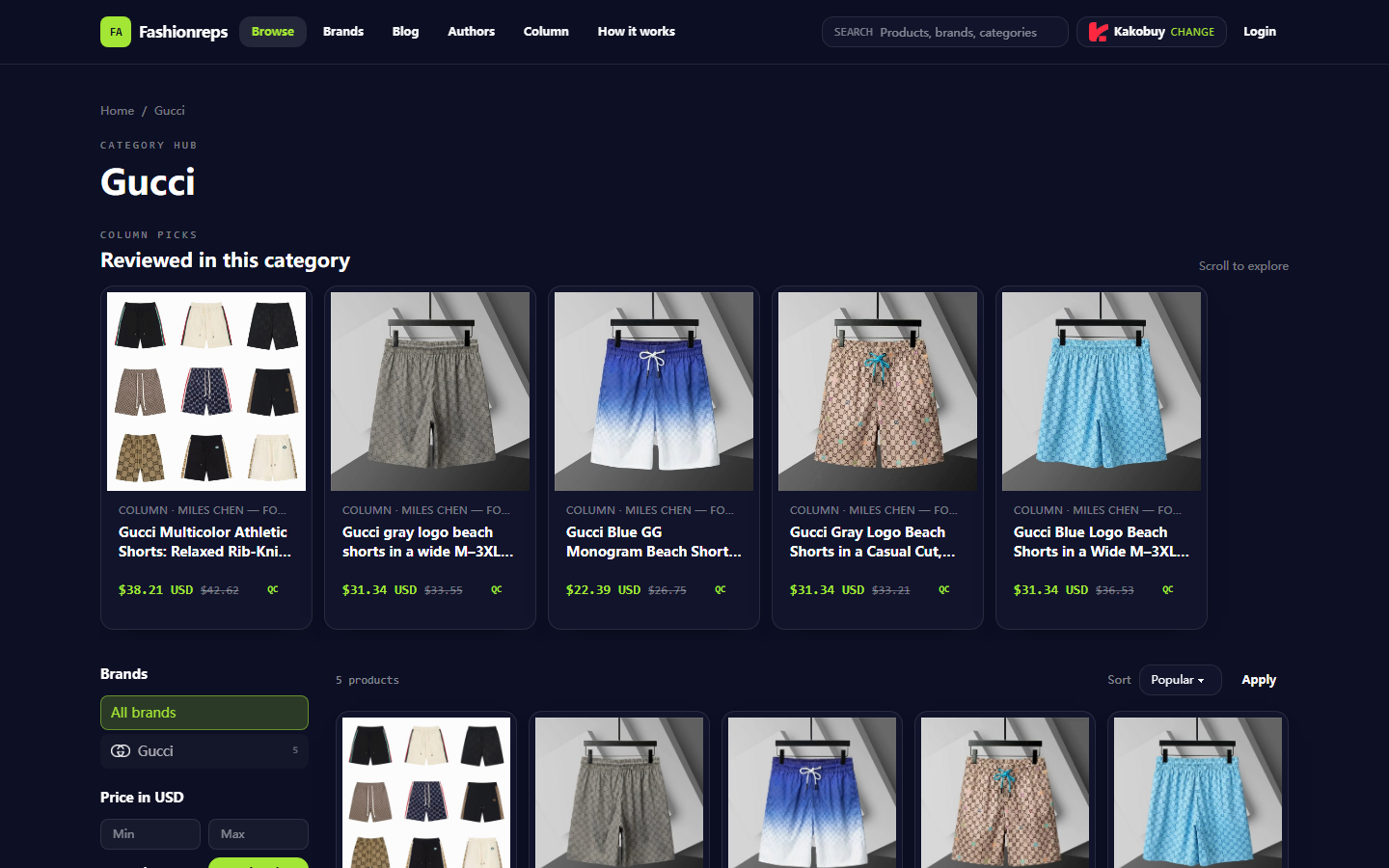
The top of the page provides brand browsing and search entry points. The catalog includes a Gucci category, and you can browse item by item via product cards. The currently checked Gucci category page shows 5 products and provides price filtering and sorting options, including popular, newest, price low to high, and price high to low.
The catalog page is better suited for the following actions:
- Enter the Gucci category by brand.
- Quickly view product titles and product images.
- Observe reference prices in the catalog.
- Narrow visual browsing by price or page sorting.
- Open product pages to continue checking specific information on the page.
- Use the purchase platform selection entry provided on the page to go to an external agent platform of your choice.
Note that the reference prices on the catalog page are not the final delivered prices. The total cost may also include domestic shipping from the seller to the warehouse, international shipping, customs-related fees, insurance, or other route costs. Inventory, sizes, and link status may also change after page updates. 🧭

Image: Product cards, price filter, and sorting entry on the Gucci brand catalog page. The page screenshot is only for illustrating catalog browsing and does not represent inventory, price, or product quality commitments.
How to build a Gucci candidate table in Google Sheets
Google Sheets' role is not to copy the entire product page, but to create a working list suitable for comparison and subsequent verification. Fewer fields make it easier to maintain, but missing links and verification times makes the table lose its reference value.
It is recommended to first set up the following fields:
| Field | Purpose | Recording principle |
|---|---|---|
| Candidate ID | For discussion and task assignment | Use simple IDs like G-001, G-002 |
| Product Name | Identify the candidate | Copy from catalog or product page, then check completeness |
| Product Category | Distinguish shorts, shoes, bags, etc. | Mark "To be confirmed" if uncertain |
| Catalog Reference Price | For initial comparison | Keep page currency and verification date |
| Product Page Link | Return to original evidence | Use full product page URL, not just search page |
| Page Screenshot or Image Description | Assist in identifying candidate | Only record actual visible content, don't write image observations as material conclusions |
| Visible Size Information | Initial filtering | Not equal to your actual size |
| Verification Date | Judge information freshness | Update after each re-check |
| Link Status | Track page accessibility | Write "Accessible", "Needs review", "Inaccessible" |
| Next Step | Push task forward | E.g., "Compare measurements", "Ask about inventory", "Not considering for now" |
If this is your first round of organizing, it is recommended to first record candidate ID, product name, reference price, product page link, verification date, and next step. Only when you confirm you need more, add size, color, seller, image notes, etc., to avoid making an overly complex table from the start.
A directly usable header can be:
Candidate ID | Product Name | Category | Catalog Reference Price | Product Page Link | Visible Size | Image Notes | Verification Date | Link Status | Next Step
Google Sheets' advantage is that you can use filters, freeze the header row, dropdown options, and collaborative comments. For example, you can limit "Link Status" to "Accessible, Needs review, Inaccessible", and "Next Step" to "Continue verification, Waiting for reply, Not considering for now, Excluded", so that multiple editors are less likely to create synonym confusion.
Corresponding recording of product cards, images, and spreadsheet fields
Catalog cards are good for quickly discovering candidates, but the information on the cards is often insufficient to support a final purchase decision. Therefore, when recording, distinguish between "what the page shows" and "what still needs verification".
For example, the currently visible Gucci candidates in the catalog include:
- Gucci Multicolor Athletic Shorts, shown as a loose ribbed style with seven pattern treatments, reference price $38.21.
- Gucci gray logo beach shorts, shown with size range M–3XL, reference price $31.34.
- Gucci Blue GG Monogram Beach Shorts, shown with size range M–3XL, reference price $22.39.
- Gucci Gray Logo Beach Shorts, shown as casual fit, size range M–3XL, reference price $31.34.
- Gucci Blue Logo Beach Shorts, shown with size range M–3XL, reference price $31.34.
These details are suitable for fields like "Product Name", "Catalog Reference Price", and "Visible Size", but you should not directly infer the following:
- The image looks like a certain material, so the product must use that material.
- The page shows M–3XL, so one of those sizes fits everyone.
- The reference price is lower than another item, so the final total cost is definitely lower.
- The item appears in the catalog, so inventory is definitely sufficient.
- There are product images, so the actual color, details, and dimensions will be exactly as pictured.
Image records can use short, verifiable wording, such as "Blue GG pattern, visible on catalog card" or "Gray Logo, visible on catalog card". If you need to judge fabric, thickness, sheerness, actual color difference, or workmanship, write the next step as "Check product page info", "Request available QC pictures", or "Verify measurement data", rather than drawing conclusions prematurely in the table. 📷
Comparison of steps between website browsing and spreadsheet filtering
The website and Google Sheets solve problems at different stages. The website presents the products, while the spreadsheet turns discovered candidates into a manageable information set.
| Task Stage | Website-style Catalog | Google Sheets |
|---|---|---|
| Discover products | Browse by brand, category, search, and product cards | Record discovery source and candidate ID |
| Initial comparison | View titles, images, reference prices, and sorting results | Filter by price, category, size, or status |
| In-depth verification | Open product page to check current visible information | Record verification date, anomalies, and to-dos |
| Collaboration | Need to repeatedly share pages or screenshots | Use comments, assignee, and status fields |
| Follow-up review | Return to original product page to confirm changes | Schedule review by verification date and link status |
Recommended practical workflow:
- Browse product cards in the Gucci brand catalog.
- Only add items you might actually consider to the spreadsheet; don't copy every card indiscriminately.
- Save product name, reference price, product page link, and verification date for each candidate.
- Go back to the product page to check size, color, product details, and whether the link is still accessible.
- Record still-unknown items in the spreadsheet, such as inventory, seller replies, measurement data, and agent platform fees.
- Use filters to narrow candidates by category, budget, visible size, or verification status.
- Before making a purchase decision, reopen the original page to confirm price, page status, and available information have not changed.
Do not treat catalog page filter results as a final purchase list. Filtering only reduces reading volume; final judgment still requires returning to the product page and the actual purchase process.
Verification boundaries for links, specs, and update times
The most common problem with candidate tables is not lack of data, but data that looks complete while you cannot determine when it was recorded, where it came from, or whether it has changed. Therefore, each row should at least keep the original link and verification date.
It is recommended to divide facts into three categories:
The first category is catalog-visible facts, such as product title, catalog reference price, displayed size range, and catalog category. These can be recorded directly, but should include the verification date.
The second category is facts that need further confirmation on the product page, such as more complete specifications, color options, seller information, inventory, available sizes, shipping conditions, and specific images. Mark these as "Pending verification" in the table; do not fill in with speculation.
The third category is facts at the purchase and shipping stage, such as warehouse inspection, domestic shipping, international route, customs requirements, destination country taxes, return window, and final package costs. These cannot be proven by catalog cards and must be confirmed separately under the relevant agent platform and destination country rules.
If a product link cannot be opened, you can temporarily keep the row, but mark the link status as "Inaccessible" and record the last successful check date. Do not continue to treat a dead link as a usable purchase entry, and do not replace the original link with a similar product link without explanation. 🔎
Which organization scenarios are suitable for each tool?
If you just want to quickly see what Gucci candidates are available, browsing the website catalog is more efficient. It allows you to see brand, images, titles, reference prices, and sorting options in a relatively short time.
If you need to compare multiple candidates, record budgets, invite friends to help filter, or come back in a few days to continue verification, Google Sheets is more suitable. It can keep candidate history and separate "Excluded" from "Pending review", reducing time spent reopening the same pages.
If you are making size choices, the spreadsheet can save your body measurements, product page measurements, and discrepancy notes, but it cannot replace actual measurement. If the page lacks sufficient measurement information, set the next step to obtain more data rather than ordering based on letter sizes.
If you are comparing total costs, the spreadsheet can add fields like "Product price, Domestic shipping, International shipping, Possible customs fees, Other known costs" and "Costs to confirm". Do not use catalog reference prices to represent final payment amounts, and do not treat any single agent platform's coupons or route descriptions as long-term fixed policies.
Next actions for using the Gucci candidate list in combination
After completing the first round of organization, continue in this order:
- First delete duplicate candidates and items that clearly do not meet your needs.
- Fill in the original product page link and verification date for the remaining items.
- Filter by category, budget, visible size, and link status.
- Reopen the page for items you are still interested in to check price, images, specifications, and page accessibility.
- Write unverifiable items into "Next Step"; do not fill in with speculation.
- If you plan to purchase, separately verify the product cost, warehouse inspection, international shipping, customs, taxes, and return policy on the agent platform.
- Before placing the order, save a version of the current candidate table to help identify price or page changes later.
This combined approach mainly saves organization time and repeated search time, not guarantee that items are cheaper. It may reduce costs from repeated page opens, repeated inquiries, and multi-person communication; but it also increases the risk of spreadsheet maintenance, link re-checking, and data expiration. It is suitable for people who need to compare multiple Gucci candidates, want to keep verification records, or need to collaborate with others.
If you only have one item in mind, the page has little information, or you don't have time to continuously maintain a spreadsheet, it's not recommended to add complex processes just to "build a list". In that case, just keep the product page link, verification date, and pending questions. Before final purchase, still rely on the currently accessible page, the actual agent platform process, and the destination country's applicable taxes and import regulations. ✅